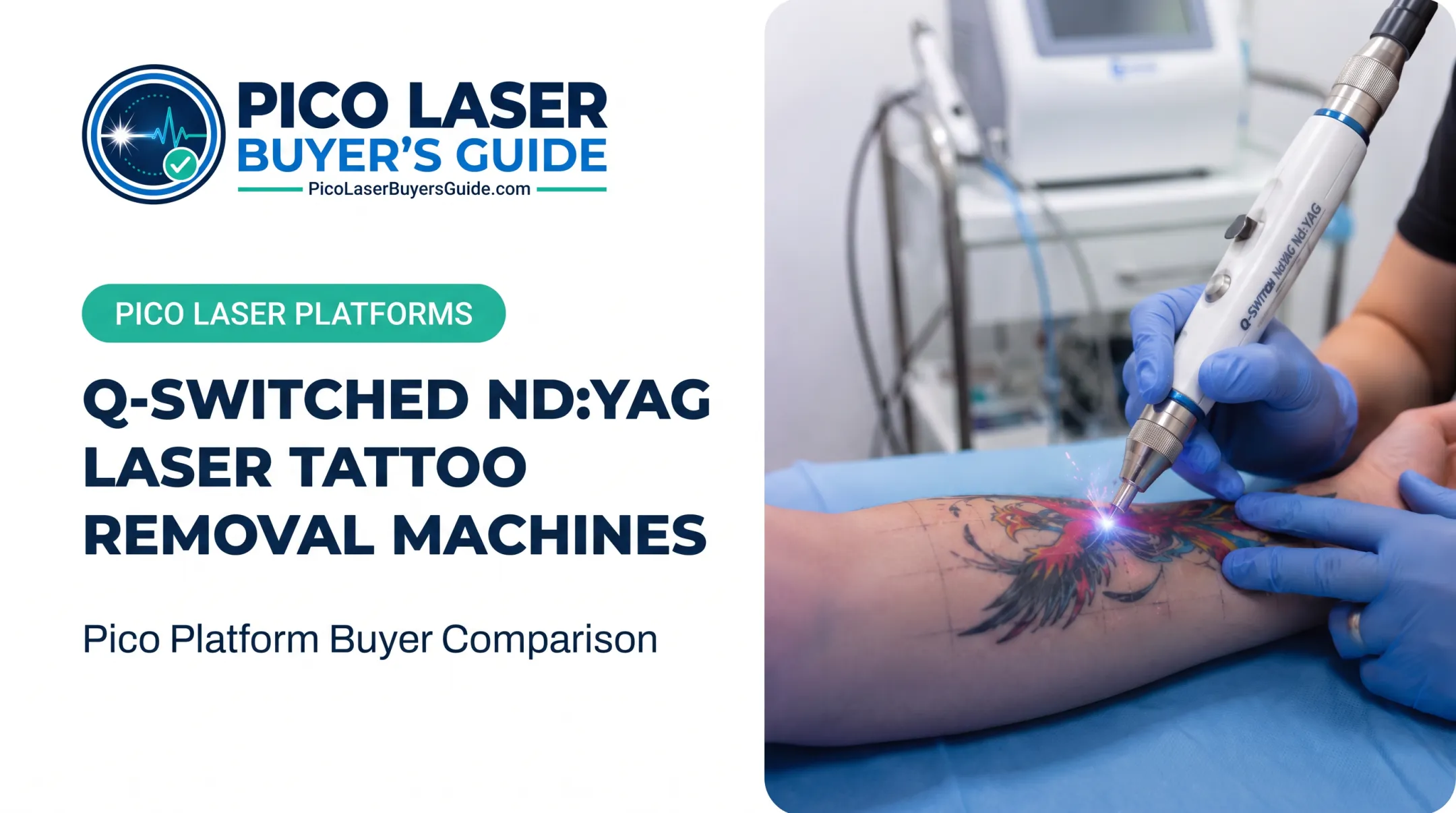

This guide is for US med spas, dedicated tattoo removal clinics, and dermatology and plastic surgery practices. It is not for consumers shopping for at-home devices. It covers picosecond versus Q-switched technology, wavelength coverage, measurable output, FDA clearance, training, service, and new versus pre-owned ownership.
Key Takeaways
- Match the system to your ink-color mix, patient skin types, treatment volume, and operator skill.
- Verify that each wavelength delivers useful power in the exact configuration quoted.
- Judge pulse duration alongside fluence, spot size, repetition rate, and clinical evidence.
- Price total ownership: training, warranty, maintenance, financing, and downtime.
How Laser Tattoo Removal Equipment Works
Tattoo pigment absorbs short, high-energy pulses that fragment the ink particles. The body's immune system then clears the fragments gradually. Equipment quality shapes results, but it never guarantees identical outcomes.
One large cohort reported tattoo removal in 74.8% of patients after 15 sessions, according to JAMA Dermatology.
Wavelength and Ink Color
Pigments absorb different wavelengths, so coverage depends on what is in the tattoo. Manufacturer labeling gives a useful starting map:
| Wavelength | Typical pigment coverage | Boundary |
|---|---|---|
| 1064 nm | Black and dark pigments; PicoWay labeling adds brown, green, blue, purple | PicoWay's 1064 nm indication covers all Fitzpatrick types |
| 532 nm | Red, yellow, orange | PicoWay's indication is limited to Fitzpatrick I-III |
| 755 nm | Black, blue, green (PicoSure Pro) | 532/1064 nm are separate optional delivery systems |
| 694 nm | Green, purple/violet response | Offered only in some Quanta EVO configurations |
Treat this as orientation, not a prescription. Visible ink color alone does not predict response.
Picosecond vs. Nanosecond
Nanosecond Q-switched lasers are not purely photothermal. They also produce photoacoustic shock waves. Picosecond pulses are expected to fragment pigment better because pigment relaxation time can be under 10 ns. A 2016 systematic review still found sparse comparative evidence.
The trials disagree:
- A 2026 split-tattoo trial of 755 nm lasers found satisfactory clearance of 73.3% with pico versus 23.3% with nano, but more hyperpigmentation with pico (21.33% vs. 12%).
- A 2017 trial of 1064 nm lasers found no clearance difference, though pico treatment was less painful.

Pico advantage is conditional. Neither result supports a universal session-reduction figure.
How Specifications Interact
Fluence, spot size, repetition rate, pulse profile, and cooling work together. Larger spots penetrate deeper with less scatter, but available pulse energy limits which spots reach useful fluence. Too much fluence risks scarring.
Console settings and delivered energy can also differ. Gentec-EO's measurement guidance distinguishes energy shown on the console from energy measured after the handpiece, since lens losses and output decline reduce delivery.
Ask vendors how they verify handpiece output and calibrate over time. Published degradation rates for current systems are not available, so request the vendor's output-verification and calibration records.
Equipment Types and 2026 Capabilities
Picosecond Platforms vs. Q-Switched Systems
Pico platforms suit practices that want faster fragmentation of stubborn blue, green, and yellow inks, and broader service menus. Q-switched nanosecond systems remain effective for black ink and often cost less. Ask any vendor for controlled clinical evidence on your target pigments. A before-and-after gallery is not a study.
Not every mode on a "pico" platform is picosecond. The Fotona StarWalker family, for instance, includes both QS modes (5-20 ns) and distinct PICO modes.
Single, Dual, and Multi-Wavelength Systems
- Black-ink-heavy, darker-skinned patient base: 1064 nm is the priority.
- Multicolor work: add 532 nm plus a 755/730 nm option for blues and greens.
- Dedicated tattoo clinic: plan for 532, 755/730, and 1064 nm coverage.
Built-In vs. Optional Wavelengths
Separate native wavelengths from add-ons. PicoWay generates 1064/532 nm, with dedicated 730/785 nm handpieces. PicoSure Pro is a 755 nm platform with optional 532/1064 nm systems. Fotona's 585/650 nm dye converters are optional handpieces. Cutera's enlighten III integrates 532/670/1064 nm. Quanta's EVO series has six configurations, so never assume all wavelengths are included.
For every configuration, request power, pulse duration, spot sizes, and the FDA clearance covering it.
Secondary Indications
Benign pigmented lesions, acne scars, and wrinkles belong in your plan only when the exact mode and handpiece are cleared. PicoWay's Resolve optics, for example, carry acne-scar and wrinkle indications with skin-type limits. Fractional scar optics and tattoo optics are different accessories.
Which Buyer Fits Which Tier
| Buyer profile | Likely fit |
|---|---|
| High volume, evidence-first, broad menu | Premium new platform (PicoSure Pro, PicoWay, enlighten III) |
| Budget-conscious, willing to validate newer evidence | Lower-cost new system such as Aesthetika PicoTech (about $60,000, two-year warranty) |
| Low risk-tolerance on price, strong technical diligence | Inspected pre-owned unit with written service agreement |
Planning ranges from the Pico Laser Buyer's Guide put PicoSure Pro near $150,000-$220,000 and enlighten III at $140,000-$195,000. Treat them as estimates and get line-item quotes.
Specifications That Matter When Comparing Systems
Define the Terms Before You Compare
- Pulse energy: joules per pulse, not the same as power in watts.
- Fluence: energy per area (J/cm²). Ask what is usable at each spot size.
- Pulse duration: measured at half-peak power points.
- Beam profile: flat-top, round, or fractional (MLA/DOE) delivery.
- Repetition rate: pulses per second (Hz). A listed 10 Hz may apply only to certain configurations.
Why "Multi-Wavelength" Isn't Enough
Two systems with the same wavelength list can differ sharply. PicoCare Majesty lists 500 mJ at 1064 nm and 250 mJ at 532 nm, while PicoLO Premium lists 500 mJ and 350 mJ.
Compare maximum and usable fluence, available spots, and handpiece options, not just the wavelength list. Fotona's published 25.46 J/cm² applies at a 2 mm spot only.
Validate Manufacturer Claims
- Search the FDA 510(k) database by device name, applicant, K number, and product code (GEX).
- Read the full clearance letter. Indications list wavelength, handpiece, and Fitzpatrick limits.
- Confirm the clearance names your exact model. PicoFusion HS-298's K260017, for example, may not cover the HS-298E.
- Request technical sheets and published, independent clinical evidence.
- Insist on a demonstration using the exact configuration you would receive.

Workflow and Usability
Check footprint and power early. PicoCare Majesty weighs 100 kg and needs 220 VAC and 4.0 kVA. PicoWay needs dedicated 200-240 VAC service.
Also evaluate:
- Interface clarity and presets
- Cooling and aiming beam
- Handpiece storage
- Staff training burden
Reliability and Support
Request in writing:
- Warranty terms and exclusions (Candela's US terms end at the earlier of one year or 1 million pulses, are nontransferable, and exclude preventive maintenance)
- Preventive-maintenance intervals and calibration procedures
- Parts availability, service response times, and loaner policy
- Software support and references from comparable practices
Budget, Ownership Model, and Total Cost
Price Is One Line Item
Purchase price is only part of the cost. No single 2026 OEM price schedule covers every platform, so request vendor quotes and build a full cost model.
Include these line items beyond the sticker price:
- Installation and shipping
- Training
- Financing costs
- Maintenance and service plans
- Optional wavelengths
- Expected downtime
The Pico Laser Buyer's Guide's five-year TCO framework also folds in utilization and treatment revenue.
Buy, Finance, or Lease
According to the SBA's equipment guidance:
| Route | Considerations |
|---|---|
| Cash purchase | Highest upfront cash; usually lowest lifetime cost; you bear maintenance and replacement |
| Financed purchase | Spreads cost; fees and interest exceed cash price |
| Lease | Less upfront cash; typically higher lifetime cost; maintenance may be included |
Ask about upgrade flexibility, end-of-term obligations, and residual value in every contract.
Pre-Owned Checklist
An FDA statement from 2024 distinguishes servicing (restoring OEM specifications) from remanufacturing (significantly changing performance or intended use). Used status alone says little about condition. Verify:
- Serial number and ownership history
- Pulse or treatment-hour counts
- Maintenance, repair, and calibration records
- Handpiece condition and serials
- Software access and parts availability
- Warranty transferability (often none)
- Independent inspection and a written service agreement
Confirm the responsible service entity for the exact serial number. Some older models, like the PiQo4, no longer appear in their manufacturer's current US menu.
US Compliance, Safety, and Implementation
State Rules Vary
Operator rules differ by state. California allows physicians to perform laser tattoo removal, and RNs and PAs under physician supervision, but not LVNs, medical assistants, or estheticians. Texas requires registration for Class 3B/4 lasers. Confirm current requirements with your state authority and a qualified legal or clinical adviser.
Clearance Is Not Approval
A 510(k) establishes substantial equivalence to a legally marketed device. It is not PMA approval, certification, or a promise of results.
Check that the clearance covers your intended use and exact configuration. State operator authorization, device registration, and FDA clearance are separate requirements.
Implementation Plan
- Credential staff per state rules and supervision requirements.
- Complete manufacturer training. Package terms vary; PicoTech's $60,000 package includes one day onsite.
- Designate a laser safety officer. ANSI Z136.3-2024 gives the LSO authority to suspend unsafe operation.
- Stock wavelength-labeled eyewear with correct optical density. No single OD covers all configurations.
- Control access to the treatment room.
- Plan plume control. OSHA has no specific laser plume standard, and a tattoo-plume study found higher ultrafine particles near treatment. Use smoke evacuation.
- Document consent, test spots, emergency procedures, and maintenance logs.
Wavelength choice also affects safety margins by skin type. For Fitzpatrick III-IV, 532 nm calls for conservative fluences and test spots. For types V-VI, 1064 nm is the standard choice.

Frequently Asked Questions
Can laser 100% remove a tattoo?
Not reliably. Results depend on ink colors and density, depth, age, location, skin type, settings, healing, and the equipment and operator.
What is the best laser tattoo removal machine in 2026?
No universal ranking exists. The best system fits your treatment mix, required wavelengths, budget, clearances, support, and total cost of ownership.
What wavelengths are needed to remove different tattoo ink colors?
1064 nm targets black and dark inks, 532 nm reds, oranges, and yellows, and 755/730 nm blues and greens. Verify usable output and cleared indications for each system.
Are picosecond lasers better than Q-switched lasers for tattoo removal?
Sometimes. Trials conflict on clearance, pain, and pigmentary side effects. Compare evidence, specifications, cost, and operator technique, not the "pico" label.
How much does professional laser tattoo removal equipment cost?
Prices range widely, roughly $60,000 for value systems to $250,000+ for premium ones, depending on wavelengths, new or used status, warranty, and service. Request itemized quotes and model total ownership cost.
Is buying a used laser tattoo removal machine safe?
It can be, if history, output, calibration, clearances, maintenance, parts availability, and warranty are independently verified, ideally with a pre-purchase inspection.