This guide answers the questions clinics ask most. What does 1064 nm treat? How does it differ from 532 nm and picosecond systems? What should you verify before you buy? It draws on peer-reviewed studies, FDA records, and manufacturer documentation.
Key Takeaways
- Q-switching delivers short, high-peak-power pulses for pigment and ink fragmentation; 1064 nm is the operating wavelength.
- 1064 nm and 532 nm are complementary, and the target color, depth, and skin type decide which to use.
- Wavelength is only one factor: pulse duration, fluence, spot size, cooling, and training matter too.
- Verify FDA-cleared indications, warranty, service terms, and total cost of ownership before purchase.
What Is a Q-Switched Nd:YAG 1064 nm Laser and How Does It Work?
Three terms, three jobs
Nd:YAG stands for neodymium-doped yttrium aluminum garnet, a solid-state crystal that serves as the gain medium.
1064 nm is the crystal's fundamental output wavelength. A KTP crystal can frequency-double that to 532 nm.
Q-switching modulates losses inside the laser cavity so energy builds up, then releases in one intense burst. Pulses fall in the nanosecond range, but the exact figure varies by device. One FDA summary lists 5-20 ns for the Cutera QSwitch and 5-10 ns for the standard Hollywood Spectra mode.
How the pulse affects ink and pigment
A brief pulse that the target absorbs strongly damages that target while sparing most of the surrounding tissue. That is the principle of selective photothermolysis, first described in Anderson and Parrish's 1983 paper. Ink fragmentation also involves photoacoustic and thermomechanical effects. Macrophages then clear the fragments gradually, which is why tattoos fade over weeks.
Excess energy or poor parameter selection can still injure surrounding tissue.
Why 1064 nm reaches deeper
Melanin absorbs less at longer wavelengths, so 1064 nm penetrates deeper. A clinical review describes penetration beyond 2 mm. That makes it the usual choice for black and dark tattoo pigment and for selected dermal pigmentation. Epidermal melanin still competes for absorption, so risk is lower, not zero.
Wavelength is not mode
A device labeled 1064 nm may be Q-switched, picosecond, or long-pulse. The Hollywood Spectra's FDA record assigns different indications to its QS1064 mode and its 0.3 ms long-pulse mode. Always separate wavelength, pulse duration, operating mode, and cleared indication.
What Can a 1064 nm Q-Switched Nd:YAG Laser Treat?
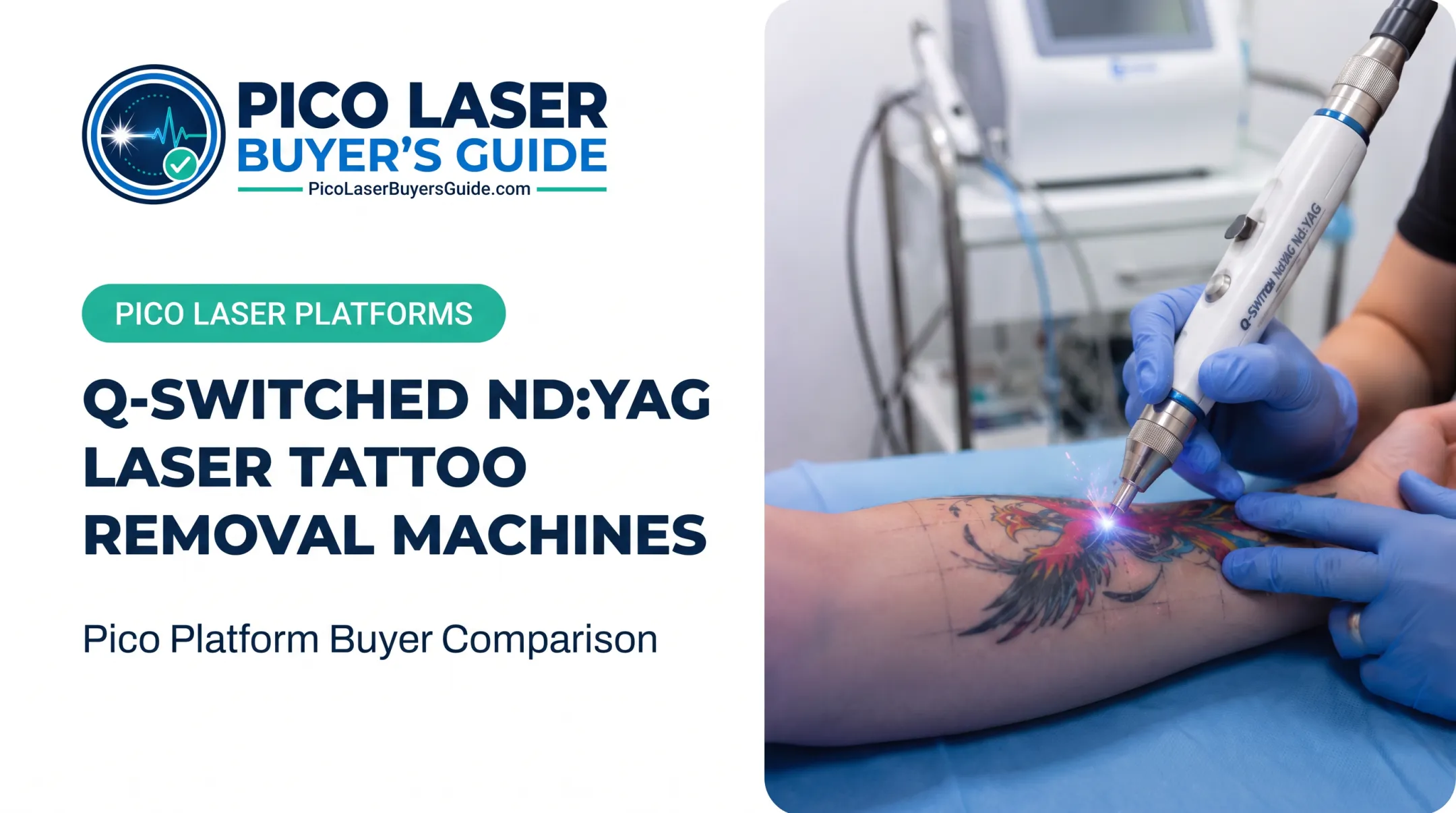
Tattoo removal
Tattoos are the primary application. Response depends on ink color and composition, depth, density, location, age, size, prior treatment, scarring, and skin type. Professional tattoos generally sit deeper than amateur ones.
The Kirby-Desai scale, built on a 100-patient retrospective study, scores these factors and correlates with session counts (r = 0.757). It predicts. It does not guarantee.
A 2021 retrospective study of 52 patients (Fitzpatrick II-IV) using QS 1064/532 nm showed how much sites and inks vary:
| Factor | Mean sessions |
|---|---|
| Face/head | 2.5 |
| Upper trunk/shoulder | 4.2 |
| Wrist/hand/ankle/foot | 7.0 |
| Amateur tattoos | 2.3 |
| Professional dark | 6.3 |
| Professional red | 6.5 |
| Professional mixed | 7.8 |
All analyzed patients reached at least 60% removal, with 2-9 sessions. Intervals started at 8 weeks and lengthened to 12 weeks after treatment four. Treat this as one cohort, not a universal outcome. It excluded previously treated tattoos.

Pigmented lesions
Evidence is strongest for dermal melanocytosis. In 50 patients with Nevus of Ota (phototypes IV-V), 66% achieved over 60% improvement. Transient PIH occurred in 10% and guttate hypopigmentation in 2%. Ota is a named indication on US QS1064 clearances.
Any apparent age spot needs assessment first. The AAD advises examining spots before treatment because some are skin cancer.
Melasma, toning, and carbon protocols
"Laser toning" is a marketing term, not a standardized protocol. A 2022 systematic review of 42 articles (1,736 patients) found heterogeneous methods and short follow-up.
Individual studies reported 20 of 34 relapses at one year and mottled hypopigmentation in 21 of 177 patients within 10 sessions. Some named QS1064 devices carry melasma clearances, so it is not universally off-label. Lightening is not durable control.
Carbon-assisted "Hollywood peel" results come from a combined protocol. A 22-patient split-face trial using quasi-long-pulse plus QS1064 cut inflammatory acne lesions by 58.6%. That does not show QS-only efficacy.
Acne scars and wrinkles
Some named QS devices carry resurfacing clearances. A 20-patient split-face study found a 33.33% score reduction with QS1064 versus 17.37% with fractional CO2, with highly variable responses. That is limited evidence, not superiority.
For scars and wrinkles, fractional, ablative, or picosecond platforms with specific labeling, such as PicoWay Resolve, may fit better.
Success is gradual
Pigment clears over weeks as macrophages remove fragments. Use standardized photography, realistic endpoints, and adequate intervals between sessions. Some tattoos never resolve fully.
How Does 1064 nm Compare With 532 nm, Long-Pulse Nd:YAG, and Pico Lasers?
| Modality | Pulse regime | Dominant effect | Common uses | Key limitation |
|---|---|---|---|---|
| QS 1064 | Nanoseconds | Photoacoustic/photothermal fragmentation | Dark ink, deeper pigment | Green ink may resist; pigment injury possible |
| QS 532 | Nanoseconds | Superficial absorption | Red/orange ink, epidermal pigment | Different darker-skin risk profile |
| Long-pulse 1064 | Milliseconds (0.25-100 ms on one platform) | Controlled thermal | Hair, vascular | Different labeling; not for ink fragmentation |
| Picosecond | Picoseconds | Photomechanical | Tattoos, pigment, some scars | Not interchangeable with QS |
1064 nm versus 532 nm
They work together. 532 nm is absorbed more superficially, including by oxyhemoglobin, and suits red, orange, and red-brown inks. 1064 nm suits dark ink.
Indications still differ by wavelength and skin type. PiQo4's 1064 nm indication covers darker inks in Fitzpatrick I-VI, while its 532 nm indication covers red, yellow, and orange inks in types I-III.
Q-switched versus long-pulse
Same crystal, different job. Long-pulse systems such as the GentleYAG hold FDA clearance for hair reduction and vascular applications. A non-Q-switched Nd:YAG is built for those thermal indications, not ink fragmentation.
Q-switched versus picosecond
A randomized trial of 21 patients with 30 black tattoos compared 1064 nm picosecond and nanosecond lasers. After two treatments six weeks apart, clearance did not differ (P=1.00). Pain scores were 3.8 for picosecond versus 7.9 for nanosecond. That finding covers two treatments at 1064 nm only.
Picosecond reviews report over 70% clearance in 69-100% of tattoos after 1-10 treatments, but that is not a pooled head-to-head advantage. Weigh pulse duration, evidence, versatility, price, and operator requirements side by side. The platforms are not interchangeable.

Multi-wavelength platforms
Multi-mode systems can broaden services. Value depends on documentation, accessories, training, and regulatory support for each mode. PiQo4 markets four wavelengths, but its 585 and 650 nm dye accessories have different energy and spot-size limits than the core 1064/532 nm output.
Safety, Candidacy, and Treatment Planning
Before the first pass
Start with a consultation covering medical history, skin assessment, tattoo or lesion evaluation, and baseline photography. Test spots help set fluence, spot size, repetition rate, and interval. A clinical review suggests them for darkly pigmented skin and cosmetic tattoos, evaluated at 4-6 weeks.
Expected effects and risks
- Common: erythema, edema, crusting, blistering, pain
- Less common: persistent PIH or hypopigmentation, scarring, textural change
- Paradoxical darkening: cosmetic inks containing iron oxide or titanium dioxide can turn black
Darker skin tones
1064 nm's lower epidermal absorption helps, but no setting is universally safe. Risk depends on diagnosis, skin type, recent tanning, settings, cooling, operator skill, and aftercare. The Ota cohort in phototypes IV-V documented pigmentary complications. Follow device labeling and your state's requirements.
State rules differ. California lets physicians perform laser tattoo removal, with RNs and PAs under physician supervision, while LVNs and estheticians may not. Texas DSHS registers Class 3B/4 medical laser businesses. Check your state.
Aftercare and sessions
- Keep the area clean and moist
- Avoid direct sun; apply broad-spectrum SPF 30+ after healing
- Don't pick or abrade
- Follow provider instructions
The AAD specifies sun protection for three months. Don't promise a universal recovery period.
ASLMS describes 6-8 week intervals and six to more than ten treatments for maximum lightening. Individualize the plan rather than quoting a fixed number.
How Should Clinics Evaluate a Q-Switched Nd:YAG Laser System?
Start with services and patient mix
Define your goals first: tattoo removal, pigment, lesions, or a broader platform. Then map each to the wavelength, pulse duration, handpiece, and cleared indication you actually need.
Technical checklist
- 1064 and 532 nm availability
- Pulse width and whether it changes with energy
- Maximum and adjustable energy
- Repetition rate and spot-size range
- Beam profile and aiming beam
- Cooling and handpiece ergonomics
- Display controls and documented output stability
Maxima are configuration-specific and may not be simultaneous. Reference points: Cutera QSwitch lists up to 1.6 J at 1064 nm, 3-8 mm spots, and 10 Hz. Hollywood Spectra's standard QS lists 1.2 J and 1-7 mm. PiQo4 guidance advises requesting the serial-specific schedule.

Verify FDA records
A 510(k) establishes substantial equivalence. It is not proof of superior clinical performance.
Search the FDA 510(k) database and read the mode-specific indications. Request labeling, contraindications, and clinical documentation for your exact configuration.
Clearance for a core wavelength may not cover optional accessories, as with PicoPlus (K173700) and its 595/660 nm handpieces.
Supplier and ownership terms
Get these in writing:
- Installation and operator training
- Service response times and preventive maintenance
- Calibration and warranty exclusions (parts, labor, travel, handpieces)
- Replacement parts, consumables, and software support
- Shipping, insurance, and financing
Published packages vary. Aesthetika PicoTech lists $60,000 with a two-year limited warranty and one day of onsite training. PicoLazer lists $99,995, and executed order terms control.
Pre-owned equipment
Request the following:
- Service history and ownership/usage records
- Inspection and output-test results
- Handpiece condition and serial numbers
- Software status and remaining warranty
- Confirmation of legal, safe operation for your intended use
Under FDA guidance, servicing restores original specifications. Significant changes to performance or intended use can count as remanufacturing, with its own regulatory duties. PiQo4 is absent from Lumenis' current US menu, so confirm support for the exact serial number.
Using the Pico Laser Buyer's Guide
The Pico Laser Buyer's Guide offers manufacturer-backed specifications, FDA-clearance verification, platform comparisons, and transparent sourcing. Use it as a comparative research tool. It does not replace clinical, regulatory, or legal review.
Decision framework
Weigh these factors together:
- Clinical fit and documentation quality
- Operator support and expected utilization
- Revenue assumptions and maintenance exposure
- Total cost of ownership
Purchase price is one input, not the decision.
Frequently Asked Questions
What is a Q-switched Nd:YAG laser?
It uses a neodymium-doped YAG crystal and Q-switching to produce nanosecond pulses, typically at 1064 nm. Common uses include dark tattoo ink and selected pigmentation. Suitability depends on the device's indications and individual assessment.
What is the difference between Q-Switch and Nd:YAG laser?
Q-switching is the pulse-generation method. Nd:YAG is the laser medium. A device can be Nd:YAG without being Q-switched; long-pulse hair and vascular systems are common examples.
What is the wavelength of an Nd:YAG laser?
The fundamental wavelength is 1064 nm, and frequency doubling produces 532 nm. Many systems offer both. Dye handpieces at 585/650 nm are separate outputs, not fundamental Nd:YAG.
Is YAG laser good for tattoo removal?
Q-switched 1064 nm is commonly used for dark pigments. Results depend on ink color and composition, location, skin type, prior treatment, and session planning. Green and light inks may resist.
How many sessions of Nd:YAG laser?
It varies by indication, ink, response, and healing interval. One cohort needed 2-9 sessions, while ASLMS cites six to more than ten for maximum lightening. Session plans should be set case by case.
How much does a Q-Switch Nd:YAG laser treatment cost?
Patient pricing differs from equipment cost. ASPS reports an average of $697 for laser skin treatments that include tattoo removal, excluding related expenses. Area, provider, location, complexity, and session count all affect the total.