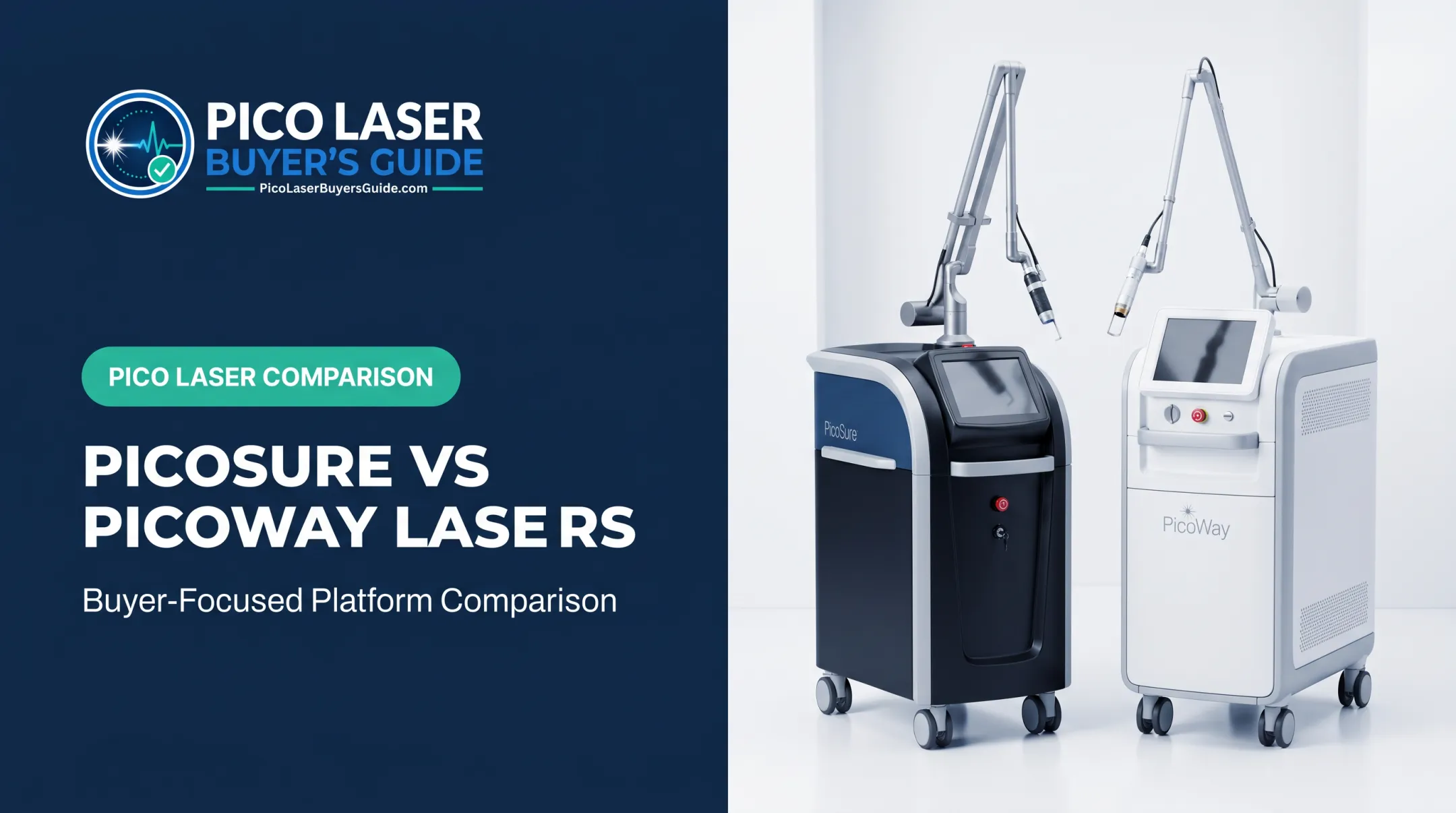
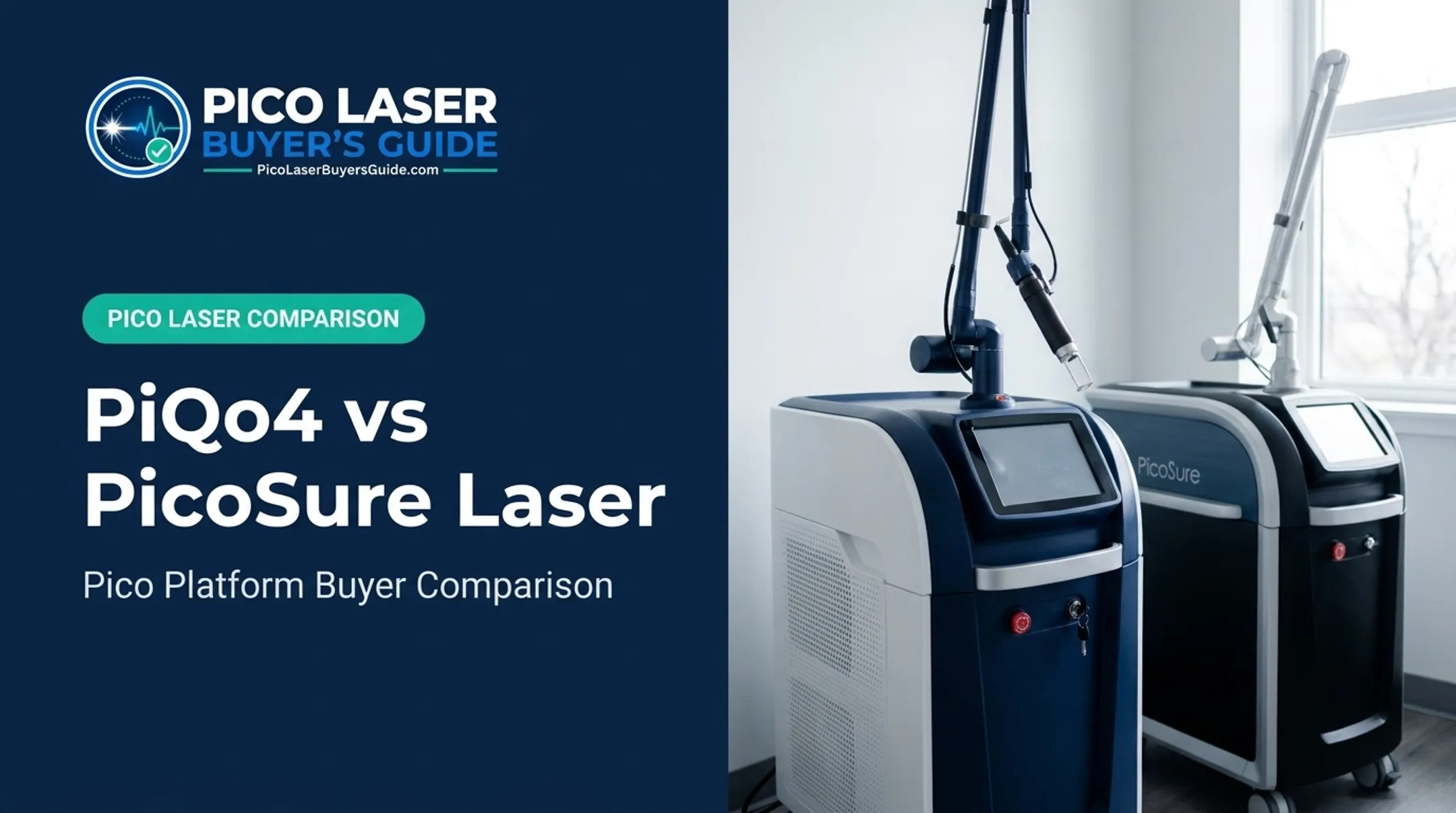
The right purchase depends on your treatment mix, required wavelengths, FDA-cleared indications, patient skin types, service support and total cost of ownership. Context helps: Grand View Research puts 2025 U.S. aesthetic-laser market revenue at $1,177.1M, though that covers all aesthetic lasers, not picosecond systems alone.
This guide compares the two platforms on facts you can verify.
Key Takeaways
- Both platforms treat tattoos and pigment, but cleared scope depends on model, wavelength and handpiece.
- Discovery Pico offers 1064/532 nm as standard, with explicit tattoo-color and phototype labeling.
- PicoSure is 755 nm-centered, with 532/1064 nm as optional add-ons.
- Compare quotes line by line, including five-year ownership cost.
Pico Discovery vs PicoSure: Quick Comparison
"Pico Discovery" is shorthand. The official names are Discovery Pico and Discovery Pico Plus (Quanta System). Cynosure makes PicoSure and PicoSure Pro.
| Factor | Discovery Pico / Plus | PicoSure / PicoSure Pro |
|---|---|---|
| Manufacturer | Quanta System S.p.A. | Cynosure |
| Standard wavelengths | 1064/532 nm; Plus adds 694 nm ruby (not picosecond) | 755 nm; 532/1064 nm optional |
| Pico pulse duration | 450 ps (1064 nm), 370 ps (532 nm) | Roughly 450-900 ps, depending on the manufacturer specification |
| Fractional optics | Microbeam handpieces optional | Focus Array / Platinum Focus lens |
| Planning price (guide estimates) | $160,000-$230,000 | $225,000-$300,000 |
| Warranty listed | 1 year | 1 year |
Treat prices as planning figures. Optional modules, handpieces and service plans change the quote, and a written quotation for the exact configuration is the only reliable number.
Cost and total cost of ownership
The guide's illustrative five-year calculator, using a 6.5% interest rate and $25 consumables per treatment, produced $262,000 total cost, or $52,400 per year. That works out to about 13 treatments a month just to cover ownership. Run your own numbers with real quotes.

Wavelengths and flexibility
Discovery's maximum pulse energy is listed at 800 mJ (25.46 J/cm² at 2 mm) versus 300 mJ (9.55 J/cm²) for PicoSure Pro. Higher headroom is not evidence of better outcomes.
PicoSure's 755 nm uses 2-6 mm zoom spots plus fixed 5, 6, 8 and 10 mm handpieces. Cynosure advertises Platinum Focus on the Pro with 40% more shots. That is a hardware claim, not a demonstrated clinical improvement.
FDA-cleared indications and skin types
Discovery's family record (K240983, June 6, 2025) lists these picosecond-mode indications:
- 1064 nm tattoo removal: Fitzpatrick I-VI
- 532 nm tattoo removal: I-III
- Benign pigmented lesions (both wavelengths): I-IV
- Fractional wrinkles: I-IV
- 1064 nm fractional acne scars: II-V
PicoSure's workstation record (K261570, June 17, 2026) covers 755 nm tattoo and benign pigmented lesions (including Nevus of Ota, Hori macules and melasma), plus acne scars and wrinkles in I-IV with the 2/6 mm handpieces and Focus Array. The 532 nm system is cleared in I-III.
"Skin revitalization" is marketing language, not a separate cleared endpoint.
Training, service and support
Request model-specific training and warranty terms from each manufacturer; public materials rarely spell them out. Cynosure publishes 24/7 U.S. customer service, but that is not a repair-response guarantee. Get loaner policies, response times and training scope in writing.
The Pico Laser Buyer's Guide maintains a manufacturer-backed source library covering 16 platforms. Use it to check specifications and clearances before requesting quotes.
What Are Pico Discovery and PicoSure?
What is Discovery Pico?
Discovery Pico is a Quanta System family, not a single configuration. Discovery Pico Plus adds a 694 nm ruby mode, but that mode is not picosecond and should not count toward pico capability. Optional Twain 2940 Er:YAG and Twain IPL modules are also non-pico.
These options change what a quote includes:
- VarioPulse (three pico-pulse selections)
- OptiBeam II round, square, and fractional optics
- Microbeam handpieces
Use Cases of Discovery Pico
Discovery fits clinics that want one platform across several service lines:
- Multicolor tattoos: 1064 nm for black, brown, green, blue, and purple; 532 nm for red, yellow, and orange
- Benign pigmented lesions
- Acne scars and wrinkles via fractional handpieces
Before buying optional modules, calculate whether your treatment volume will pay for them. The standard system includes no fractional handpiece.
What is PicoSure?
PicoSure is Cynosure's picosecond platform and was the first FDA-cleared 755 nm picosecond system. PicoSure Pro adds:
- Adjustable fluence at the same spot size
- Platinum Focus lens array
- A new 5 mm handpiece
- Faster startup and Turbo mode
Cynosure notes its before/after photos show PicoSure, not the Pro, and expects similar results from the same parameters. FDA records use the name "PicoSure Workstation."
Use Cases of PicoSure
PicoSure suits pigment-led and rejuvenation-oriented practices, especially those treating melasma, Nevus of Ota, and Hori macules. Native 755 nm is strong for blue and green inks.
Broader tattoo coverage requires the optional 532/1064 nm systems, priced separately.
Pico Discovery vs PicoSure: What Is Better?
"Better" means better aligned with your patients and business model. Neither wins outright.
Choose Discovery Pico when:
- You want verified multi-wavelength coverage and multicolor tattoo labeling
- Optional modules will see real use in your practice
- Lower acquisition cost matters
Choose PicoSure or Pro when:
- Demand centers on pigment conditions and 755 nm workflows
- Operators value the lens-array workflow
- You want stronger evidence maturity (this guide rates PicoSure "very high"; Discovery "moderate-high")
Darker skin
Don't assume one brand is safer. Published evidence is thin and not head-to-head:
- A 2016 retrospective review of 755 nm diffractive-lens treatment in 56 patients with skin types IV-VI reported transient events, mainly erythema and hyperpigmentation.
- A 1064 nm fractional study in skin types IV-V found transient PIH in 2 of 20 patients.
Compare exact wavelength clearances and Fitzpatrick ranges. Discovery's 1064 nm tattoo clearance covers I-VI, while benign pigment covers only I-IV.

Workflow matters
Consultation, test spots, parameter selection, photography, documentation, and follow-up often influence results more than a headline specification.
Operator rules also vary by state. California, for example, allows PAs and RNs to perform laser tattoo removal only under physician supervision.
Buyer's checklist
- Get the 510(k) number for your exact model
- List included accessories and wavelengths
- Confirm training scope and number of providers
- Get service response time and loaner terms
- Compare warranty (including parts, labor, travel, optics)
- Model financing and five-year cost
- Check state operating rules
- Request references from practices with a similar treatment mix
Real-World Examples and Case Studies
Neither study below compares the platforms, so neither ranks them.
Discovery Pico: A 2026 retrospective study of 545 participants (skin types V-VI excluded) built a machine-learning model to predict sessions needed for tattoo removal. It used 1064 nm at 450 ps and 532 nm at 370 ps. The model's mean absolute error was 0.58 sessions. Two authors were employed by El.En., and the study does not report adverse events.
PicoSure: A 2022 Indonesian study treated 20 patients (skin types III-V) with 755 nm at 0.71 J/cm² for two sessions, four weeks apart. Results: 60% good improvement, 40% moderate. All had erythema or slight edema, five had urticaria, two had petechiae, and none had PIH. It was small, retrospective, and short in follow-up.

Takeaway: The first supports buyers who value documented tattoo workflows. The second supports pigment and rejuvenation buyers working with skin types III-V. Use the Pico Laser Buyer's Guide source library to compare the cited documents, current clearances and written quotes before purchasing.
Conclusion
Neither Discovery Pico nor PicoSure is automatically the better choice. The right system depends on configuration, cleared indications, patient population, operator expertise, and service economics.
Before you buy, do the following:
- Compare like-for-like quotes for the exact model and options
- Confirm FDA-cleared capabilities for that configuration
- Estimate realistic treatment volume and payback
- Weigh training, warranty, and service support alongside the specs
Frequently Asked Questions
Which Pico laser is best: PicoSure, PicoWay, or Pico Discovery?
No universal winner exists. Compare exact models, wavelengths, cleared indications, skin types, treatment mix and support terms. PicoWay is made by Candela and has its own clearances.
How do CO2 or carbon lasers compare to Pico lasers for facial resurfacing?
CO2 ablates skin for resurfacing, with longer downtime. Pico lasers mainly fragment pigment photoacoustically, with selected fractional rejuvenation options. The choice depends on treatment depth and acceptable downtime.
How does erbium laser compare to Pico lasers for wrinkles?
Er:YAG resurfaces more directly, with reepithelialization typically 4-7 days. Pico is less ablative. Compare device, clearance, skin type and downtime.
What is the difference between Pico Discovery and PicoSure?
Discovery Pico (Quanta) is 1064/532 nm standard; PicoSure (Cynosure) is 755 nm with optional 532/1064 nm. Handpieces, pulse modes and cleared indications differ, so compare the quoted configurations.
Is PicoSure the same as a pico laser?
No. PicoSure is one branded family within the broader picosecond category, alongside Discovery Pico, PicoWay and others.