
Price alone tells you little. Wavelength coverage, verified pulse performance, training, safety controls, service support and your patient mix all drive outcomes and profit.
This guide compares picosecond and Q-switched platforms, then shows how to verify specifications, FDA clearance, ownership cost and fit for your practice.
Key Takeaways
- The best machine depends on ink colors, skin types, volume, operator skill and budget, not brand name.
- Picosecond systems may help with resistant or multicolor ink, but Q-switched lasers remain viable.
- Prioritize wavelengths, verified pulse duration, spot sizes and energy stability over marketing labels.
- Confirm exact-model FDA 510(k) clearance, warranty, service and total ownership cost.
Overview of Laser Tattoo Removal Machines in the US Aesthetic Industry
How the technology works
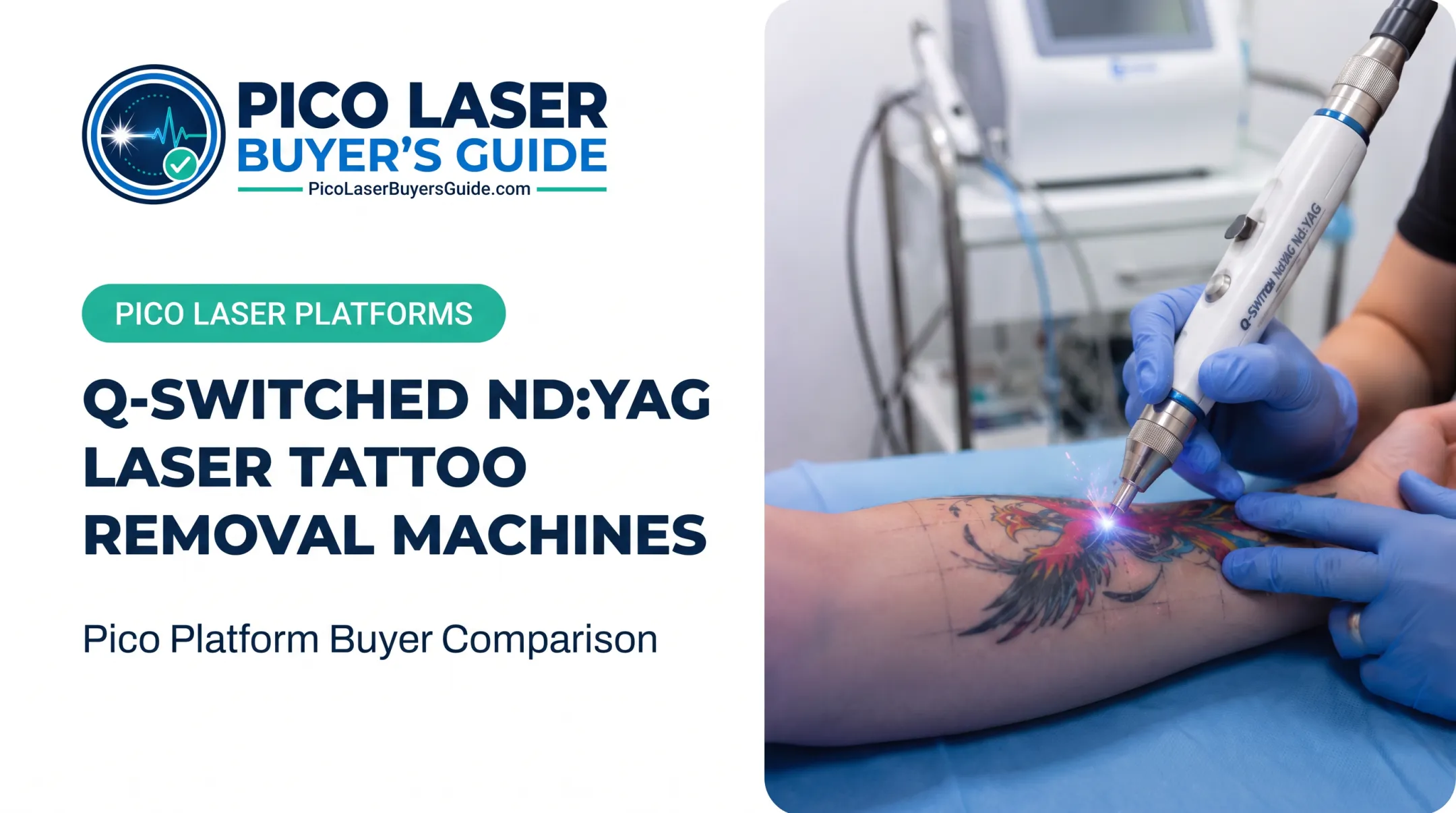
Tattoo lasers deliver wavelength-specific energy to pigment. Short pulses fragment the ink through thermomechanical (photoacoustic) effects, and macrophages then clear the particles over the following weeks. This is why treatment takes multiple sessions.
Picosecond systems pulse in hundreds of picoseconds. PicoSure Pro's brochure lists 500–900 ps, while Q-switched nanosecond systems run around 6–50 ns. Shorter pulses alone don't prove better clearance, as the evidence below shows.
Wavelengths and ink colors
| Wavelength | Typical ink association | Qualification |
|---|---|---|
| 1064 nm | Black, dark blue; PicoWay also lists brown, green, blue, purple | PicoWay indication covers Fitzpatrick I–VI |
| 532 nm | Red, orange, yellow | PicoWay tattoo indication: Fitzpatrick I–III |
| 755 nm | Dark pigment, blue, black | Response varies by device and tattoo |
| 694 nm | Blue, sky blue, black, green, violet | Q-switched (30 ns), not picosecond |
| 730/785 nm | Green and blue | PicoWay indications: Fitzpatrick II–IV |
Color coverage and skin-type clearance are wavelength-specific. They aren't platform-wide promises.
US regulatory and safety requirements
An FDA 510(k) shows substantial equivalence and permits distribution. Say "FDA-cleared," never "FDA-approved," and check the indication for your exact model and wavelength.
State rules differ. California treats laser procedures as medical treatments, so physicians, or RNs and PAs under physician supervision, may perform them. Texas requires a physician, PA or APRN onsite or immediately available. Check your own state board.
For eye protection, OSHA 29 CFR 1910.133 requires appropriate filter lenses, and ANSI Z136.3-2024 covers laser safety in healthcare settings, including medical spas.

The machines below suit different clinic profiles. They aren't interchangeable.
Best Laser Tattoo Removal Machines for US Clinics
Each system below has verifiable manufacturer or FDA documentation. Current platforms come first, followed by legacy systems you'll mostly meet on the pre-owned market. Specifications vary by configuration, so confirm them in a written quote.
Candela PicoWay
Candela, founded in 1970 and based in Marlborough, Massachusetts, makes PicoWay. FDA record K220853 lists tattoo indications at 532 nm (red, yellow, orange; I–III), 730/785 nm (green, blue; II–IV) and 1064 nm (black, brown, green, blue, purple; I–VI).
It suits established dermatology, plastic surgery, tattoo-removal and high-volume practices that want four picosecond wavelengths for multicolor work. Evidence includes a prospective prototype study with a mean 79% clearance after an average 6.5 treatments. That was a single-arm study, not a test of the current configuration.
| Item | Details |
|---|---|
| Configuration | 532/1064 nm Zoom (2–10 mm); dedicated 730/785 nm applicators; 1064 nm 450 ps, up to 400 mJ; 1–10 Hz |
| Best fit | High-volume clinics with mixed ink colors and a broad skin-type range |
| Ownership checks | Planning range $150,000–$325,000 depending on source; 1-year standard warranty; confirm cooling with the manufacturer |
Cynosure PicoSure Pro
PicoSure Pro is Cynosure Lutronic's current US model. FDA record K261570 names the PicoSure Workstation, not "Pro" explicitly. It includes 755 nm tattoo indications, with optional 532 nm (I–III) and 1064 nm.
Native 755 nm is strong for blue and green inks. It also treats pigmented lesions, acne scars and wrinkles, which helps clinics that want a multi-use system. Ask Cynosure for Pro-specific peer-reviewed tattoo data rather than relying on brochure claims alone. Some brochure photos are labeled legacy PicoSure results, so don't treat them as Pro validation.
| Item | Details |
|---|---|
| Configuration | 755 nm standard; optional 532/1064 nm; 500–900 ps; 300 mJ ±20%; zoom 2–6 mm plus fixed 5, 6, 8, 10 mm |
| Best fit | Dermatology, plastic surgery and multi-service aesthetic practices |
| Ownership checks | Planning range roughly $150,000–$300,000; optional wavelengths priced separately; 1-year warranty; get a written quote |
Quanta Discovery Pico
Quanta System (Italy) makes the Discovery Pico family, and Astanza was named exclusive US distributor on December 1, 2025. Know the variants: Pico and Pico Derm offer 1064/532 nm, and Pico Plus adds 694 nm ruby.
That ruby wavelength runs at 30 ns, not picoseconds. FDA record K240983 covers the family, with 1064 nm picosecond pulses at 450–800 ps and 532 nm at 370–600 ps. A 2025 split-lesion study used the Plus, but tested an adjunct treatment, not a pico-versus-nano comparison.
| Item | Details |
|---|---|
| Configuration | Up to 0.8 J at 1064 nm; round 2–12 mm and square handpieces; 10 Hz max (3 Hz at 694 nm); confirm cooling applicability with Astanza |
| Best fit | Clinics wanting multi-wavelength flexibility and a broader menu |
| Ownership checks | Confirm configuration, add-ons, US pricing, training, warranty and service through Astanza |
Astanza Trinity (legacy)
Astanza says Trinity is no longer available for purchase, though it still supports owners. Expect it only on the pre-owned market.
It's a three-wavelength Q-switched system: 1064, 532 and 694 nm, with 6 ns pulses (30 ns at ruby) and up to 1.5 J from the Nd:YAG. Spot sizes run 2–7 mm square, with optional microbeam accessories. Ask any seller for Trinity-specific FDA documentation and peer-reviewed trial evidence.
For used units, request service and calibration records, confirm the serial number with Astanza, and check which handpieces are included.
Candela AlexTriVantage (legacy)
AlexTriVantage is an established Q-switched alternative at 755, 1064 and 532 nm. Its pulse is 50 ns, with up to 800 mJ at 755 nm and 400 mJ at 1064 nm. Confirm new-sale availability with Candela or an authorized dealer. Related FDA record K063072 covers Candela's 532/1064 nm accessories, but it isn't an explicitly named AlexTriVantage clearance.
It may fit practices focused on common dark pigments with a limited capital budget. In a small study of 11 Asian patients (Fitzpatrick III–IV), post-inflammatory hyperpigmentation at 1064 nm was 27.0% with nanosecond versus 21.6% with picosecond. Those are that study's numbers, not universal risk rates.
For pre-owned units, check service history, lamp costs, calibration, warranty transferability and expected downtime.

How We Chose the Best Laser Tattoo Removal Machines
We weighed clinical fit and verifiable performance over brand reputation and sticker price. A "pico" label or long list of modes isn't a reason to buy.
What the evidence does and doesn't show
The trials conflict. A 2017 randomized trial found no better clearance from 1064 nm picosecond pulses.
A 2018 JEADV study found at least 75% reduction in 33% of picosecond versus 14% of nanosecond tattoos, but included only five polychromatic tattoos. Neither study establishes a universal picosecond advantage or Fitzpatrick V–VI superiority.
Our criteria
- Wavelength and pulse specs: match wavelengths to your real ink mix, and check pulse duration, energy stability, spot-size range, repetition rate and cooling.
- Regulatory evidence: verify the exact 510(k) record and indications. Clearance isn't proof of superiority.
- Total cost of ownership: add installation, room prep, eyewear, training, warranty, service contracts, parts, downtime and financing.
- People and support: assess operator training, medical oversight, patch-testing practice, maintenance records and technical support.
- Used equipment: FDA distinguishes servicing from remanufacturing that changes performance or intended use. Demand traceable records.
Candela's used-equipment guide flags wear parts and missing peripherals as common cost exposures on pre-owned systems.
Pico Laser Buyer's Guide backs this framework with a comparison library of 16 pico platforms, manufacturer source documents, specifications and FDA-clearance references, plus disclosure of its editorial and commercial relationships.

Conclusion
No machine wins for every clinic. Your patient demographics, ink-color mix, skin-type range, volume, clinical capability, budget and operator skill decide the right choice.
Compare verified specifications, regulatory records, clinical evidence, service support and total ownership cost before settling on a premium system, a lower-cost one or a pre-owned unit. Practice owners and medical professionals can use the Pico Laser Buyer's Guide's comparisons and source documentation to narrow a shortlist and buy with more confidence.
Frequently Asked Questions
What is the best laser machine for tattoo removal?
It depends on wavelength coverage, ink colors, skin types, volume, operator expertise, regulatory status and budget. No single machine is best without those qualifiers.
Which is better for tattoo removal: PicoWay, PicoSure, or Q-switched lasers?
PicoWay offers four picosecond wavelengths, PicoSure Pro is built on 755 nm, and Q-switched systems use nanosecond pulses. Trials conflict on picosecond superiority, so match the device to your patient mix.
Can laser tattoo removal completely remove a tattoo?
Substantial or complete clearance is possible but not guaranteed. Ink color and depth, age, layering, cosmetic pigments, skin type and technique all matter. FDA notes complete removal may be impossible.
Can you remove a 20 year old tattoo?
Yes, age alone doesn't prevent treatment. Assessment should consider ink depth, fading, colors, location and skin condition. Set expectations at consultation.
Is laser tattoo removal safe, and what are the risks?
Risks include pigment changes, blistering, scarring, infection and allergic reactions. White, flesh-tone and some cosmetic inks can darken paradoxically. Trained operators, patch testing and aftercare lower the risk.
Is it worth getting laser tattoo removal?
That depends on your goals. Weigh the number of sessions (often 7–10 or more with older technology), cost, discomfort and incomplete-clearance risk against what you want. A thorough clinical assessment helps.