This article compares laser architecture, pulse and wavelength specifications, clinical capabilities, FDA documentation, ownership costs, and evidence quality. The decision standard is simple: pick the platform that matches your indications, patient skin types, workflow, budget, and service needs, backed by documented clearances rather than marketing claims.
Key Takeaways
- "Picosecond" describes pulse duration; "Nd:YAG" describes the laser medium. Compare them separately.
- Wavelengths, handpieces, beam quality, and operator control matter as much as pulse width.
- Verify the exact 510(k), current labeling, warranty, training, and service terms before purchase.
- No universal winner exists. Your tattoo, pigment, scar, and rejuvenation mix decides.
What Does "Picosecond Nd:YAG" Mean?
The "picosecond" and "Nd:YAG" parts are different attributes
A picosecond is 10^-12 seconds, an ultrashort pulse duration. Nd:YAG is neodymium-doped yttrium aluminum garnet, the medium that produces near-infrared light at 1064 nm. A picosecond Nd:YAG is one type of pico platform, not an alternative to all of them.
Other media exist. PicoSure's original workstation is described by the FDA as a 755-nm alexandrite system, and the PicoSure Pro brochure lists a 755-nm core with optional 532/1064-nm add-ons. Label each platform accurately in any comparison. Nd:YAG platforms such as enlighten can also run both picosecond and 2-ns modes.
How pulse duration affects pigment
The theory traces to Anderson and Parrish's 1983 selective photothermolysis work: selective absorption plus a suitably brief pulse damages a target while sparing surrounding tissue. Tattoo particles run roughly 30-300 nm, with thermal relaxation times under 10 ns. Sub-nanosecond pulses add mechanical stress, though thermal and plasma effects still occur.
This is a mechanistic rationale, not proof of better clearance. An early human comparison found greater lightening in 12 of 16 black tattoo areas with 35-ps pulses versus 10-ns pulses. But a modern randomized trial found no significant clearance difference (covered below).
Wavelength and pulse duration work together
Wavelength decides what absorbs the energy and how deep it goes. 1064 nm penetrates deepest with the least melanin competition, suiting black and dark inks. 532 nm stays shallower, targets red, orange, and yellow pigment, and is absorbed readily by epidermal melanin. Pulse duration shapes how that energy arrives.
Always confirm a platform's real wavelength options, pulse modes, energy range, spot sizes, and handpieces from current manufacturer documentation.
Which Specifications Matter When Comparing Picosecond Nd:YAG Lasers?
Pulse, energy, and repetition
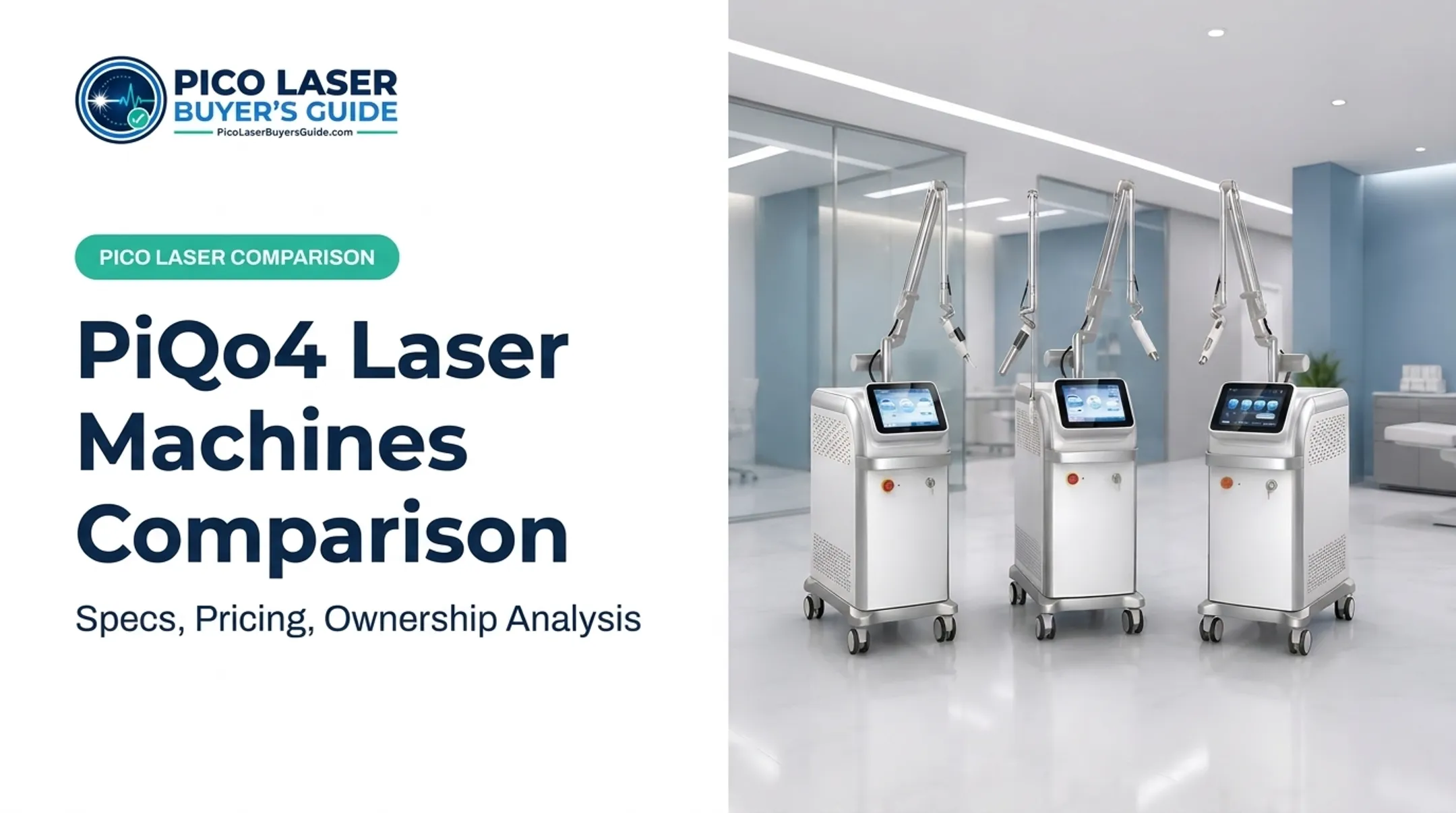
Compare the same fields on every platform: pulse duration, pulse energy, fluence, repetition rate, peak power, and operating modes. Published maxima are not independent performance tests.
Here is how published figures differ:
| Platform | Pulse duration | Max energy (1064/532 nm) | Spots |
|---|---|---|---|
| PicoWay | 450/375 ps (RevB brochure) | 400/200 mJ (Zoom) | 2-10 mm |
| enlighten III | 750 ps; 2-ns modes | 600/300 mJ | 2-8 mm |
| Discovery PICO | 450/370 ps | 800/300 mJ | Not published |
| PICOPLUS | 450 ps | 800/300 mJ | 1-10 mm |
Watch the denominators:
- PicoWay Resolve's 2.9/1.5 mJ figures are per central beam in a fractional field, not whole-pulse energy
- enlighten III's 600 mJ isn't allocated by picosecond versus nanosecond mode
- PicoSure Pro's 50/60 Hz is AC line frequency, not treatment repetition
Some sources also disagree with each other. Published PicoWay pulse durations vary between documents, and PicoStar figures differ between US seller materials (up to 400 ps, 2 GW) and newer sources (about 300 ps or less, 2.7 GW). Treat missing or ambiguous data as a procurement red flag.
Wavelength architecture and delivery
Core Nd:YAG output is 1064 nm and frequency-doubled 532 nm. Extras vary: enlighten III adds 670 nm, PicoWay offers 730/785 nm applicators, and PicoTech lists 755, 585, and 650 nm. Count an added wavelength only if platform-specific documentation supports it, and only if it comes with clinically useful energy and cleared labeling.
Ask about handpieces too:
- Zoom versus flat-top spot sizes
- Fractional, microlens array, or diffractive attachments
- Beam profile and alignment systems
Cooling, ergonomics, and operator control
Most of these platforms use articulated arms. Evaluate:
- Handpiece weight and reach on curved treatment areas
- Beam alignment stability over time
- Cooling options (contact or air)
- Preset libraries, interlocks, and parameter adjustment
Public cooling and alignment details are thin for several systems, so ask for them in writing.
Build a source-controlled matrix
Build your matrix from manufacturer technical documents, user manuals, FDA records, and dated links. Skip reseller summaries. Mark each cell as manufacturer-reported, FDA-cleared, peer-reviewed, or your own interpretation.
How Do Picosecond Nd:YAG Platforms Compare in Clinical Use?
Tattoo removal and multicolor ink
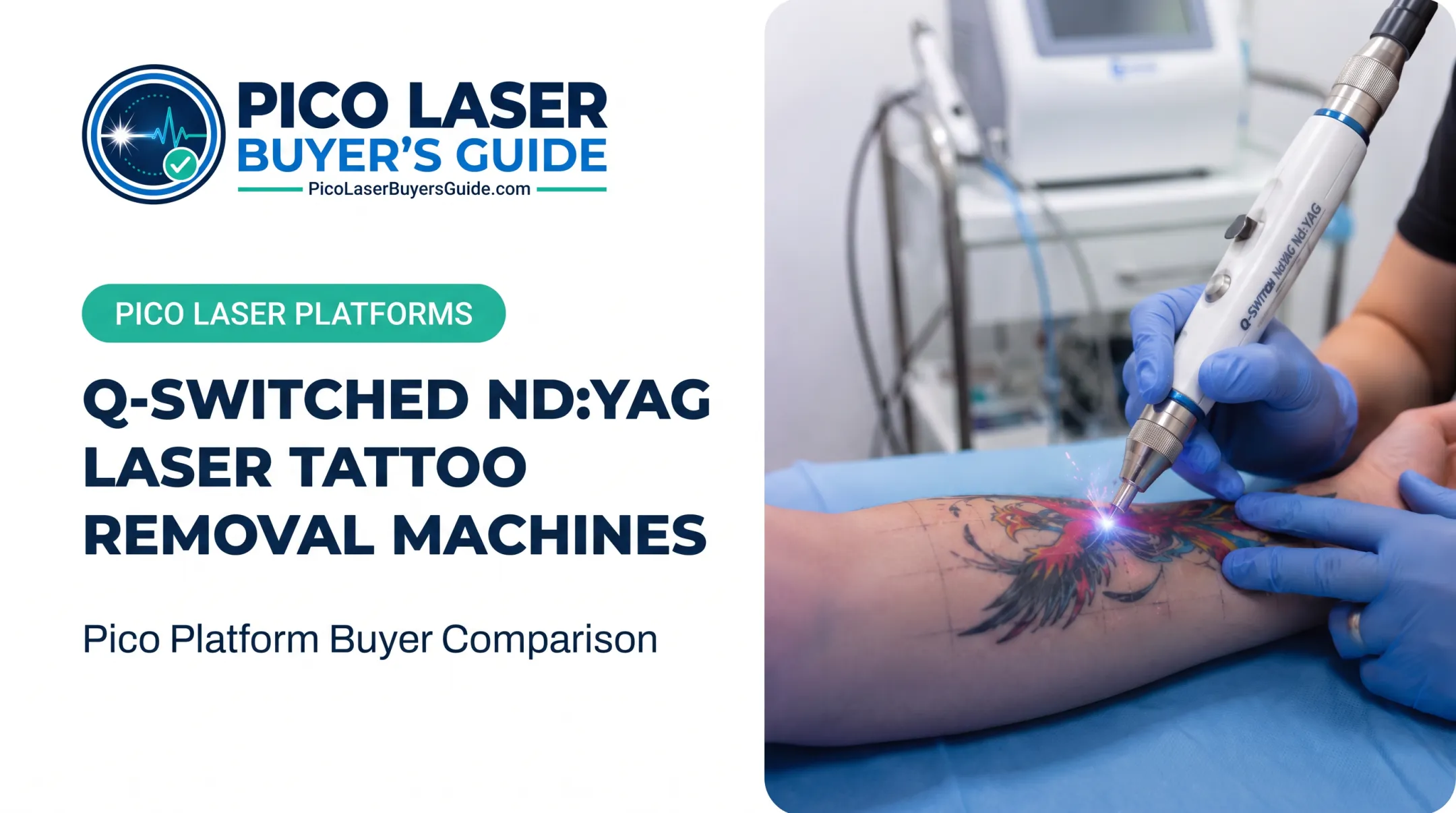
1064 nm handles black and dark inks; 532 nm covers red, orange, and yellow. Blue and green are harder, which is why some platforms add 670, 730, 755, or 785 nm options. No system treats every color equally.
A 2017 randomized trial of 21 patients found no significant clearance difference between 1064-nm picosecond and nanosecond Nd:YAG on black tattoos (P=1.00). Pain was lower with pico (3.8 versus 7.9). So clearance and comfort can diverge.

A manufacturer-funded prototype study reported 79% average clearance after 6.5 treatments. Clearance by color:
- Black: 92%
- Yellow: 85%
- Red: 80%
- Purple: 78%
- Green: 65%
- Blue: 43%
It enrolled no skin types V-VI and is a benchmark, not a head-to-head comparison. Outcomes also depend on ink, depth, age, density, prior treatment, and technique.
Pigmented lesions, melasma, and facial use
FDA labels differ by indication and skin type. Don't assume one clearance covers everything:
| Device (K-number) | Tattoo | Benign pigmented lesions | Acne scars |
|---|---|---|---|
| PicoWay (K220853) | 1064: I-VI; 532: I-III | I-IV | 1064 Resolve: II-V |
| enlighten III (K182997) | 1064: I-VI; 532: I-III | 1064: I-VI; 532: I-IV | 1064 MLA: II-V |
| Discovery Pico family (K240983) | 1064: I-VI; 532: I-III | I-IV | 1064 fractional: II-V |
| PICOPLUS (K173700) | 1064: I-VI; 532: I-III | I-IV | Not listed |
Evidence is indication-specific. In a 60-woman melasma trial (skin types III-IV), 1064-nm pico improved MASI by 35.9% at 24 weeks, versus 25.5% for 755-nm pico and 24.0% for hydroquinone. Recurrence still occurred in 5%.
A 20-woman solar lentigines study (types III-V) found 532-nm pico beat Q-switched Nd:YAG on improvement, with PIH of 5% versus 30%.
For nevus of Ota, one retrospective cohort of 16 type IV patients reported improvement, which says nothing about types V-VI. Darker skin demands careful wavelength and fluence choices, test spots, photoprotection, and a close read of labeled limits.
Acne scars, texture, and rejuvenation
Fractional handpieces (microlens array, diffractive, microbeam) carry their own indications and skin-type limits. In a 31-patient split-face pilot, 1064-nm pico MLA reduced scar scores 39.11% versus 43.73% for fractional ablative Er:YAG. The difference was not significant, but pico caused less pain and PIH. Nonsignificance doesn't prove equivalence.
In a 25-subject rejuvenation study, pico MLA improved visible pores 54.2% versus 41.7% for quasi-long-pulsed Nd:YAG, with wrinkle differences not significant. Pico offers modest non-ablative improvement. For deeper scars or advanced resurfacing, it isn't automatically the strongest choice.
Comfort, recovery, and adverse events
In the prototype tattoo study, erythema followed 69.3% of treatments and edema 94.0%. No immediate blistering or scarring occurred, and six tattoos showed mild pigment changes. Pain depends on the comparator: lower with pico in the tattoo trial, higher than quasi-long-pulsed Nd:YAG in rejuvenation.
Safe outcomes rest on patient selection, conservative settings, eye protection, laser safety procedures, training, and aftercare, not pulse duration alone.
Let evidence and clearance decide
For each shortlisted system, write a one-page summary covering its 510(k), indication-specific literature, manufacturer claims, known limits, and gaps. Don't name a universal winner. Match platform traits to your use cases instead.
What Should a US Clinic Evaluate Before Buying?
Total cost of ownership
Price is only the start. Budget for:
- Installation, room needs, and electrical service (PicoWay needs dedicated 200-240 VAC)
- Calibration, wear parts, and replacement handpieces
- Service contracts, software, and training
- Warranty length, which ranges from one to two years across these systems
- Downtime risk, which you should ask each vendor to document in writing
Market-estimate planning ranges (not list prices) include roughly $60,000 for PicoTech, $150,000-$210,000 for PicoStar, and $250,000-$325,000 for PicoWay. Replace them with written quotes.

US regulatory and documentation checks
Surgical lasers fall under FDA medical-device and radiation rules. Pull the current 510(k), intended-use labeling, and user manual for the exact configuration. Some platforms have gaps: confirm that the PicoStar configuration you want maps to a trade-name 510(k), and note that PicoTech's non-1064/532 wavelengths aren't cited as cleared.
State rules vary too. California lets physicians, and supervised PAs and RNs, perform laser tattoo removal, while New York treats laser use outside hair removal as practice of medicine. Confirm your state's rules.
New versus pre-owned
For used units, ask for shot counts, service history, refurbishment standards, warranty, and parts availability. Servicing that significantly changes performance or intended use can count as remanufacturing under FDA rules. Discontinued systems such as Pico Clear (roughly $20,000-$35,000 used) may lack factory support, so verify the service path in writing.
How to Choose the Right Picosecond Nd:YAG Laser
Build a weighted scorecard
Score each candidate on:
- Expected treatment mix and patient skin types
- Required wavelengths and FDA-cleared indications
- Throughput and operator experience
- Service access and budget
- Planned expansion into tattoo or pigment work
The Pico Laser Buyer's Guide maintains a manufacturer-backed comparison library across 16 platforms and is a solid starting point. Confirm every specification, clearance, warranty term, and commercial claim independently before buying.
Due-diligence sequence
- Shortlist platforms cleared for your indications.
- Request full technical and service documentation.
- Review the clinical evidence.
- Get written total-cost estimates.
- Arrange a demo or inspection.
- Choose the strongest documented fit, not the boldest spec.

Frequently Asked Questions
How long will a Pico laser last?
Hardware lifespan varies by model and is not standardized across platforms. It depends on usage, maintenance, calibration, service support, and parts availability. Device life also differs from result duration: melasma, for instance, can recur.
What are the differences between a YAG laser and a Pico laser?
Nd:YAG names the laser medium; pico names the pulse duration. A picosecond Nd:YAG combines both.
Is a picosecond laser the most effective for tattoo removal?
Not universally. Results depend on wavelength, ink color, tattoo traits, skin type, settings, and operator skill. A randomized black-tattoo trial found no significant clearance difference versus nanosecond Nd:YAG.
Is a Pico laser good for the face?
Cleared labels cover some facial uses, including selected pigment, acne scars, and wrinkles, depending on handpiece and skin type. Check device-specific clearances and get a professional assessment.
What is the most effective laser for aging skin?
It depends on whether the goal is pigment, fine lines, texture, laxity, or deeper resurfacing. Picosecond Nd:YAG is one option among several energy-based technologies.
How painful is Nd:YAG laser treatment?
Sensations vary with area, indication, settings, spot size, and individual sensitivity. Cooling and topical or local anesthesia reduce discomfort. Pico caused less pain in one tattoo trial but more in one rejuvenation study.