Introduction
Clinics often struggle when laser choice for hyperpigmentation follows brand prestige or peak power instead of clinical fit. The platform has to match the pigment diagnosis, the patient's skin tone, the clinical goal, and your team's expertise.
For US clinics, procurement adds another layer. Wavelengths, pulse durations, FDA clearances, service terms, and ownership cost all affect patient safety and whether a pigmentation service line pays off.
This guide compares five pico platforms: PicoSure Pro, PicoWay, enlighten III, Discovery PICO, and PiQo4. It also explains when IPL, fractional resurfacing, Q-switched, or CO2 technology may fit better.
Key Takeaways
- Pico lasers use trillionth-of-a-second pulses; match the platform to pigment type, depth, and skin tone.
- Verify the exact FDA indication; tattoo clearance does not prove pigmentation suitability.
- Compare wavelengths, pulse duration, handpieces, evidence, and training before buying.
- Total ownership cost includes service, maintenance, training, and utilization, not just price.
Overview of Lasers for Hyperpigmentation in the US Aesthetic-Device Market
Hyperpigmentation Is Not One Diagnosis
Hyperpigmentation covers conditions that should not be treated as interchangeable:
- Solar lentigines: flat, round or oval sunspots, light brown to black, per Mayo Clinic.
- Melasma: darker patches, usually on the face, in tan, brown, or gray-brown tones.
- Post-inflammatory hyperpigmentation (PIH): flat discoloration after inflammation, including cleared acne. It is usually not a scar.
Acne scars involve altered collagen and texture, so scar-remodeling results are not pigment-clearance results.
Technology Categories Compared
| Technology | How it works | Recovery and PIH notes |
|---|---|---|
| Picosecond | Very short pulses disrupt pigment photoacoustically | Erythema, crusting, and occasional PIH still reported |
| Q-switched nanosecond | Selective photothermolysis; 1064 nm reaches deeper | Minimal downtime at low fluence; PIH, rebound, and hypopigmentation remain concerns |
| IPL | Broad-spectrum light, not a laser | Darker epidermal pigment raises PIH concern |
| Non-ablative fractional | Microscopic treatment zones | Less recovery than ablative; PIH still possible |
| Ablative fractional (CO2) | Ablates tissue columns | Heavier wound-healing burden; PIH a material concern in darker skin |
No universal downtime or PIH percentage applies across categories, devices, and Fitzpatrick IV-VI patients. Treat the platforms below as equipment options, not universal clinical recommendations.

Top 5 Pico Laser Platforms for Hyperpigmentation in US Clinics
Selection criteria: pigment-related FDA indications, wavelength flexibility, pulse options, handpieces, clinical evidence, skin-type limits, service support, and ownership cost. The evidence does not support a ranked efficacy league table, so the order below is not a ranking of outcomes.
PicoSure Pro
Cynosure (now Cynosure Lutronic) builds PicoSure Pro around a 755 nm alexandrite laser, with optional 532 and 1064 nm add-ons. Handpieces include a 2-6 mm zoom, fixed 5, 6, 8, and 10 mm options, and the Platinum Focus Lens.
The FDA record covers benign pigmented lesions, including melasma, nevus of Ota, and Hori macules. Cynosure's brochure lists Flat Lens pigment treatment for Fitzpatrick I-VI, while Platinum Focus acne-scar and wrinkle clearance is I-IV. PIH is not listed among documented applications.
| Area | What to know |
|---|---|
| Specs | 755 nm; 532 ps pulse listed at 450 ps; zoom 2-6 mm; ask Cynosure for cooling specs |
| Evidence | A 2017 case series of three Korean patients (FST IV) with melasma and PIH showed fair to good improvement. It used the original PicoSure, not Pro, so treat it as generation-qualified evidence |
| Procurement | Estimated new price $225,000-$300,000; one-year warranty; Cynosure cites a 24-48 hour technical response for warranty and contract customers; confirm training and typical downtime with Cynosure |
PicoWay
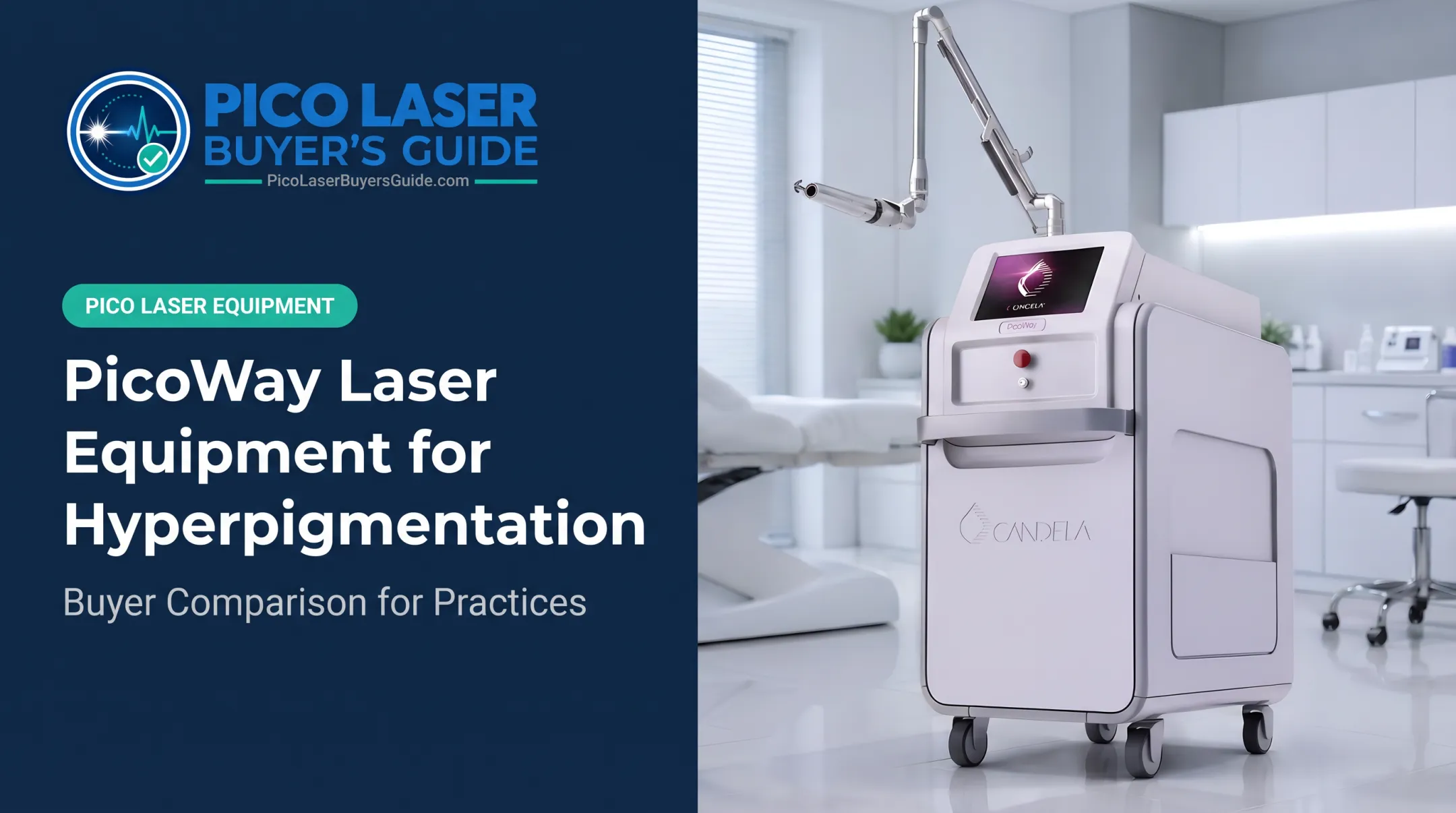
Candela's PicoWay offers 1064 and 532 nm, plus optional 730 and 785 nm applicators. Handpieces include Zoom full-beam, Resolve fractional, and Resolve Fusion.
Benign pigmented lesion clearance covers Fitzpatrick I-IV. Tattoo labeling reaches further, but that does not transfer to pigmentation. Labeling includes melasma, lentigines, CALMs, and nevus of Ota, depending on wavelength and handpiece.
Published evidence is clearer than for most rivals:
- A 2022 prospective 730 nm study of lentigines (FST II-IV) found 36% of treated areas scored 4 for clearance and 38% scored 3 at 12 weeks. Four subjects developed early PIH that resolved in 3-4 weeks.
- A 2023 Resolve melasma study reported mean improvement of 37% at 3 months and 27% at 8 months, per Bernstein's study. Every subject had mild-to-moderate erythema.
Those melasma numbers fade over time, so avoid permanent-clearance claims. Estimated new pricing runs $250,000-$325,000, with purchase or lease options and a one-year warranty. Candela offers ServicePlus tiers after warranty expiry.
enlighten III
Cutera's enlighten III combines 1064, 532, and 670 nm with picosecond and nanosecond modes (750 ps or 2 ns at 1064/532; 660 ps or 2 ns at 670). The optional fractional handpiece is the Micro Lens Array.
Its FDA record is notably broad for benign pigmented lesions: 1064 nm for Fitzpatrick I-VI, 532 nm for I-IV per the FDA summary, and 670 nm for I-III. Confirm 532 nm and 670 nm skin-type labels against the current clearance document, since sources differ. The MLA acne-scar clearance is not PIH clearance.
Cutera emerged from Chapter 11 on May 1, 2025 and operates privately. That is a restructuring, not a product discontinuation, but ask about service continuity.
- Ask Cutera for model-specific clinical data on lentigines, melasma, or PIH; do not borrow generic 1064 nm figures.
- Estimated new price: $180,000-$250,000; pre-owned about $90,000-$130,000.
- One-year warranty listed; confirm terms in writing.
Discovery PICO
Quanta System's Discovery PICO family pairs 1064 and 532 nm picosecond modes. The Plus configuration adds a 694 nm ruby, which is not a picosecond wavelength. A 2025 FDA filing (K240983) lists pulse durations of 450/600/800 ps at 1064 nm and 370/500/600 ps at 532 nm.
Picosecond benign-pigment clearance covers Fitzpatrick I-IV. That filing does not list a named melasma indication, and Q-switched or ruby indications must not be carried over to pico modes.
Published evidence is thin: a 2024 single case of partial unilateral lentiginosis improved with transient redness. Estimated new planning range is $160,000-$230,000. Warranty is quote-specific, and articulated-arm or handpiece repairs may cost extra out of warranty. Confirm voltage and circuit needs for your serial number.
PiQo4
PiQo4 was marketed by Lumenis, but its FDA applicant is Focus Medical, LLC. Its 2015 clearance (K151473) describes benign pigmented lesion removal, yet the skin-type statements shown concern tattoos, so pigmentation limits are not established.
One melasma study (NCT03565341, 20 patients) has no posted results. Confirm current US availability, specifications, warranty, and service with the manufacturer before purchase. Treat PiQo4 as an unresolved entry, not a verified purchase recommendation, and be cautious with used units.

How We Chose the Best Lasers
Common purchasing mistakes:
- Buying on brand familiarity.
- Treating tattoo-removal clearance as pigmentation proof.
- Overlooking skin-type safety.
- Comparing sticker prices without service and maintenance costs.
Clinical fit. Match platform to pigment type, depth, skin tone, treatment area, and downtime tolerance. Wavelength matters: 532 nm suits epidermal pigment such as freckles and lentigines but needs extreme caution in darker skin. 1064 nm is generally preferred for deeper dermal pigment and higher-risk skin. Providers must diagnose melasma, PIH, and lentigines before treatment.
Technical capability. Compare wavelengths, pulse duration, fluence, spot size, handpieces, and cooling. Cooling specs are rarely published for these platforms, so request them from the manufacturer or dealer.
Regulatory and evidence quality. A 510(k) shows substantial equivalence to a predicate, not superiority. Verify the exact model, wavelength, handpiece, mode, indication, and skin type, and check whether studies address hyperpigmentation at all.
Total cost of ownership. Include price, financing, installation, training, warranty, maintenance, consumables, room needs, utilization, and resale value. Our comparison library covers multiple pico platforms with transparent sourcing and disclosure.

Conclusion
The best laser for hyperpigmentation fits your patient population, clinical skills, treatment goals, regulatory needs, and budget. Price and marketing volume alone do not determine the right fit.
Before signing a purchase or lease, validate:
- Current specifications and FDA clearances
- Clinical evidence and available training
- Service support and written warranty exclusions
Pico Laser Buyer's Guide's technical comparisons and source documentation can help you build a defensible shortlist. Final treatment decisions belong to qualified medical professionals.
Frequently Asked Questions
How much does laser treatment for hyperpigmentation cost?
Patient pricing varies by technology, area, provider, session count, and location. The ASPS lists a $1,829 average for broader skin resurfacing, not pico pigmentation specifically. Clinic equipment costs are a separate matter.
What is the best laser treatment for hyperpigmentation?
No single laser fits every case. The choice depends on pigment type, skin tone, diagnosis, goals, and downtime. Pico, IPL, and fractional technologies each have different roles.
What is the most effective treatment for facial hyperpigmentation?
Diagnosis comes first, since melasma, sun spots, and PIH respond differently. Sun protection, conservative settings, and a qualified clinician's plan matter most.
Is IPL or pico laser better for treating pigmentation?
IPL may suit superficial sun-related pigment and redness. Pico offers short-pulse energy and wavelength options. Skin tone, pigment type, configuration, and provider skill decide suitability.
Which is better for hyperpigmentation: PRP or CO2 laser?
They are different categories, not interchangeable. A 2024 review found PRP improved melasma but did not show superiority over CO2, which is ablative with PIH risk. A clinician should match the option to the pigment type and skin tone.
Can laser permanently remove hyperpigmentation and dark spots?
Laser can reduce existing pigment but cannot prevent new discoloration from sun, hormones, or inflammation. One split-face trial reported 12.5% melasma recurrence at three months. Daily sun protection remains necessary.