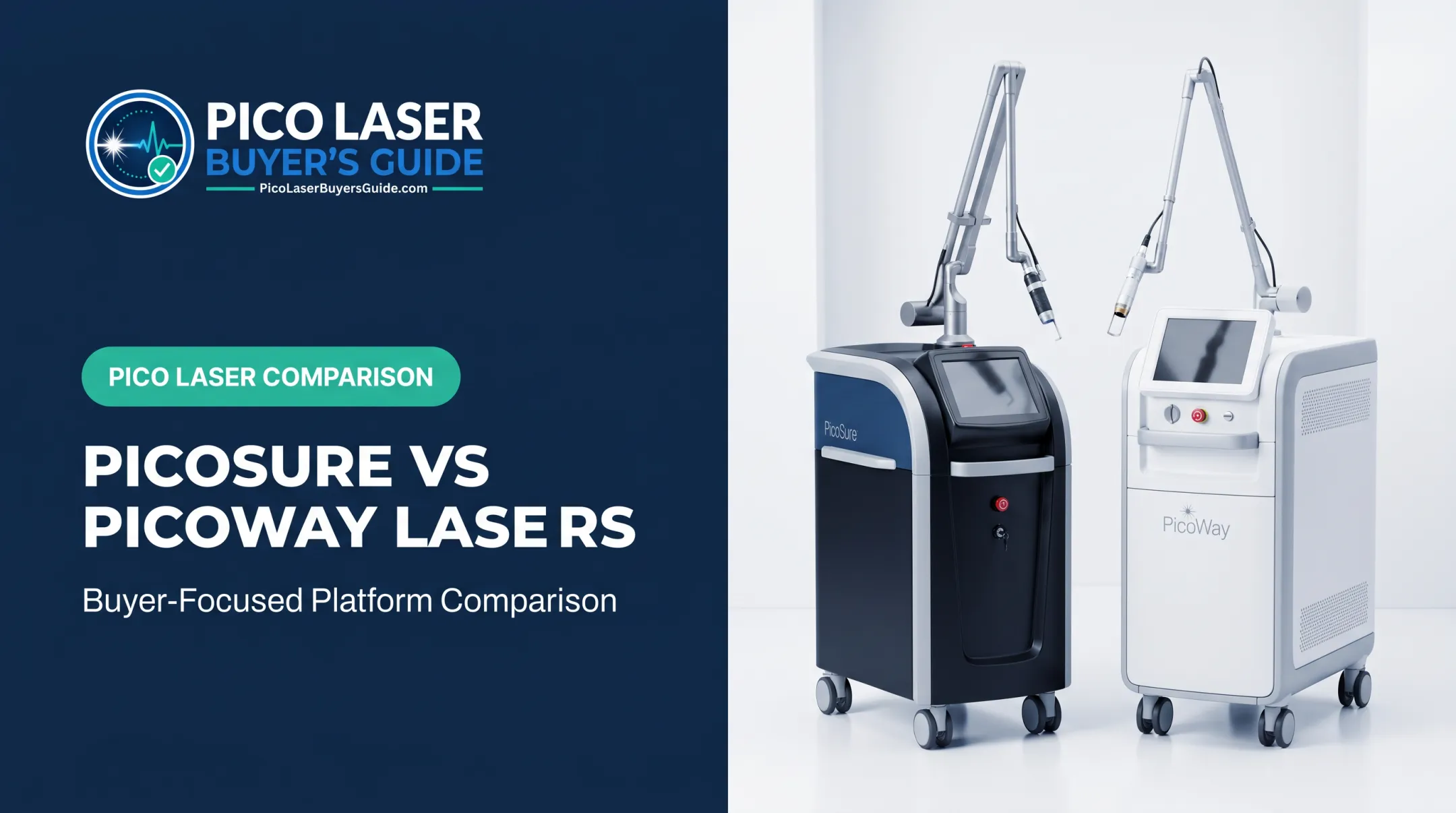

The market is crowded. AmSpa's 2024 report recap counted 10,488 US medical spas in 2023, up from 8,899 in 2022. That means more practices competing on the same service menu.
Pick the wrong configuration and you risk gaps in treatment coverage, tight utilization math, and service headaches. This article compares the two on verified specifications, FDA records, clinical evidence, and ownership costs.
Key Takeaways
- PicoSure is a platform family, so specs vary by generation, configuration, and handpiece.
- Both share a 755 nm core with optional 532 and 1064 nm wavelengths.
- No published head-to-head study shows Pro outperforming the original clinically.
- Price, warranty, and service terms decide value more than the "Pro" label.
PicoSure vs. PicoSure Pro: Quick Comparison
Cynosure launched PicoSure Pro on June 1, 2022, describing it as an upgrade to PicoSure, with 50% more energy. That's energy, not peak power. Don't conflate them.
| Specification | Original PicoSure | PicoSure Pro |
|---|---|---|
| Core wavelength | 755 nm alexandrite | 755 nm |
| Optional wavelengths | 532 nm, 1064 nm | 532 nm, 1064 nm |
| Pulse duration | 450-900 ps (2018 FDA record) | 500-900 ps (2022 brochure) |
| Pulse energy | Unconfirmed; ask Cynosure for the current figure | 300 mJ ±20% |
| Spot sizes | 2-6 mm, 8 mm, 10 mm | 2-6 mm zoom; fixed 5, 6, 8, 10 mm |
| Fractional-style optic | Focus Lens Array | Platinum Focus lens; separate Flat lens |
| Modes | Pigment/tattoo; skin revitalization | Flat-lens pigment; Platinum Focus; Turbo mode for stubborn tattoos |

Three cautions apply:
- The pulse-duration ranges come from different document types, so don't treat the gap as a performance difference.
- Pro marketing photos explicitly show original PicoSure treatments, not Pro results.
- Compare peak power, cooling, and handpiece availability only using like-for-like manufacturer documents.
Ownership terms differ too, and the details are in the sections below.
What Are PicoSure and PicoSure Pro?
What is PicoSure?
PicoSure is a branded picosecond platform, not a generic technology label. One picosecond is 10^-12 seconds, but a "picosecond" device doesn't necessarily emit a 1 ps pulse. Results depend on wavelength, energy, spot size, handpiece, and protocol.
FDA 510(k) records trace the system's growth:
- K121346 (2012): tattoo and benign pigmented-lesion removal.
- K140719 (2014): adds 3 mm/6 mm handpieces and Focus Array for acne scars and wrinkles, skin types I-IV.
- K143105 and K160480 (2015-2016): add 532 nm and 1064 nm delivery.
- K210226 (2021): 755 nm indication expressly includes nevus of Ota, Hori macules, and melasma.
These are 510(k) clearances, not PMA approvals. Several early PDFs carry May 2016 corrected letters; that isn't the original clearance date.
What is PicoSure Pro?
Cynosure's Pro product page lists 755 nm as standard, with 532 and 1064 nm optional and priced separately. Flat-lens labeling covers pigment and tattoos; Platinum Focus covers acne scars and wrinkles in skin types I-IV. Optional 532 nm tattoo labeling is limited to types I-III.
FDA records list the system as "PicoSure Workstation," not under a separate Pro trade name. The most recent record, K261570, lists the same indication categories, names K210226 as its predicate, and reports no technological-characteristic changes.
Be careful with internal specification tables. Some list maximum fluence as 6.37 J/cm², others 9.55 J/cm² at 2 mm. Primary Cynosure documentation should settle it.
The evidence gap
A feature is not an outcome. More energy may broaden options or affect workflow, but claims of fewer sessions, less discomfort, or faster clearance need indication-specific evidence. No peer-reviewed original-versus-Pro efficacy study exists. Trial NCT05102617 includes both devices but is nonrandomized, open-label, and posted no results.

Before trusting any supplier comparison, get a written quote listing:
- Exact device name and serial or model designation
- Included handpieces and software
- Warranty and service terms
- Training and installation requirements
PicoSure vs. PicoSure Pro: What Is Better for Your Practice?
Start with your case mix: tattoo-color mix, pigment and texture indications, skin types, monthly volume, provider experience, room power, and budget.
Clinical fit by use case
Tattoo removal. Cynosure associates 755 nm with black, blue, and green ink, 532 nm with red, yellow, and orange, and 1064 nm with black ink in darker skin. A 2021 systematic review of 36 studies favored picosecond lasers for blue, green, and yellow pigments, while both laser types handled black ink safely. Confirm which wavelengths your exact unit includes.
Melasma and pigment. A 2023 randomized trial found 25.5% MASI improvement at week 24 with PicoSure, with recurrence in 2 of 20 participants. That is comparable to 2% hydroquinone. Don't promise permanent clearance.
Acne scars and texture. The original-era Brauer study measured 24.3% scar-volume improvement in a 10-patient imaging subset, and Cynosure partly funded it. A 2025 Pro study found no significant added benefit when combined with radiofrequency microneedling. Different designs, so no generational ranking.
Total cost of ownership
Authoritative public prices for either model, new or pre-owned, are difficult to confirm. Our internal planning range for a new PicoSure Pro is $225,000-$300,000, with a separate comparison-table estimate of $200,000. Optional wavelengths cost extra, and a written quote is required.
Budget for installation (Pro commonly needs 200-240 V), training, service contracts, and downtime. Cynosure states a 24-48 hour technical response for warranty and contract customers. That isn't a repair-completion guarantee. Current US terms specify the shorter of 12 months from installation or 15 months from receipt.
Run a break-even model. If ownership runs $5,000 monthly and each treatment contributes $375, you need about 14 treatments a month to cover it. Use your own numbers.

For pre-owned units, ask for:
- Service logs and parts availability
- Calibration and safety documentation
- Loaner and repair policies
- References from comparable practices
- Resale restrictions or recertification fees (AmSpa flags these)
Training, patient selection, settings, and aftercare influence results as much as the name on the cabinet.
Situational recommendations
- Choose original PicoSure when its verified configuration matches your service menu and the lower cost fits your model.
- Consider Pro when documented capabilities solve a clear clinical or workflow need and utilization supports the premium.
- Pause if the seller can't supply model-specific documentation, FDA details, service history, warranty terms, or a component list.
Real-World Procurement Examples and Evaluation Checklist
Independently verified US buyer accounts with model-specific cost and measured return are hard to find. The scenario below uses no invented numbers.
Scenario: independent med spa adding tattoo removal. The owner wants multicolor ink capability and some pigment work on a limited budget. The decision criteria: which wavelengths come in the quote, whether 532 nm is included or priced separately, and whether a pre-owned original unit comes with documented service history. The Pro's premium only pays off if monthly volume clears the break-even point.
Clinical-use examples exist, but they're limited. The San Diego 2025 Pro study came from authors affiliated with the practice, and the New York acne-scar work had Cynosure funding. Neither discloses purchase economics.
Pre-purchase checklist
- Exact model and wavelengths
- FDA-cleared indications by wavelength and handpiece
- Included handpieces and software
- Warranty, parts, labor, and service terms
- Training and installation requirements
- Utilization assumptions and total cost of ownership
- Quality of clinical evidence
Before requesting quotes, use the Pico Laser Buyer's Guide's manufacturer-backed source library and comparison resources, which cover 16 platforms.
Conclusion
PicoSure and PicoSure Pro aren't interchangeable, but neither wins universally. Shared wavelengths and a shared regulatory lineage mean the real differences lie in configuration, handpieces, support, and price.
Compare documented capabilities, FDA clearances, evidence quality, serviceability, and expected utilization. The right platform fits your actual treatment mix and pays for itself over your ownership period.
Frequently Asked Questions
Is there a difference between PicoSure and PicoSure Pro?
Yes. They're related Cynosure platforms that can differ in pulse specifications, optics, treatment modes, and configuration. Verify the exact model through current manufacturer and FDA documents.
Is PicoSure Pro worth it?
It depends on case mix, utilization, added capabilities, and service coverage. Run a practice-specific break-even analysis rather than assuming "Pro" means better returns.
What is PicoSure Pro used for?
Documented uses include tattoo removal, benign pigmented lesions, melasma, nevus of Ota, Hori macules, acne scars, and wrinkles. Indications depend on the configuration, lens, skin type, and provider protocol.
What wavelengths does the PicoSure Pro laser use?
755 nm is standard, with optional 532 nm and 1064 nm. Confirm what's included in your quote against Cynosure's product page.
Is Q-switch or pico laser better?
Neither is universally better. A 2016 systematic review found sparse superiority evidence, mostly noncomparative studies. Choice depends on ink or pigment, skin type, indication, and cost.
Is Pico a Fraxel laser?
No. "Pico" describes pulse duration, while Fraxel is a branded fractional platform using thermal zones. PicoSure's focused optic works through laser-induced optical breakdown, a different mechanism.