
Introduction
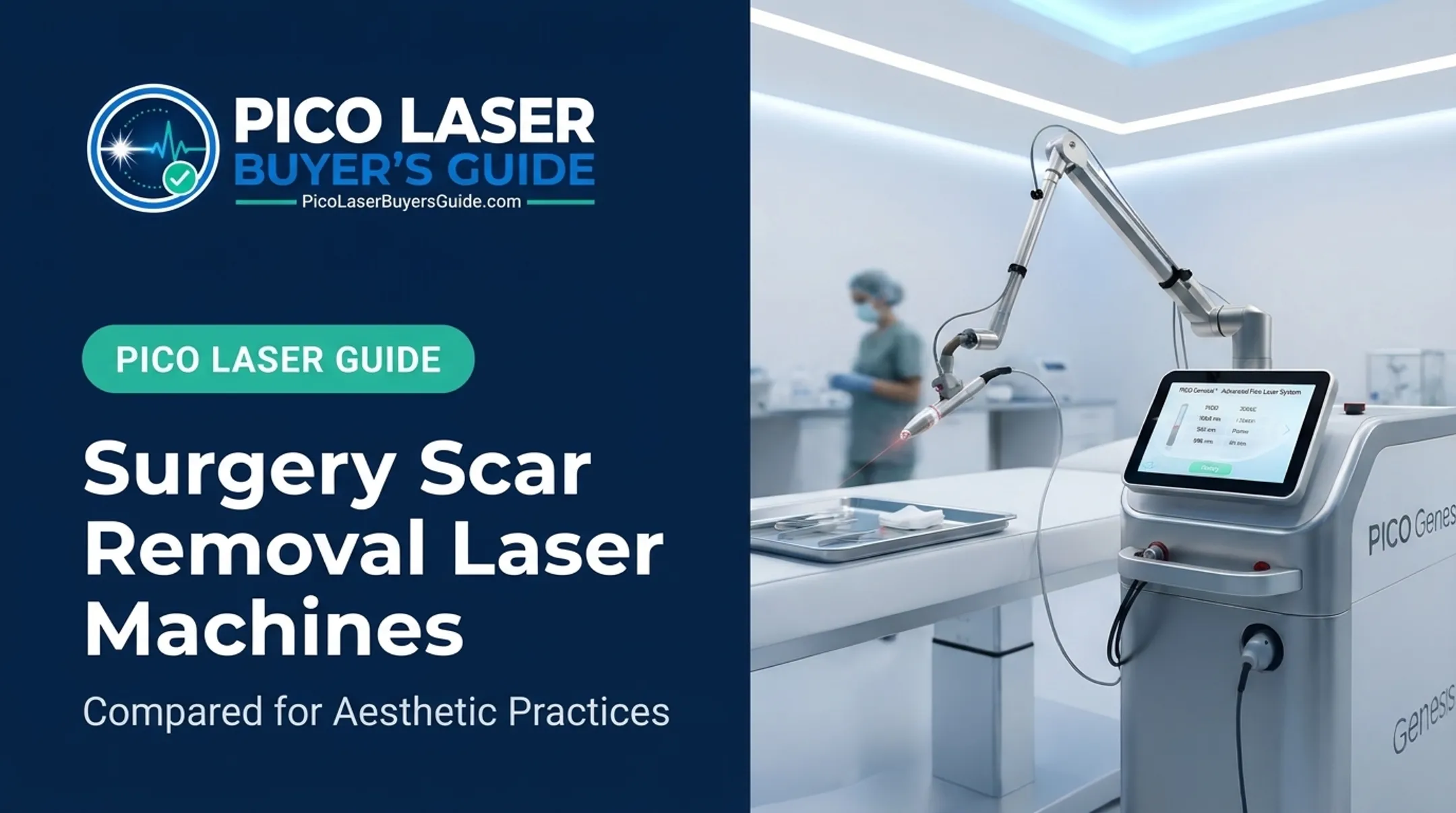
Pico laser is not a universal scar-removal tool. A surgical scar can be red, brown, sunken, tethered, raised, or all of these at once, and each pattern needs a different approach.
The evidence is thin. A 2026 systematic review covered 13 studies, 446 patients, and 475 scars for traumatic and surgical scars. All five randomized studies carried some bias concern.
This article is for clinicians, practice owners, technical evaluators, and informed patients. It covers where pico may fit, how it compares with microneedling and other options, and what to check before buying a platform.
Pico Laser Buyer's Guide is an independent educational resource built on manufacturer documentation, specifications, and transparent sourcing. It is not a clinical provider and does not replace medical evaluation.
Key Takeaways
- Treatment depends on scar traits and the patient's healing and pigment history, not on the scar being surgical.
- Pico may suit selected discoloration or texture concerns when device, evidence, and clinician assessment support it.
- Microneedling, fractional resurfacing, injections, silicone, or revision may fit some scars better.
- Aim for reduced visibility. Never promise complete removal.
Understanding Surgical Scars Before Choosing a Treatment
Classifying surgical scars
Scar type drives which treatments can help. Per the AAD and plastic surgery sources:
- Flat: may start reddish or raised, then flattens as it heals
- Atrophic/depressed: sits below surrounding skin
- Tethered: attached to underlying tissue, documented after abdominal surgery
- Contracture: tightens and restricts movement
- Hypertrophic: raised but within the original wound boundaries
- Keloid: grows beyond the original wound boundaries
Separate color concerns (red, pink, brown, hypopigmented, mixed) from structural ones (raised tissue, indentation, firmness, restricted movement). A laser aimed at pigment will not release a tethered scar.
Age matters too. Published reviews put maturation at roughly 1-2 years toward paler, softer, flatter scars. A stable, fully closed scar is a different candidate from a recent incision or an inflamed area.
Separating the treatment goal from the device
Start with the outcome: less pigment, less redness, smoother texture, flattening, softening, symptom relief, or better movement. Then choose the tool.
Document the baseline with consistent photography, lighting, and scar descriptors. Validated tools such as the Vancouver Scar Scale (vascularity, height, pliability, pigmentation) and POSAS (patient pain and itch) give a standardized record. Memory and cherry-picked before-and-after images do not.
How Pico Laser Works for Surgical Scars, and What the Evidence Supports
Mechanisms and treatment modes
Picosecond pulses deliver energy in trillionths of a second. Standard full-beam delivery covers the whole spot and relies on melanin or ink for photomechanical fragmentation.
Fractional delivery splits the beam with a micro lens array (MLA) or diffractive optical element (DOE). The goal is laser-induced optical breakdown (LIOB): plasma formation, shockwaves, and microscopic vacuoles that may trigger collagen remodeling without breaking the surface.
Not every platform does this. An ex vivo study found DOE gave more homogeneous microbeam distribution than MLA, though porcine tissue is a weak stand-in for living human skin. Depth and effect depend on wavelength, optic, settings, and scar.
Evidence specific to surgical scars
| Study | Design | Findings |
|---|---|---|
| Mammoplasty, 2025 (direct) | Randomized, 18 enrolled/17 completed, Fitzpatrick III-V, 1064 nm MLA, four monthly sessions started 15-31 days postoperatively | Treated scar width fell 75.3%, thickness 84.9%; controls did not change significantly. 2 of 18 developed PIH |
| Atrophic scars, 2023 (mixed) | Split-scar, 25 patients, traumatic and surgical scars over 1 year old | Volume advantage at 3 months (p=0.019); insufficient 6-month data |
| Postoperative prevention, 2026 (direct) | Split-scar, 14 adults, pico vs pulsed dye laser | Both improved; no significant difference between them |
Indirect evidence from acne scars, stretch marks, or rejuvenation can inform but should not be treated as equivalent. An acne trial of 20 subjects found no significant added benefit from a 755-nm pico on top of radiofrequency microneedling. It says little about surgical scars.
Limits are real:
- Small samples
- Anatomically specific cohorts
- No patient blinding
- Mixed scar types
- Short follow-up
- Varied platforms and settings

Appropriate expectations
Do not present pico as a guaranteed fix for:
- Thick keloids
- Active hypertrophic scarring
- Deep tethering
- Major contour defects
- Scars needing functional correction
Those may need excision, Z-plasty, or grafting.
Avoid claims such as "scar removal," "works for all skin types," and "better than every other treatment." Label any claim that rests only on manufacturer material. The Pico Laser Buyer's Guide library treats technically possible, FDA cleared, and clinically validated as distinct confidence levels.
Pico Laser vs Microneedling and Other Surgical-Scar Treatments
Comparing pico laser with microneedling
Neither treatment wins in every case. Mechanism, depth, pigment risk, downtime, operator control, evidence quality, and scar type all shape the choice.
- A 2022 surgical study of 25 patients found microneedling improved VSS, POSAS, and GAIS scores at 16 weeks (p<0.001). That is a baseline result, not proof against pico.
- A 2023 review of needling versus ablative fractional lasers found 60% of comparisons showed no significant difference. Those lasers were CO2 and Er:YAG, not pico.
The better option depends on the scar presentation. Discoloration, shallow texture, depression, tethering, raised tissue, and scars over moving joints each favor different tools.
Other options clinicians may consider
- Fractional CO2 or Er:YAG resurfacing, used for hypertrophic scars
- Radiofrequency microneedling (the FDA's 2025 safety communication reports burns, scarring, fat loss, and nerve damage with certain uses)
- Pulsed dye laser, often with silicone or injections for persistent linear hypertrophic scars
- Silicone and pressure therapy, the 2014 guideline's first-line non-invasive approach
- Corticosteroid injections, with silicone, for minor keloids
- Surgical revision for functional deficits
- Observation, where appropriate
Raised or keloid-prone scars follow a different pathway and belong with a dermatologist or plastic surgeon.
Combination treatment and sequencing
Plans may use different modalities at different stages. Combinations should follow scar assessment, healing status, evidence, and risk, not stacked procedures built for marketing.
Patient Selection, Timing, Safety, and Aftercare
Is the patient a candidate?
Review these before treatment:
- Scar maturity and complete wound closure
- Infection, inflammation, or herpes/cold sore history
- Abnormal scarring history
- Skin tone and PIH risk
- Medical conditions, smoking, medications, supplements
- Patient expectations
The mammoplasty trial excluded skin infection, herpes history, immunocompromise, pregnancy, and scar treatment within six months.
Refer back to the operating surgeon or a specialist for wound separation, drainage, increasing pain, suspected infection, rapid growth, severe itching, restricted movement, or an uncertain diagnosis.
Timing and preparation
There is no universal start date. Pico studies began at postoperative day 14 or 15-31 days, which are study windows only. A 2020 review of 17 randomized trials could not conclude whether early laser reduces scar formation.
Preparation topics include sun exposure, recent tanning, active skincare, photosensitizing drugs, anesthesia needs, and consent. On isotretinoin, a 2017 consensus found insufficient evidence to routinely delay fractional lasers, but it is not pico-specific. A tan or sunburn can preclude treatment, per the AAD.
Recovery and monitoring
In the mammoplasty cohort, all patients had transient erythema and grid-like scabs lasting about 2-3 days. PIH in Fitzpatrick III-V skin appeared in 11% and resolved in about three weeks. That is neither zero downtime nor zero PIH.

Provide written aftercare, broad-spectrum SPF 30+, gentle skin care, follow-up photos, and adverse-event documentation. Set an escalation path for lasting pigment change, infection, worsening, or abnormal growth.
Clinical Technology and Procurement Checklist for Pico Laser Evaluation
Specifications that affect scar-related use
Compare:
- Wavelength options and pulse duration
- Fluence range, spot size, repetition rate
- Beam profile and fractional optics (MLA or DOE)
- Handpieces, cooling, and coverage
- The manufacturer's stated indications
A marketing label is not enough. Platforms differ in wavelengths, delivery modes, software, and flexibility. One mammoplasty paper reported a Discovery PICO at 750 ps, while the manufacturer's US page lists 450 ps at 1064 nm. Confirm exact configuration.
Regulatory, evidence, and documentation checks
FDA 510(k) establishes substantial equivalence, not proof of effectiveness for every use. On the FDA clearances for PicoSure Workstation, PicoWay, enlighten III, and Discovery Pico, scar labeling centers on acne scars; an explicit surgical-scar indication does not appear on those documents. Verify the model, wavelength, handpiece, mode, and indication.
Request:
- Technical documents and studies matching your exact configuration
- Contraindication guidance and training requirements
- Service, maintenance, and warranty terms
- Total cost of ownership
Using an independent research resource
Pico Laser Buyer's Guide is a reasonable starting point for comparing manufacturer-backed specifications and sources across 16 platforms. Verify current details with manufacturers and clinical advisors.
Keep a procurement record that separates manufacturer claims, peer-reviewed evidence, regulatory documents, user experience, and your own protocols.

Frequently Asked Questions
Is microneedling better than pico laser for surgical scars?
Neither is universally better. Compare scar type, depth, color, tethering, skin characteristics, downtime, and evidence for the treatment area.
What is the best treatment for surgical scars?
There is no single best option. The choice depends on whether the scar is flat, pigmented, depressed, tethered, hypertrophic, keloid-prone, symptomatic, or still maturing.
Can pico laser remove surgical scars completely?
No. Treatments aim to make scars less noticeable in visibility, color, or texture, not erase them. Outcomes depend on scar biology, device parameters, and healing.
How long after surgery can you have pico laser on a scar?
Only after the incision is fully closed and a clinician confirms adequate healing. Timing varies by procedure, location, scar maturity, and complications.
Is pico laser safe for darker skin or people prone to keloids?
Risk depends on settings, skin history, scar type, and provider experience. Darker skin needs pigment-risk management, and keloid-prone or raised scars need specialist assessment before any laser.