The honest answer is that neither wins across the board. Your decision affects clinical range, capital outlay, training, workflow, service support, and the patients you can treat.
This guide compares the two on pulse duration, wavelength, intended use, clinical evidence, operator control, total cost of ownership, and FDA documentation.
Key Takeaways
- Pico delivers picosecond pulses and Q-switched delivers nanosecond; pulse length alone is not decisive.
- Wavelength and target pigment matter as much as pulse duration.
- Head-to-head trials show mixed results by indication, so avoid blanket superiority claims.
- Compare full platforms: specs, handpieces, 510(k)s, training, service, and utilization.
Pico Laser vs Q-Switched Laser: Quick Comparison
Pulse Duration and Energy Delivery
One picosecond is 10^-12 seconds; one nanosecond is 10^-9 seconds (NIST). Real devices vary. In one Asian tattoo trial, the pico system ran at 375/450 ps and the nanosecond comparator at 50 ns.
Picosecond pulses can produce a stronger photomechanical effect and limit heat diffusion. They aren't heat-free. Q-switched pulses also generate photoacoustic waves and thermomechanical pigment disruption. Results with either depend on wavelength, fluence, spot size, and operator technique.

Wavelength and Platform Configuration
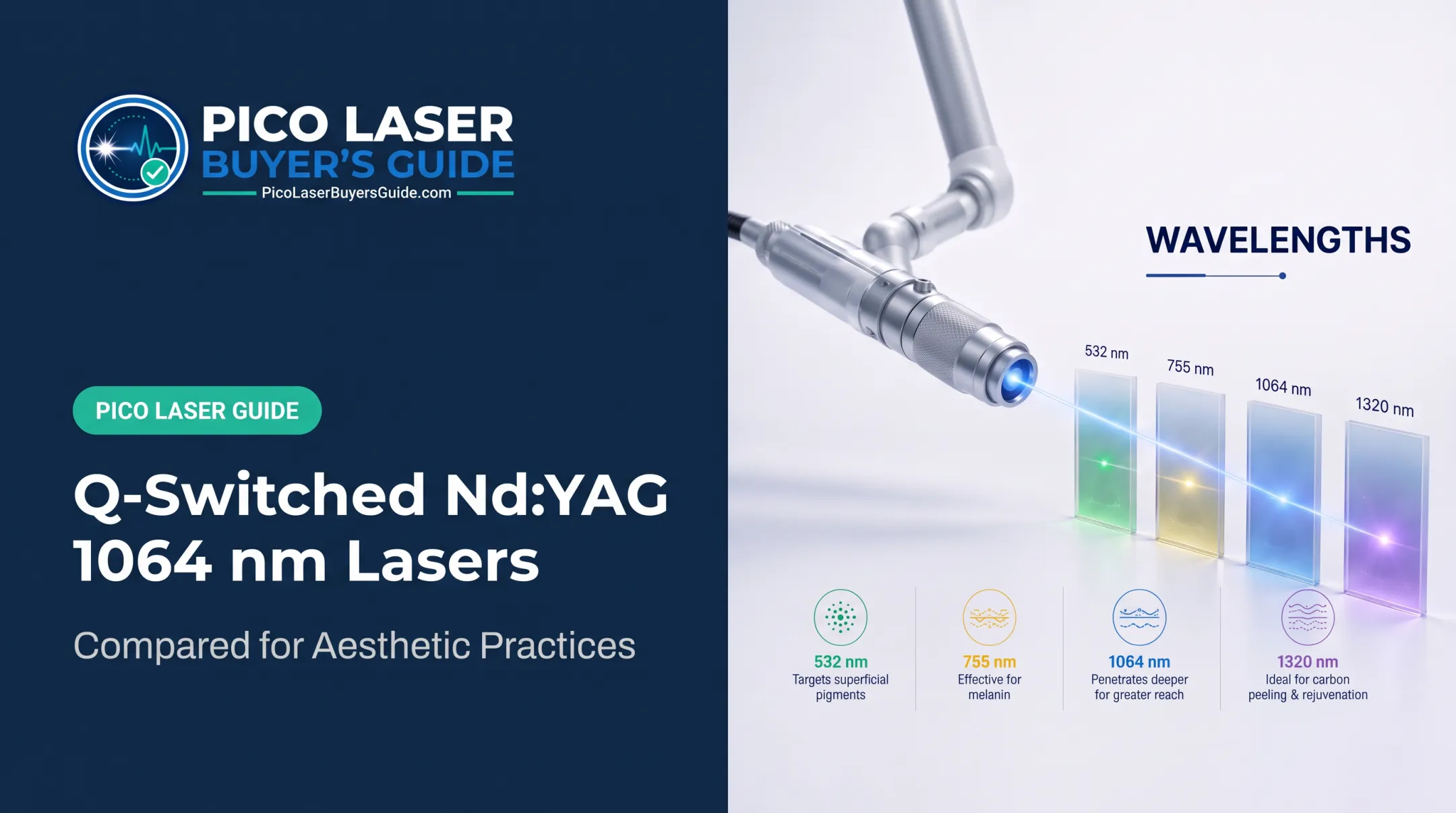
Don't assume all pico devices share capabilities. Compare the wavelengths each platform actually offers:
- 532 nm: frequency-doubled Nd:YAG, labeled for red, yellow, and orange ink on PicoWay
- 694 nm: ruby, used for black and colored tattoos in a 2022 comparison
- 755 nm: alexandrite, with tattoo and benign pigment labeling on PicoSure
- 1064 nm: Nd:YAG, labeled for black, brown, green, blue, and purple ink on PicoWay
"Q-switched" describes how the pulse is generated. Nd:YAG is the laser medium. Ruby and alexandrite lasers can be Q-switched too, so a Q-switched Nd:YAG is one configuration, not a synonym.
Clinical Applications
- Pico: tattoos, selected benign pigmented lesions, post-inflammatory pigmentation, and fractional uses such as acne scars when the device is cleared
- Q-switched: black and dark tattoo ink, selected freckles and solar lentigines, and other benign pigmented lesions within intended use
Treatment Experience and Recovery
Expect redness, swelling, and sometimes blistering or crusting from either. The American Academy of Dermatology notes that light or dark spots can take 6-12 months to fade. That's pigment recovery, not wound closure.
In a 2022 split-tattoo study, clearance didn't differ significantly, but pico caused less pain (P < .001). A melasma trial also reported lower pain scores with pico (3.13 vs 5.31). Pigmentary complications remain possible with both.
Procurement and Operating Economics
Compare these line items, not just the sticker price:
- Acquisition price and financing
- Consumables and preventive maintenance
- Service contracts and warranty terms
- Training and replacement parts
- Expected treatment volume
Public pricing for like-for-like pico and Q-switched systems is hard to find, so request written quotes. A cheaper purchase price or per-session fee says little about value without realistic utilization over the device's service life.
What Are Pico and Q-Switched Lasers?
What Is a Pico Laser?
A picosecond laser delivers energy in pulses measured in picoseconds. The short pulse can create a pronounced photoacoustic effect with potentially less heat diffusion into surrounding tissue.
Verify these variables before buying:
- Wavelength options and pulse energy
- Repetition rate and spot sizes
- Beam profile, handpieces, and cooling
- Fractional capabilities and treatment modes
- Manufacturer-supported indications
Pico may fit practices treating colored or resistant ink, selected pigmented lesions, and acne-scar protocols where the platform supports them. Demand device-specific evidence rather than broad superiority claims.
Use Cases of Pico Lasers
Tattoo clinics often prioritize wavelength flexibility. Med spas and dermatology practices may value a broader mix of pigment, scar, and rejuvenation work. For example, the PicoWay's standard 1064 and 532 nm can be expanded with optional 730 and 785 nm applicators for difficult blue and green pigment.
The best-documented comparison is the Asian professional-tattoo trial (11 patients, 37 tattoos, Fitzpatrick III-IV, four treatments 4-6 weeks apart). Photographic clearance favored 1064 nm pico for black ink and 532 nm pico for red.
Post-inflammatory hyperpigmentation (PIH) still appeared in every arm, from 21.6% to 35.1%. The sample was small and the study had no cost comparison.
What Is a Q-Switched Laser?
Q-switching stores laser energy and releases it as a short, high-power pulse, typically in nanoseconds. These systems target pigment through wavelength-specific absorption. Common configurations include Q-switched Nd:YAG, ruby, and alexandrite.
In equipment comparisons, always separate the medium, wavelength, pulse duration, and model.
Q-switched systems fit black tattoo removal, selected benign pigmented lesions, and established pigmentation workflows. Conservative settings and careful patient selection matter, especially for patients prone to post-inflammatory pigment change. The 1064 nm wavelength is absorbed less by epidermal melanin than shorter wavelengths, which lowers complication risk.
Use Cases of Q-Switched Lasers
Q-switched suits practices wanting an established platform and a focused menu. It isn't automatically outdated.
Published comparisons sometimes favor Q-switched systems. In a split-face freckle study, a Q-switched 755 nm alexandrite produced greater curative effect and satisfaction than a 532 nm pico (P < .001, 18 patients).
In a melasma trial, 1064 nm pico and Q-switched Nd:YAG showed no significant efficacy difference. That study was small, single-center, all-female, and not designed to prove equivalence.
Check whether the study's wavelength and device match the platform you're considering.
Pico Laser vs Q-Switched Laser: What Is Better?
Start with the target condition, wavelength, patient population, goals, available expertise, and business model. Pulse duration and marketing language come last.
When to Evaluate Pico
- You need specific wavelengths for colored or resistant ink
- Lower pain or thermal exposure matters to your patients
- You want a broader service menu to stand out locally
- The device has evidence and clearance for your indications
In a 2023 solar lentigines trial, 532 nm pico scored higher (mean improvement 2.95 vs 1.80, P < .05), with PIH at 5% vs 30% (P = .057). A 2025 meta-analysis of 971 patients found lower hyper- and hypopigmentation with pico, though evidence outside Asian cohorts was sparse. It found no clear clearance difference for endogenous pigment (RR 1.06, 95% CI 0.85-1.31).

When to Evaluate Q-Switched
- Your workflow centers on black tattoos or common pigment indications
- Entry cost matters
- Your operators already know the technology
- You want a focused clinical offering
Patient and Operational Factors
- Skin type and history of PIH
- Tattoo color and depth
- Pigment diagnosis and treatment area
- Treatment intervals (4 weeks in one ruby study, 4-6 weeks in another)
- Discomfort management, downtime, and aftercare
Skill matters too. Parameters, diagnosis, and realistic expectations can outweigh the technology label. Neither category is universally faster, safer, cheaper, or more effective.
Buyer's Due-Diligence Checklist
- Confirm FDA 510(k) clearance for the exact model, wavelength, handpiece, mode, and indication
- Check intended use, available wavelengths, energy range, and spot sizes
- Ask about cooling, training, and credentialing requirements
- Get service response times, warranty coverage, and consumable costs in writing
- Speak with reference sites
Clearances differ widely. For example, PicoWay's tattoo labeling covers Fitzpatrick I-VI at 1064 nm but I-III at 532 nm. Operator qualifications also vary by state. California, for instance, limits laser tattoo procedures to physicians and supervised PAs and RNs.
Real-World Examples and Procurement Lessons
What the Comparative Evidence Shows
Take the 2022 study by Bäumler: 23 people, 30 black and colored tattoos, Fitzpatrick II-IV, up to eight split-tattoo sessions 4 weeks apart. Pico (532/1064 nm) was compared with a 694 nm Q-switched ruby. Key findings:
- Clearance was not significantly different between arms
- Pico hurt less
- Neither caused scarring
- Complete removal was frequently incomplete
The limits are real: the two arms used different wavelengths, so it isn't a pulse-duration-only test.
A Procurement Example
A supplier case study describes BH Laser Tattoo Removal launching in 2018 with an Astanza dual-wavelength Q-switched laser. It later upgraded to full-spectrum and added permanent-makeup removal. The supplier reports growth from under 20 to nearly 300 monthly clients across two locations. That's a vendor-reported result, not a controlled ROI analysis, and it omits purchase price and isolated profit.
For the cost side, an illustrative ownership model estimates 13 monthly treatments to cover annual ownership cost. At a $375 contribution margin, monthly ownership costs map roughly as follows:
- $3,000/month: about 8 treatments
- $5,000/month: about 14 treatments
- $8,000/month: about 22 treatments

Those are illustrations, not guarantees.
Match the device to your primary revenue-generating indications, then confirm documentation before purchase. The Pico Laser Buyer's Guide offers manufacturer-backed specification and comparison resources across 16 platforms to continue your evaluation.
Conclusion
Pico and Q-switched lasers are different pulse-delivery technologies, not interchangeable names. The right choice depends on several practice-specific factors:
- Wavelength and clinical indication
- Supporting clinical evidence
- Workflow and operator expertise
- Total cost of ownership
Evaluate pico for the capabilities it demonstrably supports, such as certain colored inks and lentigines. Consider Q-switched where established indications, economics, and operational fit match your practice. Compare documented specifications and FDA information before committing.
Frequently Asked Questions
How often can you do Q-Switch laser?
It depends on the indication, treated area, skin response, and settings. Published protocols range from 4 to 6 weeks for tattoos, but there is no universal schedule.
How long does a Q-Switch laser take to heal?
Immediate redness and swelling settle first, while crusting or pigment changes can last longer. Healing varies with settings, wavelength, skin tone, and aftercare.
How long do Q-Switch laser results last?
Tattoo ink removed stays removed, though clearance is often incomplete. Pigmentation such as melasma can return; in one trial, six-month recurrence was 18.8% after Q-switched treatment.
Which is better, Q-Switch laser or Pico laser for tattoo removal?
Both treat tattoo ink. Pico may help with some colored or resistant pigments and cause less pain, but one 2022 comparison found no significant clearance difference. Wavelength, ink, skill, and treatment history decide suitability.
Does Q-Switch laser remove pigmentation permanently?
Not reliably. Some pigment clears, but sun exposure, hormones, inflammation, and the underlying condition can bring it back.
Is Nd:YAG laser the same as a Q-Switch laser?
No. Nd:YAG is the laser medium; Q-switching is the pulse-delivery method. A device can be a Q-switched Nd:YAG, and picosecond Nd:YAG lasers exist too.