Introduction: Laser Pigment Removal Explained for Patients and Clinics
"Laser pigment removal" means two different things. It can describe fading unwanted skin pigmentation, such as sun spots and freckles, or breaking up tattoo ink. The safest treatment depends on which pigment you have and how deep it sits.
This guide serves two readers. Patients get a clear picture of how pigment-targeting lasers work. Clinic owners get a framework for assessing technologies, indications, safety protocols and FDA documentation.
Expectations matter. Lasers can substantially reduce targeted pigment, but they don't stop new discoloration from sun, hormones, inflammation or aging. The American Academy of Dermatology notes that age spots can return whichever treatment you choose.
Key Takeaways
- Choose a laser by pigment type, skin tone, depth and goal, not by brand.
- Picosecond, Q-switched, IPL and fractional systems are not interchangeable.
- Darker skin and melasma call for diagnosis, test spots and conservative settings.
- Clinics should check the exact 510(k) record, specifications, evidence, service and total ownership cost.
What Is Laser Pigment Removal?
Laser pigment removal uses targeted light to reduce excess melanin or fragment exogenous pigment like tattoo ink. The principle dates to the 1983 paper on selective photothermolysis: short pulses of selectively absorbed light can damage pigmented targets without needing precise aiming.
Common concerns differ in location, composition and response:
- Sun spots (solar lentigines) and freckles: superficial, sun-related brown spots
- Post-inflammatory hyperpigmentation (PIH): a response to prior skin inflammation
- Melasma: a recurrent condition that needs its own diagnosis and plan
- Tattoo ink: particles deposited in the dermis, in varying colors
Get suspicious spots checked first. Skin cancer can resemble an age spot. A spot that is new, changing, itching or bleeding needs a dermatologist's assessment before any cosmetic laser treatment.
How Laser Energy Breaks Down Pigment
Melanin and tattoo ink absorb certain wavelengths more strongly than surrounding tissue. That selective absorption lets the operator target pigment while limiting damage to nearby skin.
Pulse duration changes how the energy acts. Pigment fragmentation can involve photothermal, photochemical, and photoacoustic effects. Picosecond pulses rely on photoacoustic shockwaves that shatter 10–100 nm ink aggregates. Even so, picosecond treatment still has thermal effects.
Picosecond vs. Q-switched evidence
Pulse duration and wavelength are separate specifications. Cutera documents 2 ns and 660/750 ps modes on its enlighten III, for example. The trials don't crown a universal winner:
| Study | Finding |
|---|---|
| 36-study tattoo review | Pico favored for blue, green and yellow ink; both effective for black |
| 2017 1064-nm RCT (30 black tattoos) | No clearance difference; less pain with pico |
| 2026 755-nm split-tattoo RCT (30 subjects) | Satisfactory clearance 73.3% vs. 23.3% for pico, but hyperpigmentation 21.33% vs. 12% |
| 2019 lentigine RCT (20 women, Fitzpatrick III–V) | Better improvement score with pico; PIH difference not statistically significant |
A 2018 lentigine trial found no significant clearance difference between platforms. Results depend on the condition, wavelength, and skin type.

Choosing the Right Laser Technology for Pigment Removal
Match the technology to the concern
- Superficial sun spots and freckles: 532 nm suits shallow, melanin-rich targets, with caution on darker skin.
- Deeper dermal pigment and some melasma protocols: 1064 nm penetrates deeper with less melanin absorption.
- Melasma and PIH: Require diagnosis and recurrence planning before wavelength selection.
- Multicolor tattoos: Require multiple wavelengths matched to ink colors.
IPL vs. pigment-selective lasers
IPL is broad-spectrum, noncoherent light (about 515–1200 nm), not a single-wavelength laser. The American Society for Dermatologic Surgery describes it as a nonablative option for sunspots with minimal recovery.
It can suit diffuse superficial discoloration, redness and photodamage. Pigment-targeting lasers offer tighter wavelength control. Skin tone, tanning history and settings matter for both.
Wavelengths and configurations
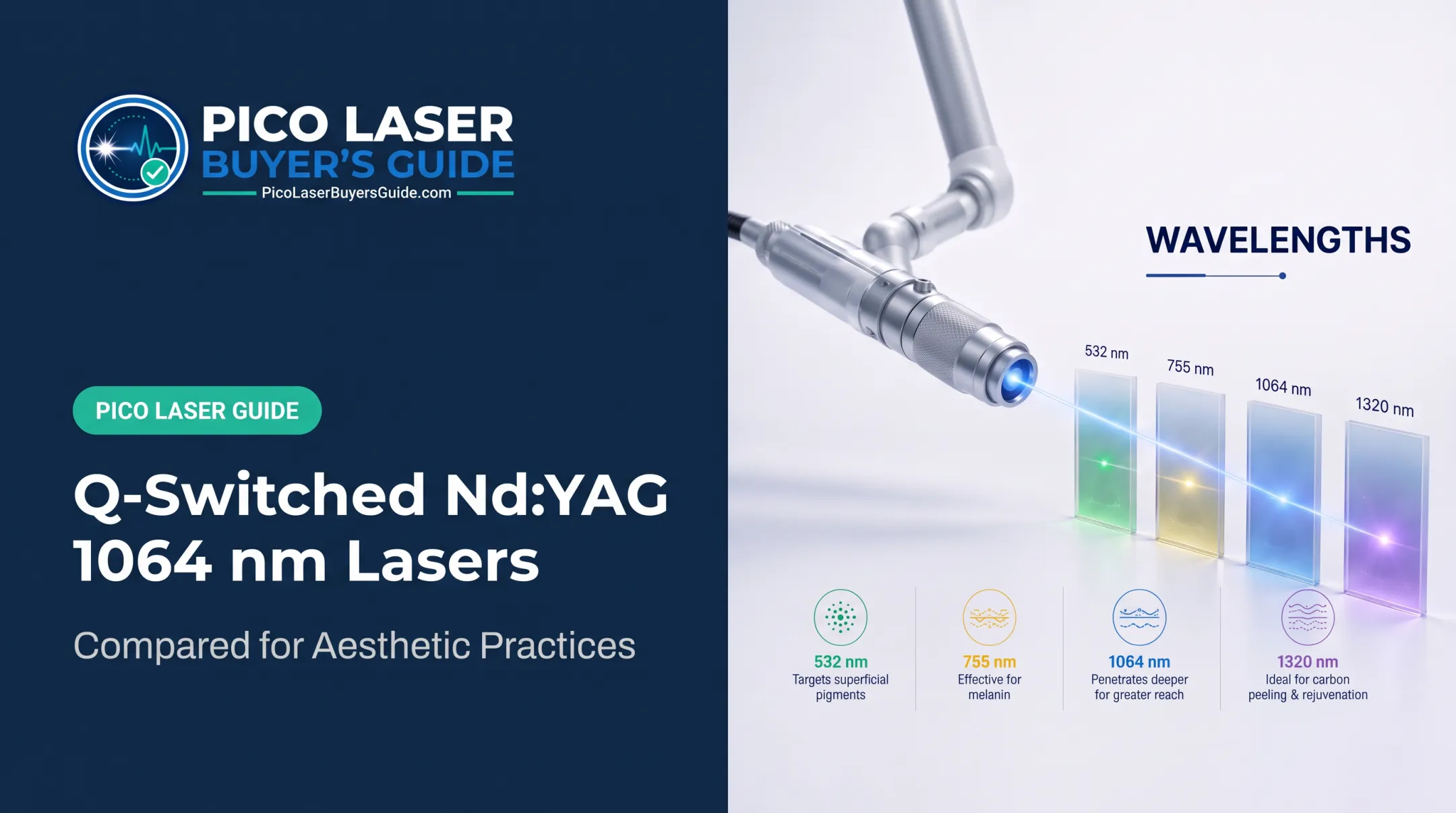
Tattoo colors absorb differently. Black ink absorbs broadly. 532 nm suits red, yellow and orange, while 730/755/785 nm suit green and blue. Configurations vary, so confirm what is installed:
| Platform | Documented wavelengths |
|---|---|
| Cynosure PicoSure Pro | 755 nm; optional 532/1064 nm delivery systems |
| Candela PicoWay | 532, 730, 785, 1064 nm |
| Cutera enlighten III | 532, 670, 1064 nm |
| Quanta Discovery Pico Series | 532/1064 nm; Plus adds 694 nm |
These are configuration facts, not head-to-head rankings.
Set goals before choosing
A system built for isolated lesions may not serve a tattoo clinic, and a tattoo-focused platform may lack resurfacing features. Match the platform to expected demand, treatment areas, downtime tolerance and combination plans.
Safety, Skin Tone, and Clinical Candidate Selection
Skin tone and pigment-change risk
Darker skin isn't an absolute contraindication, but burns, blistering, hyperpigmentation, and hypopigmentation are real risks, especially with recently tanned skin. A clinical reference favors 1064-nm Nd:YAG for darker skin and notes greater hypopigmentation risk with ruby. No laser is universally safe for every complexion.
Conservative protocols
Risk reduction typically includes:
- Test spots
- Wavelength matched to skin type
- Cautious energy settings
- Adequate spacing between sessions
- Cooling and eye protection
- Close follow-up
Providers should individualize parameters rather than copy another patient's or device's settings.
Melasma is a management problem
Heat and inflammation can worsen melasma. A 2017 expert consensus says lasers aren't first-line therapy or advised as monotherapy.
In one 2010 study of 22 patients, all had recurrence, and some developed mottled hypopigmentation or rebound hyperpigmentation. The AAD says the best results usually combine sun protection with topical medications, sometimes plus a procedure.
Confirm candidacy
Consultations should cover:
- Pigment type and medications
- Active acne or infection
- Recent tanning
- Healing history (keloids, hypertrophic scars)
- Prior reactions to light
The AAD advises against laser tattoo removal during pregnancy or breastfeeding. A provider may postpone, choose a non-laser approach, or refer for medical assessment.
Verify FDA documentation
A 510(k) clearance means substantial equivalence to a legally marketed predicate. It is not PMA approval, and it doesn't guarantee an outcome. Labeling can differ sharply by wavelength. PicoWay's 2022 summary lists tattoo labeling as:
- 532 nm at skin types I–III
- 730/785 nm at II–IV
- 1064 nm for all types
Review the exact indications, contraindications, and evidence for your model.
Treatment Workflow, Results, and Aftercare
A typical visit follows these steps:
- Consultation and baseline photos
- Skin cleansing and eye protection
- Test spot, when appropriate
- Treatment with cooling
- Written aftercare instructions

Patients commonly feel warmth, snapping, or stinging. The American Academy of Dermatology (AAD) notes that numbing cream or injected anesthetic may be offered.
Afterward, expect redness, swelling, and sometimes slight blistering. Treated age spots may darken and crust. Immediate whitening ("frosting") comes from gas bubbles and does not prove the pigment is gone.
Fading is gradual. The laser fragments pigment and the body clears particles over weeks. Treatment intervals vary. A clinical reference describes 6–8 weeks between sessions, a 2026 trial used 3 months, and the AAD describes one or two treatments for age spots. Depth, skin tone, body area, and individual response all change the timeline.
Aftercare basics:
- Follow your provider's wound-care instructions
- Don't pick or irritate the area
- Keep treated tattoo skin covered until healed
- Protect it from sun for 3 months, per the AAD
- Report blistering, severe pain, signs of infection, or lasting pigment changes
How Clinics Should Evaluate a Pigment Removal Laser
Define intended use
Start with a short checklist:
- Tattoo removal, benign lesions, PIH, melasma, photodamage or rejuvenation
- Treatment areas and expected patient volume
- Skin tones you intend to serve
Pay for features that support your actual menu.
Review the specification sheet
Compare these items on the specification sheet:
- Wavelengths, pulse duration and fluence range
- Spot sizes, repetition rate and beam profile
- Handpieces, cooling and ergonomics
Fluence is energy per area, so energy without spot size is incomplete. Shorter pulses aren't automatically better. Separate published specifications from sales language, and ask for the serial-specific technical schedule.
Verify indications and evidence
Check the exact model's 510(k) record, indications for use, contraindications and literature. Match evidence to the condition and skin type. A before-and-after gallery isn't a controlled study.
Assess training and service
Ask about:
- Installation, training and software updates
- Preventive maintenance, warranty and repair response
- Parts availability and loaner units
Downtime affects scheduling, revenue and clinical risk as much as specs do.
Operator rules also vary by state. California, for example, requires a physician or a supervised RN/PA to operate lasers. Laser safety also involves wavelength-appropriate eye protection and ANSI Z136.3 standards.
Compare total cost of ownership
Weigh purchase or financing against maintenance, accessories, insurance, room needs and training. PicoWay, for example, needs a dedicated 200–240 VAC supply.
Internal planning ranges run roughly $160,000–$240,000 for the Fotona StarWalker PICO Pro and $250,000–$325,000 for PicoWay, so request line-item quotes.

Clinical professionals can use the Pico Laser Buyer's Guide for manufacturer-backed specifications, cross-platform comparisons and source documentation to build an objective shortlist.
A simple scoring framework
Score each shortlisted device from 1 to 5 on:
- Clinical fit
- Safety and skin-type labeling
- Documentation and evidence
- Workflow
- Service support
- Ownership cost
- Expected patient demand
Weight them by your practice's priorities, not by brand recognition.
Frequently Asked Questions
How much does laser pigmentation treatment cost?
Cost varies with area, pigment type, device, provider expertise, market and session count. Ask for a complete estimate that states whether consultation and aftercare are included.
How long does it take for pigmentation to fade after laser treatment?
Fading is progressive over weeks and depends on the laser, pigment depth and skin response. Temporary darkening or flaking isn't the final result.
Does laser treatment hurt?
Most people feel warmth, snapping or stinging. Comfort measures, such as numbing cream, depend on the area, device and provider protocol.
Can laser permanently remove pigmentation?
Treated pigment can be permanently reduced, though complete clearance isn't always possible. New pigmentation from sun, hormones, inflammation or aging can still appear, and melasma often recurs.
Is laser pigmentation treatment a good option for me?
It depends on diagnosis, skin tone, tanning, medical history, pigment depth, goals and willingness to follow aftercare. A qualified consultation is the way to find out.
Is laser safe for dark skin?
Some wavelengths and protocols can suit darker skin, but PIH and hypopigmentation risks require individual assessment, conservative settings and experienced oversight.