
This guide is for clinical professionals, practice owners, engineers, and procurement teams. It covers how nanosecond pulse lasers work, where they fit, where they fall short, how they compare with picosecond and femtosecond systems, and how to evaluate one before you buy.
Key Takeaways
- One nanosecond is 10^-9 seconds; pulse duration shapes peak power, heat transfer, and ablation behavior.
- Wavelength, pulse energy, repetition rate, beam quality, spot size, and cooling matter as much as pulse width.
- Shorter pulses can reduce thermal effects, but they are not automatically the better or cheaper choice.
- Test representative samples and verify regulatory documentation before committing.
What Are Nanosecond Pulse Lasers?
What "nanosecond" means
A nanosecond pulse laser emits optical pulses lasting from one to several hundred nanoseconds. Four terms get confused often:
- Pulse duration: how long each pulse lasts
- Wavelength: the color (or infrared/UV band) of the light
- Pulse energy: joules delivered in one pulse
- Average power: pulse energy multiplied by repetition rate
Two nanosecond lasers can differ sharply in pulse width, wavelength, energy, repetition rate, beam delivery, and cooling. A 2 ns, 1064 nm clinical handpiece and a 20 ns industrial marking source share a label and little else.
Common architectures
- Active Q-switch: stores energy while cavity loss is high, then releases it on command. It accepts external triggering, but higher repetition rates commonly reduce energy and lengthen pulses, according to RP Photonics.
- Passive Q-switch: uses a saturable absorber. It needs no drive electronics but generally lacks external triggering and delivers lower energy.
- Gain-switched diode: short current pulses create optical pulses. Timing is adjustable, but seed energy is limited.
- Fiber MOPA: a master oscillator seeds power amplifiers. Width, shape, and repetition rate are flexible, at the price of more gain stages and complexity.
In practice, Q-switched designs favor high pulse energy; MOPA favors waveform control.
Key specifications to understand
Compare these side by side:
- Pulse energy and peak power
- Average power and repetition rate
- Fluence (energy per area)
- Beam quality (M²) and pulse-to-pulse stability
- Timing control and cooling requirements
Headline wattage alone predicts very little. A 50 W source with low pulse energy may mark beautifully and ablate poorly. A low-wattage, high-energy clinical system can fragment pigment well and be useless for production throughput.
How Do Nanosecond Pulse Lasers Work?
Pulse generation and energy release
Q-switching holds back output while the gain medium stores energy, then opens the cavity so everything leaves in one short, intense pulse. Gain-switched diodes instead pulse the pump current directly. MOPA systems generate a low-energy seed pulse and amplify it.
No design is universally superior. The right one depends on how much energy, control, and complexity the job justifies.
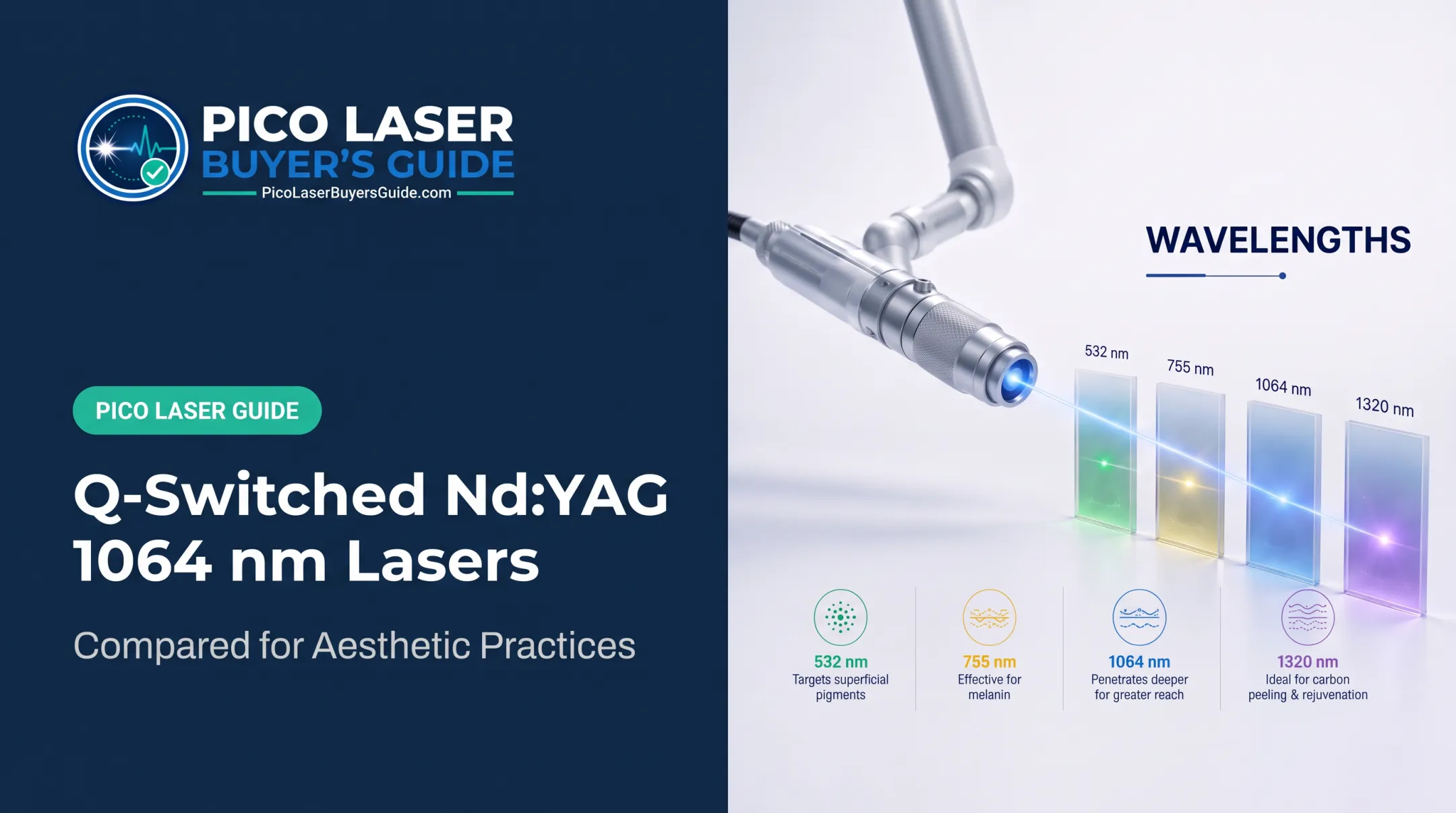
A real-world example: Quantel's Centurion+ uses nonlinear crystals to offer Nd:YAG outputs at 1064, 532, 355 and 266 nm. One source, four wavelengths.
Laser–material interaction
The target absorbs light and may heat, melt, vaporize, ablate, or change at the surface. The result depends on wavelength, fluence, material properties, and pulse overlap.
Nanosecond pulses give heat time to diffuse. That can leave a heat-affected zone, a recast layer, discoloration, or substrate damage. In glass micromachining, a 2025 review describes melting and recast as possible with nanosecond processing.
In tattoo removal, the mechanism is different. Q-switched pulses cause rapid thermal expansion and photoacoustic shock waves that fragment ink.
Peak power versus average power
Peak power is roughly pulse energy divided by pulse duration. For a Gaussian pulse it is about 0.94 × E/τ. Average power is pulse energy times repetition rate.
- 100 mJ in 10 ns gives roughly 9.4 MW peak
- The same 100 mJ at 10 Hz gives only 1 W average
Peak power drives ablation. Average power drives heat load and throughput.

Wavelength and absorption
Absorption varies by material, and it is not the whole story.
- Metals: copper absorbs green better than near-infrared; UV raises absorption in many materials.
- Polymers: 532 and 355 nm extend markability compared with 1064 nm.
- Glass: large bandgaps limit single-photon absorption, so UV is commonly chosen.
- Ceramics: one nanosecond study found higher green absorption did not produce greater removal under its conditions.
- Tattoo inks: dark inks respond to 1064 nm; red and yellow to 532 nm.
Beam delivery and process consistency
Repeatability depends on focusing optics, spot size, beam quality, scanner or handpiece design, pulse overlap, triggering, cooling, and pulse-to-pulse stability. A source datasheet does not describe the performance of the whole system. Ask for data on the full configuration you will actually use.
Applications, Advantages, and Limitations
Medical and aesthetic applications
Nanosecond systems are used for tattoo pigment fragmentation and selected benign pigmented lesions. Verify each device's FDA clearance, intended use, wavelength, and operator requirements.
The FDA record for Lutronic's PICOPLUS (K173700) shows how specific this gets. Its 2 ns modes are cleared for:
| Wavelength | Indication | Skin types |
|---|---|---|
| 1064 nm | Benign pigmented lesions; dark tattoos | I–VI |
| 532 nm | Benign pigmented lesions | I–IV |
| 532 nm | Lighter inks, including red and yellow | I–III |
The same device's 450 ps modes carry separate indications. Clearance for a picosecond platform does not transfer to a nanosecond one, even at the same wavelength.
Use "cleared," not "approved," for 510(k) devices. State rules on who may operate vary; California, for example, limits laser tattoo removal to physicians and supervised RNs or PAs.
Industrial and manufacturing applications
Established uses include marking, engraving, cleaning, coating removal, drilling, micromachining, and welding.
- Coherent's PowerLine F Varia spans 1.5–350 ns for marking
- TRUMPF's TruPulse nano removes insulation from copper hairpins without harming the copper
- Coherent's AVIA LX drills vias in PCB and flex materials at under 25 ns
UV nanosecond systems suit materials that absorb UV readily or need smaller features with less thermal impact, such as small codes on glass.
Scientific and sensing applications
Required parameters vary widely:
- Lidar: NASA's ICESat-2 uses 532 nm, about 1.3 ns pulses at 10 kHz
- LIBS: a few ns, mJ-to-J energies, Hz to hundreds of Hz
- Fluorescence: Centurion+ lists under 14 ns at 1064 nm, 1–100 Hz
- Nonlinear optics: Peacock XT pumps an optical parametric oscillator with under 5 ns pulses for tunable output
Advantages
- Mature, well-integrated technology
- High peak intensity and useful pulse energy
- Flexible wavelength options
- Generally lower cost and complexity than ultrafast systems
RP Photonics identifies nanosecond as the lower-cost ablation option. Confirm throughput and reliability claims against current manufacturer documentation.
Limitations
Poorly matched parameters can cause heat accumulation, larger heat-affected zones, recast, chipping, cracking, and substrate or pigment damage.
Evaluate picosecond or femtosecond systems for heat-sensitive materials, extreme precision, minimal subsurface damage, or selective thin-layer removal. Expect trade-offs in cost, pulse energy, throughput, and complexity.
Nanosecond vs. Picosecond and Femtosecond Lasers
Comparing pulse-duration regimes
A nanosecond is 10^-9 s, a picosecond 10^-12 s, a femtosecond 10^-15 s. Each step is a thousand times shorter. Shorter pulses can limit thermal diffusion, but outcomes also depend on wavelength, fluence, repetition rate, overlap, and material.
Practical trade-offs
| Dimension | Nanosecond | Picosecond/femtosecond |
|---|---|---|
| Thermal effects | Melting and recast possible | Often reduced, not always eliminated |
| Finish | Depends on material and process | A glass review found less thermal damage with fs, yet some rougher ps/fs channels than ns |
| Throughput | Removal rate can limit speed | A Fraunhofer ceramics report found ps gave better quality and higher ablation rate at equal power |
| Cost and complexity | Lower | Substantially higher; mode locking, dispersion control, compression |
Within the nanosecond regime, pulse width itself matters. A silicon study reported ablation threshold rising from 5.63 to 24.84 J/cm² as pulses lengthened from 26 to 500 ns. Those values are specific to that study.
The clinical evidence is equally mixed. In a 2017 randomized trial of 30 black tattoos, 1064 nm ns and ps lasers showed no statistically significant clearance difference after two treatments, though ps was less painful. Less pain is not better clearance.

Application-led decision guidance
- Nanosecond often fits: cost-effective tattoo and pigment work that tolerates some thermal effect, plus marking, cleaning, and bulk removal.
- Test pico or femto for: multicolor or stubborn ink, heat-sensitive skin, and precision cases where collateral damage must stay low.
- Weigh more than pulse length: clearance, pain, session count, and cost per outcome often matter as much as the ns vs. ps label.
No pulse duration is "best" until you define the indication, desired outcome, treatment volume, skin type, and total cost of ownership.
How to Evaluate and Buy a Nanosecond Pulse Laser
Start with the application and acceptance criteria
Document the fundamentals before you shop:
- Target material and desired feature or clinical outcome
- Work envelope, tolerances, and workload
- Acceptable heat-affected zone
Then set measurable acceptance criteria: depth, spot size, contrast, removal completeness, repeatability, surface finish, or post-processing time.
Compare the complete specification
Build a checklist covering:
- Wavelength and pulse-duration range
- Pulse energy, peak and average power
- Repetition rate and beam quality
- Spot-size range and pulse stability
- Triggering, scanner or handpiece options
- Cooling, footprint, electrical needs, software
Some figures vary by mode. PiQo4, for instance, lists up to 2,000 mJ at 1064 nm in nanosecond mode versus 650 mJ in pico mode. Ask for the serial-specific technical schedule, and request test conditions behind any performance claim.
Validate with representative samples
Test the actual material, pigment, coating, or clinical scenario with documented settings. Measure:
- Thermal effects and edge or surface quality
- Consistency and throughput
- Operator workflow, cleanup, and finishing
Review safety, regulatory, and support requirements
Clinical (US): verify the 510(k) documentation, cleared indications, wavelengths, accessories, contraindications, training, and state or facility rules. A general "FDA cleared" label is not enough; check the exact model, handpiece, mode, and indication.
Industrial and lab: confirm laser classification, enclosures and interlocks (21 CFR 1040.10), fume extraction, eyewear, cooling, installation, maintenance, warranty, spare parts, training, and service response. ANSI Z136.1 covers safe-use programs; Z136.3 covers health care settings.
Calculate total cost of ownership
Include every recurring and one-time cost:
- Acquisition, installation, and facility changes
- Cooling, consumables, maintenance, and calibration
- Software, training, downtime, and insurance
- Financing and post-processing
Use supplier quotations and written service terms, not generic price ranges.

Use independent, transparent research
The Pico Laser Buyer's Guide is an independent resource for comparing manufacturer documentation, specifications, FDA clearance information, and pico platforms alongside nanosecond alternatives. It separates "technically possible," "FDA cleared," and "clinically validated," a useful habit for any purchase.
Apply the same filter to every source: manufacturer-backed specifications, peer-reviewed evidence, independent testing, and promotional claims are different things. A before-and-after gallery is not a controlled study.
Conclusion
Nanosecond pulse lasers remain versatile across aesthetic, medical, industrial, and scientific work. Suitability depends on how pulse duration interacts with wavelength, energy, target material, workflow, and acceptance criteria.
Before you choose:
- Compare complete specifications
- Verify regulatory and safety documentation
- Test representative samples
- Calculate total cost of ownership
Frequently Asked Questions
What is laser ablation used for?
Controlled material removal: marking, micromachining, coating removal, tattoo-pigment fragmentation, and analytical sampling. The right laser depends on the target and intended use.
How does a femtosecond laser work?
An ultrashort pulse delivers very high peak intensity and confines energy before much heat spreads into surrounding material. Results still depend on wavelength and settings.
What is 1 nanosecond equal to?
One nanosecond is 10^-9 seconds, a billionth of a second. A picosecond is a thousand times shorter, and a femtosecond a million times shorter.
Are nanosecond lasers suitable for tattoo removal?
Some are. Suitability depends on wavelength, pulse energy, FDA clearance, ink colors, skin type, protocol, and a qualified operator.
What specifications should you compare when buying a nanosecond laser?
Pulse duration, wavelength, pulse energy, repetition rate, beam quality, spot size, stability, and cooling. Add safety documentation, support terms, and total cost of ownership.