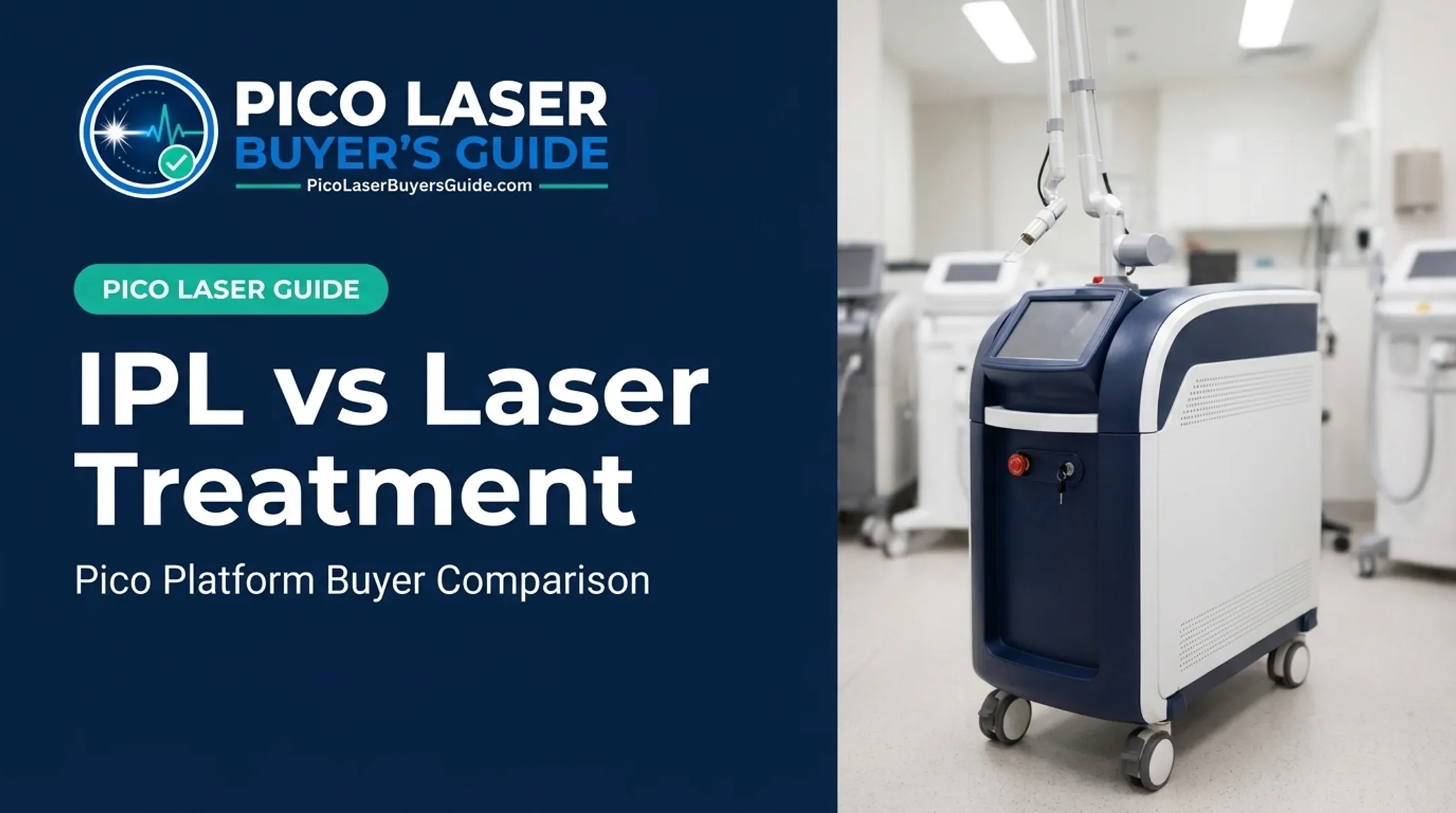

For a US practice, the choice affects which indications you can legally market, which patients you can treat safely, how much downtime you must explain, and how long capital takes to pay back. This article compares mechanisms, indications, skin-type risk, downtime, ownership economics, and two clinical studies. It does not name a universal winner, because the evidence doesn't support one.
Key Takeaways
- IPL uses filtered broad-spectrum light for pigment and vessels; pico lasers use picosecond pulses for targeted pigment work.
- Indication, skin type, FDA clearance, and patient volume should drive the choice.
- Wavelength, pulse duration, spot size, handpieces, and cooling matter more than the technology label.
- Weigh total cost of ownership and evidence quality against sticker price.
Pico Laser vs IPL: Quick Comparison
Energy Delivery and Mechanism
A picosecond laser emits pulses on the 10^-12-second scale. The short pulse produces a mainly photomechanical effect that fragments pigment or ink with limited surrounding heat. One cited PicoWay configuration lists 240-500 ps pulses at 532, 730, 785, and 1064 nm.
IPL is not a laser. It is noncoherent flashlamp light, and filters shape the spectrum. The Stellar M22 IPL, for example, specifies 400-1200 nm. Its effect relies on selective photothermolysis: melanin and oxyhemoglobin absorb the light and heat up.
Side-by-Side Snapshot
| Factor | Pico Laser | IPL |
|---|---|---|
| Source | Laser, single wavelength per mode | Broadband filtered light |
| Main effect | Photomechanical, some photothermal | Photothermal |
| Typical cleared scope | Tattoo, benign pigment, some scars and wrinkles | Benign pigment, vascular lesions, hair reduction (device-specific) |
| Vascular capability | Not a universal pico indication | Common |
| Tattoo removal | Core use | Not a use case |
Skin Type and Safety
Neither technology is universally safer. A 2023 melasma trial of 60 patients (Fitzpatrick III-IV) reported PIH in 1 of 20 patients in each pico arm. That cohort says little about types V-VI.
For IPL, epidermal melanin competes for absorption, so darker or tanned skin carries greater thermal-injury risk. A 2017 review also documents PIH and recurrent pigmentation after IPL in melasma.
Downtime and Comfort
Published courses vary by indication:
- Pico, melasma: 3 sessions at 4-week intervals; median erythema 1.3 hours (1064 nm) and 2.0 hours (755 nm)
- Pico, tattoos: up to 8 treatments at 4-week intervals
- IPL, lentigines: immediate darkening, then microcrusting that desquamated in 3-14 days
- IPL, rosacea telangiectasia: redness to blisters subsiding within a week
Visible darkening can outlast the burning and redness, so "no downtime" claims for IPL omit documented recovery.
Financial and Operational Factors
Pico and IPL do not share one verified, comparable price range. Compare these items in written quotes:
- Purchase or lease price and financing terms
- Warranty length and service contract scope
- Handpieces, filters, lightguides, and consumables
- Training, room, and electrical requirements
Price spreads inside pico alone are wide. The Pico Laser Buyer's Guide estimates the Aesthetika PicoTech at about $60,000 with a two-year warranty, and the Cynosure PicoSure Pro at about $150,000-$220,000 with a one-year warranty. Market-level revenue figures are not a substitute for practice-level ROI.

Understanding Pico Laser and IPL Treatments
Pico Laser
A picosecond (pico) laser platform emits pulses measured in trillionths of a second. The brief pulse limits heat diffusion into adjacent tissue while shattering pigment granules, which are typically 10-100 nm.
Benefits for a practice:
- Targeted pigment treatment
- Tattoo-removal capability
- Multiple wavelengths on many platforms
- Fractional handpieces on some systems for acne scars and wrinkles
Limitations:
- FDA clearance attaches to the exact model, wavelength, handpiece, and indication. "FDA cleared" at platform level is not enough.
- Not every pico covers every indication. The PICOHI 300's clearance (K201773) covers tattoo removal and benign pigmentation; scar revision and skin rejuvenation are not cleared.
- Post-inflammatory hyperpigmentation (PIH) remains possible, particularly with 532 nm in darker skin.
Best-fit use cases: tattoo removal, benign pigmented lesions, melasma (where cleared), and fractional scar or wrinkle work on platforms that include it.
IPL
Intense pulsed light (IPL) uses filters and adjustable settings to direct broadband light at melanin or hemoglobin. "IPL photofacial" usually names a treatment protocol performed with an IPL device, not a separate technology.
Benefits for a practice:
- Pigment and vascular concerns treated with one platform
- Versatility through interchangeable filters
- Contact cooling to protect the epidermis
Limitations:
- Darker skin, tanning, and melasma require careful screening
- Indications vary by filter and applicator. In FDA file K250809, the Stellar M22's wrinkle indication belongs to a separate laser module, not the IPL handpiece.
Best-fit use cases: photofacials, redness reduction, superficial pigment, and broader rejuvenation menus.
Pico Laser vs IPL: What Is Better?
Start with the clinical objective, not the technology.
- Define your service menu. Tattoo removal and deeper pigment point to pico. Redness, vascular lesions, and general photorejuvenation point to IPL.
- Screen your patient mix. Skin type, tanning history, melasma, and prior PIH shape risk. Selection should follow an in-person assessment, not a generic "best" label.
- Check the clearance. Match each cleared indication to the exact configuration you plan to buy.
- Compare outcomes and downtime. Use indication-specific evidence, not blanket session counts.
- Test operational fit. Look at price, financing, warranty, service response, training, and room turnover.

Situational guidance:
- Choose IPL when pigment-and-vascular versatility matters and your patients suit a heat-based mechanism.
- Consider pico when tattoo removal or specific pigment indications are central and the chosen platform's clearance supports them.
Real-World Evidence
Pico vs IPL for rejuvenation (2026). In a randomized trial, 38 Asian women aged 30-60 received three treatments with either fractional 1064-nm pico or IPL. Pico performed better for periorbital fine lines (p=0.0315) and T-zone pores (p=0.0473).
Pigmented spots and several other measures improved in both groups without a between-group difference. Transient erythema was the most common response.
The study was single-center and limited to one population, and downtime was not quantified. It suggests pico's edge lies in texture and fine lines, while pigment results were comparable.
Pico vs nanosecond for tattoos (2022). A split study of 23 subjects with 30 tattoos found numerically better clearance with pico, though not statistically significant. Pico was significantly less painful (p<0.001). Hyperpigmentation occurred with both systems.

Takeaway: A practice built around fine-line and texture work may justify fractional pico, while a pigment-only photofacial menu may not.
Before comparing specific platforms, use the Pico Laser Buyer's Guide's manufacturer-backed specifications and source documentation to check clearances and ownership costs.
Conclusion
Pico Laser and IPL solve overlapping but different problems. The right choice depends on indications, patient characteristics, platform specifications, evidence, budget, and workflow. Neither is universally safer, faster, cheaper, or more profitable.
Verify FDA clearance for the exact device, get qualified clinical guidance, and compare total cost of ownership over several years. Judge the specific platform in front of you, not the label on the technology.
Frequently Asked Questions
How many IPL sessions are needed?
It depends on the indication, skin type, settings, and baseline severity. Published photorejuvenation studies used three to four treatments, but those are study benchmarks, not guarantees.
What are the key differences between IPL lasers and IPL photofacials?
IPL is not technically a laser. "IPL photofacial" usually names a treatment protocol performed with IPL, where filters, targets, and clinical goals define the treatment.
Is pico laser beneficial?
For cleared indications such as tattoos, benign pigment, and some scars or wrinkles, it can be. Outcomes depend on the device, diagnosis, parameters, clinician, and patient.
Can I use IPL during pregnancy?
Postpone elective IPL unless a qualified healthcare professional advises otherwise. A 2022 review recommends avoiding cosmetic lasers until after delivery, and Sciton lists pregnancy as a BBL exclusion.
Which is better for darker skin tones, Pico Laser or IPL?
Neither is automatically appropriate. Wavelength, pulse settings, diagnosis, clinician experience, and PIH risk all matter, so professional assessment is essential.
Can Pico Laser and IPL treat the same skin concerns?
They overlap on some pigmentation and rejuvenation goals. They differ in energy delivery, vascular capability, tattoo suitability, device clearances, and skin-safety considerations.