Two listings with the same brand name can differ in model generation, installed wavelengths, included handpieces, condition, service history and seller support. Brand alone tells you very little.
This guide explains the technology, the specifications that matter for tattoo removal, new versus pre-owned buying, ownership costs, and a due-diligence checklist for US buyers.
Key Takeaways
- Picosecond pulses and multiple wavelengths matter most for clinics treating varied ink colors.
- Verify the exact configuration, accessories, records and service support before you pay.
- Purchase price is one piece of cost; training, maintenance, warranty and downtime count too.
- Operator skill and realistic expectations shape outcomes as much as the device.
What Is the Candela PicoWay Platform?
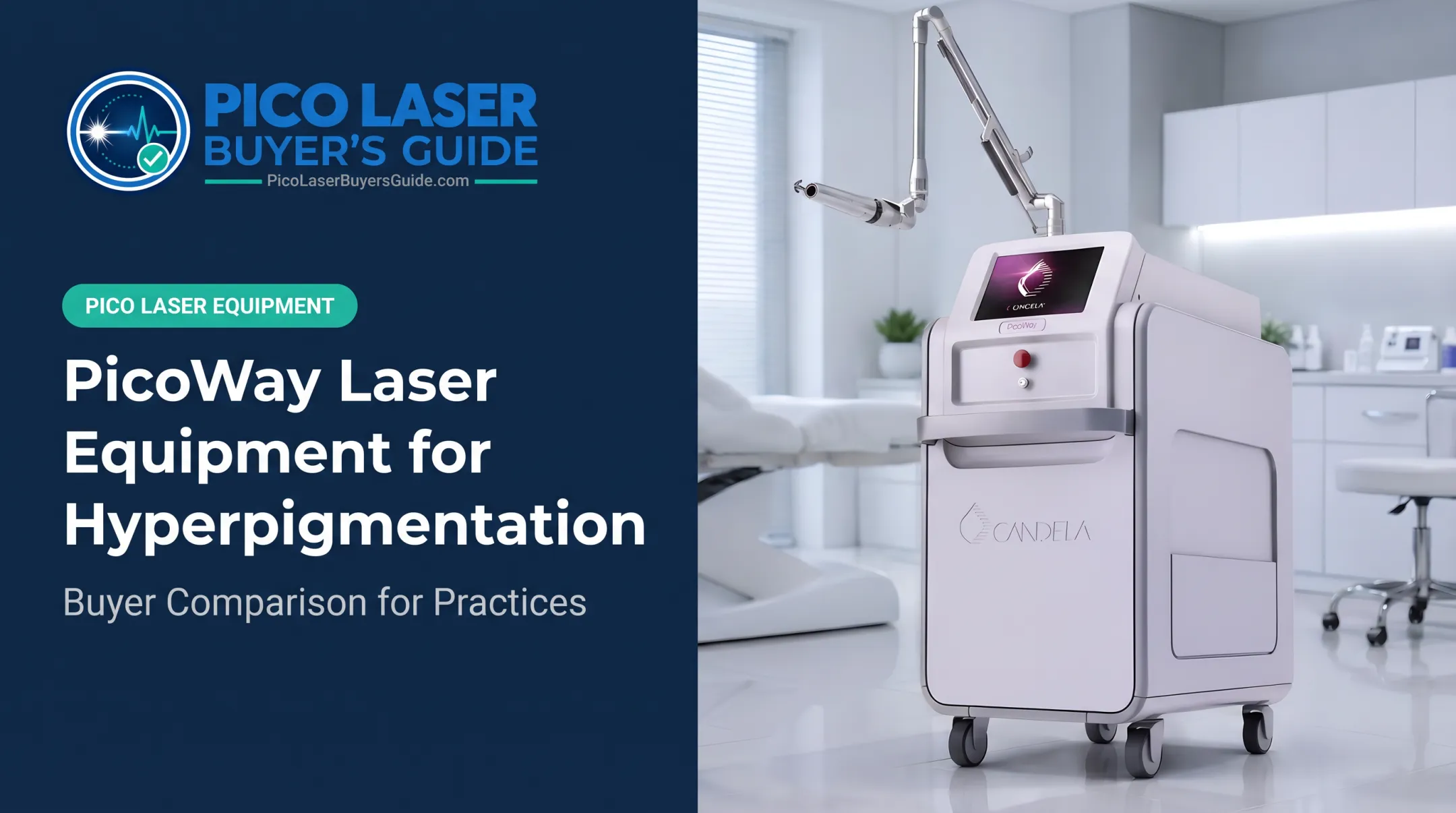
PicoWay is Candela's multi-wavelength picosecond Nd:YAG platform for tattoo removal, benign pigmented lesions, and fractional skin treatments.
A picosecond laser fires extremely short pulses that fragment tattoo pigment into small particles. The body then clears those fragments over time through phagocytosis and lymphatic drainage, as described in a clinical review of laser tattoo removal.
Picosecond versus nanosecond
Older Q-switched nanosecond lasers also work through photoacoustic effects, so the difference is not simply "heat versus no heat." Picosecond pulses tend to increase photomechanical fragmentation. That is the rationale, not a guarantee of fewer sessions.
Why wavelengths matter
Different pigments absorb different wavelengths. Under the 2022 FDA clearance (K220853), the tattoo indications are:
| Wavelength | Tattoo colors | Fitzpatrick types |
|---|---|---|
| 532 nm | Red, yellow, orange | I-III |
| 730 nm | Green, blue | II-IV |
| 785 nm | Green, blue | II-IV |
| 1064 nm | Black, brown, green, blue, purple | All types |
Color coverage and skin type need to be evaluated together. Other indications, including benign pigmented lesions, acne scars, and wrinkles, are handpiece-specific. Confirm them against current Candela and FDA documents for the exact configuration.
Advantages and limits
Published clearance rates look strong in the right setting, but they are study-specific. A 2015 prototype study reported 79% mean clearance after 6.5 treatments, with six tattoos showing mild pigment changes. A 730 nm study found clearance of 70% to 83% for black, green, and blue/purple, but only 26% for red and 8% for yellow. Neither study supports complete-clearance or fixed-session promises.

Buyers comparing several picosecond systems can use the Pico Laser Buyer's Guide as an independent resource. It lines up manufacturer-backed specifications and FDA-clearance information across platforms before you request quotes.
PicoWay Specifications and Configurations for Tattoo Removal
Start with the exact listing: model, generation, serial number, manufacture date and installed configuration. Reseller descriptions often skip these.
Standard versus optional hardware
PicoWay supports four wavelengths (532, 730, 785 and 1064 nm), but that is platform capability, not proof that a given unit has all four.
- Standard: the Zoom 532/1064 nm applicator, full beam, 2-10 mm spots
- Optional: 730 nm and 785 nm applicators (2, 3 and 4 mm spots)
- Optional fractional: Resolve (6 x 6 mm) and Resolve Fusion 532 nm
Candela's eBook lists maximum energy of 400 mJ at 1064 nm and 200 mJ at 532 nm, with 730 and 785 nm at 100 mJ. Pulse durations range from 250 to 450 ps. Treat these as reference values and confirm them for your unit in official technical documents.
Two PicoWay listings may not offer the same color coverage if wavelengths, handpieces, software or accessories are missing.
Which buyer needs what
- Dedicated tattoo clinic: high multicolor volume makes the 730/785 nm applicators worth the investment.
- New med spa: the Zoom 532/1064 nm handpiece covers core work, and fractional options add cosmetic services.
- Dermatology or plastic surgery practice: Resolve handpieces support acne-scar and wrinkle indications alongside tattoos.
Daily workflow specs
- Weight: 275 lb (125 kg); dimensions 42 x 18 x 27 inches
- Power: 200-240 VAC, 50/60 Hz, 30 A, so plan a dedicated circuit
- Cooling, HVAC and clearance requirements: request the installation guide from the seller or Candela before you commit floor space
- Maintenance: Candela service visits cover alignment, calibration, software and fluids; confirm the recommended interval with Candela or your service provider
How to Evaluate a PicoWay Laser for Sale
Know the purchase pathways
- New, authorized channel: Candela advertises a one-year warranty on new devices.
- Manufacturer certified pre-owned: Candela's used laser buyer's guide describes inspection, refurbishment and testing, but does not confirm current PicoWay inventory.
- Third-party refurbished or as-is: warranty and support depend entirely on the seller. New-device terms do not carry over.
"Refurbished," CPO, FDA clearance and manufacturer warranty are four separate claims. Ask which one the seller actually means.
Verify the seller
- Confirm business identity and ownership history
- Check the serial number and reason for sale
- Confirm title and lien status
- Ask where the unit is located
- Request an inspection or live demonstration
Request technical records
- Service and repair history and preventive-maintenance records
- Calibration reports and error logs
- Software version and shot count, where available
- Replaced components and storage conditions
Inspect the unit
Check the console, cooling system, delivery arm, handpieces, optics, foot pedal, cables, screen and emergency stop. Look for impact damage, fluid leaks, overheating marks or unauthorized modification.

Lock it in writing
Every wavelength, handpiece and accessory belongs on the quote or purchase agreement. Negotiate or verify:
- Warranty length and exclusions
- Inspection or return period
- Installation, shipping insurance and delivery responsibility
- Operator training and technical support
- Replacement-part availability and service response times
FDA also distinguishes servicing from remanufacturing, and it judges the activity, not the seller's label. Ask what work was actually done.
Pricing and Total Cost of Ownership
New PicoWay planning estimates run about $250,000 to $325,000 for a well-configured system. Options, applicators, training and the commercial package all move the number.
Pre-owned pricing is quote-only and depends on shot count, condition, included handpieces and seller. Get current written quotations rather than relying on any published figure.
Keep two prices separate: what you pay for the device, and what patients pay per session. Device cost drives the capital decision; session fees drive revenue modeling.
Total-cost framework
Total ownership includes:
- Purchase or financing payments
- Shipping, installation and facility preparation (including electrical work)
- Training
- Maintenance and service contracts, which can be significant after warranty
- Consumables, insurance and compliance costs
- Marketing and downtime
Candela notes that not every service plan is available for every device.
Testing the business case
Use your own treatment volume, realistic session pricing, staffing, local competition and financing terms. The Pico Laser Buyer's Guide calculator illustrates the method. At a 6.5% interest assumption, it shows a $262,000 five-year ownership estimate and about 13 monthly treatments to cover annual ownership cost. That figure is illustrative, not a projection.

Build break-even models on conservative volume, not optimistic vendor projections.
US Compliance, Training, and Risk Considerations
FDA clearance
Verify the 510(k) documentation for the specific device and intended use. K220853 grants marketing permission through substantial equivalence. It is not "FDA approval" and does not guarantee clinical outcomes.
State rules differ
Buying a laser does not authorize your staff to operate it. Examples from official sources:
- California: physicians may perform laser tattoo removal; PAs and RNs only under physician supervision. Estheticians and medical assistants may not.
- New York: a 2025 NYSED determination treats tattoo removal as the practice of medicine.
- Florida: laser registration does not authorize human treatment.
- Texas: cosmetology or esthetician licensure does not confer laser authority.
Confirm requirements with your state authorities and a qualified compliance professional.
Training and safety
- Documented manufacturer or qualified-provider training
- Wavelength-specific eye protection for patients and staff
- Room controls and a laser safety program
- Informed consent covering risks and alternatives
- Treatment records and emergency procedures
- Protocols for pigmentary or other adverse reactions
ASLMS guidelines cover education, consent and emergency planning in more detail. Device training does not replace state practice authority.
Final Buying Guidance
Buy only after you:
- Match the exact configuration to your intended tattoo colors and services
- Confirm documentation, condition and written inclusions
- Calculate total ownership cost
- Confirm who may legally operate the laser in your state
Then compare PicoWay against other picosecond and Q-switched systems on verified specifications, service support, regulatory documentation and operator fit. Brand reputation should not decide it.
Frequently Asked Questions
How much does a PicoWay laser treatment typically cost?
No authoritative per-session benchmark exists, and patient fees vary by tattoo size, ink and session count. That is separate from device cost, which depends on configuration, condition and seller.
What is the best laser for tattoo removal?
It depends on ink colors, skin type, tattoo depth, configuration and operator expertise. PicoWay is one option to compare, not an automatic winner.
What is PicoWay laser good for?
Cleared uses include tattoo removal, benign pigmented lesions, acne scars and wrinkles. Indications vary by wavelength, handpiece and skin type, so check the labeling for your configuration.
Does Pico laser remove eyebrow tattoos?
Sometimes, after qualified assessment. Cosmetic pigments containing iron oxide or titanium dioxide can darken unpredictably, so start conservatively with clinical oversight.
What should I check before buying a used PicoWay laser?
Confirm the exact model, wavelengths, serial number, service records, calibration, handpieces and error history. Also get warranty terms in writing, test the unit live, and verify state compliance.
How do I compare PicoWay with other picosecond tattoo-removal lasers?
Compare verified wavelength coverage, pulse and spot-size specifications, clinical indications, service network, training, regulatory documentation and total cost of ownership.