
This guide is written for US med spas, tattoo-removal clinics, and dermatology and plastic surgery practices evaluating equipment. It is not treatment advice. It covers how Alexandrite lasers work, which pigments and skin types they suit, how they compare with Nd:YAG and Ruby, and which specs and documents to verify before you buy.
Key Takeaways
- A 755 nm laser fits black, blue, and green ink; warm colors usually need another wavelength.
- Q-switched and picosecond Alexandrite use different pulse technology, so don't compare them on marketing alone.
- The right machine depends on tattoo mix, skin-tone range, volume, training, service, and total cost.
- Verify FDA 510(k) clearance, specs, evidence, warranty, and service terms in writing.
What Is an Alexandrite Tattoo Removal Laser?
What the 755 nm wavelength means
Alexandrite is the solid-state laser medium. The FDA's clearance records describe an Alexandrite rod. 755 nm is the output wavelength.
Neither term tells you pulse duration, fluence (energy per unit area, in J/cm²), spot size, or repetition rate. Those are separate specifications.
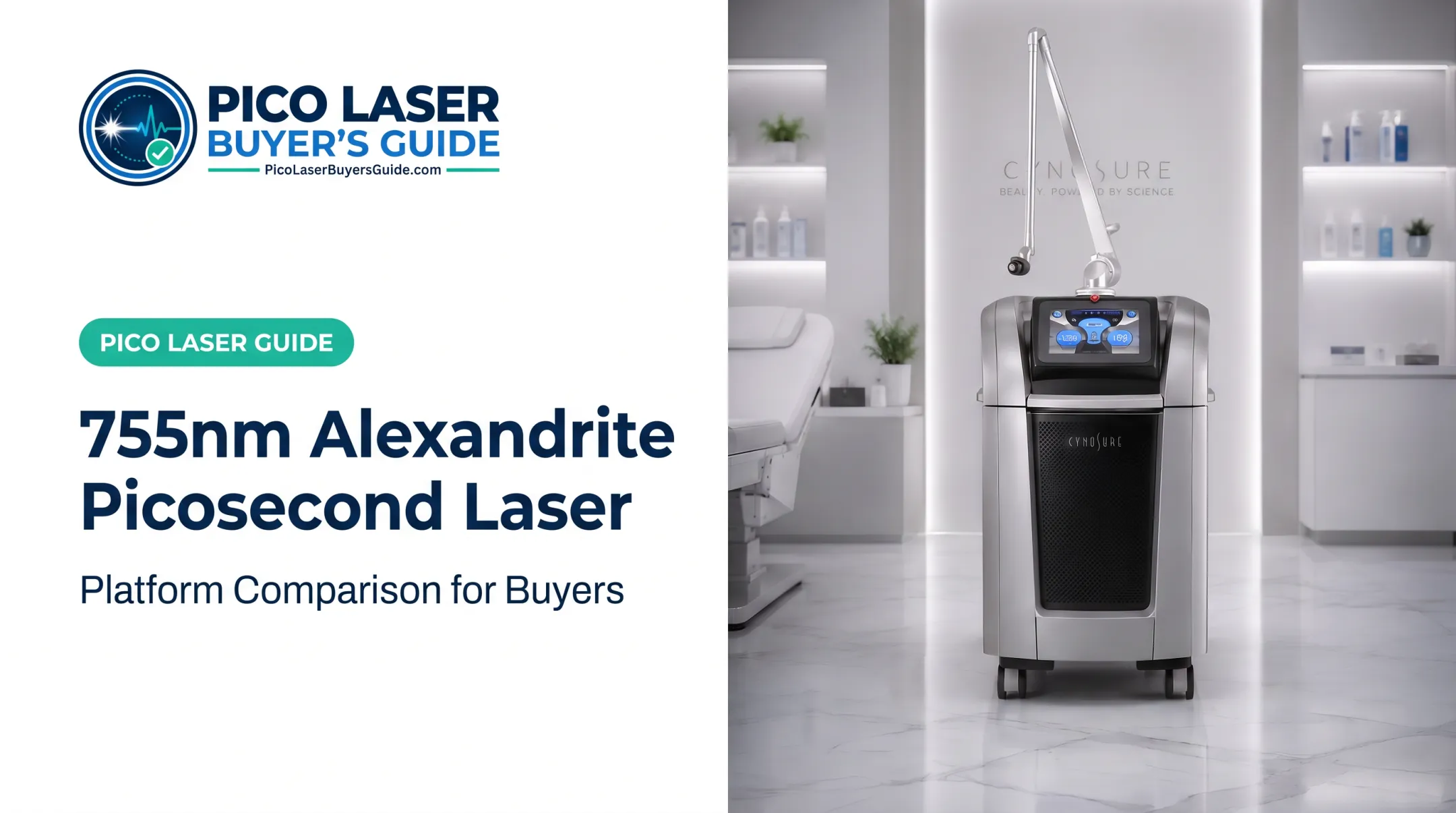
Wavelength matters because tattoo pigments absorb light differently. Cynosure's PicoSure Pro page lists 755 nm for black, blue, and green ink, and offers 532 nm for red, yellow, and orange. It is not an all-color solution.
Q-switched versus picosecond Alexandrite
Conventional Q-switched systems deliver nanosecond pulses (10^-9 seconds). Picosecond systems deliver 10^-12-second pulses. Shorter pulses can change how pigment fragments, but that does not promise faster clearance.
When comparing platforms, ask each vendor for:
- Pulse duration and pulse energy
- Spot-size range and repetition rate
- Beam profile and handpiece options
- Cooling method
A reference point from PicoSure Pro's published specs:
- Pulse duration: roughly 500-750 ps
- Pulse energy: 300 mJ ±20%
- Maximum fluence: 6.37 J/cm²
- Spot size: 2-6 mm zoom
- Repetition rate: up to 10 Hz
Cooling, aiming beam, and treatment-area details aren't published, so request them from the vendor.
A "picosecond" label is not evidence. Ask for device-specific clinical data collected under comparable conditions.

Alexandrite's place in a broader platform
A 755 nm device is often one piece of a multiwavelength strategy. Confirm exactly what's in your quote.
A dedicated Alexandrite platform differs from a system with a 755 nm module or handpiece. PicoSure Pro includes 755 nm as standard, while 532 nm and 1064 nm systems are optional and priced separately.
Watch for look-alikes, too. FDA records show PicoWay's treatment outputs are 532, 730, 785, and 1064 nm. An internal Alexandrite pump is not a 755 nm treatment output.
How Alexandrite Lasers Work and Which Tattoos They Target
Selective photothermolysis in plain terms
Short, intense pulses are absorbed by pigment particles. Rapid heating and photoacoustic effects fragment the ink while limiting heat to surrounding tissue. Over the following weeks, phagocytosis and lymphatic drainage carry the fragments away, according to a clinical update in PMC.
Two points often confuse new buyers:
- Transient whitening comes from gas formation after rapid heating. It is not ink clearance.
- Fading is delayed. Results appear over weeks, not minutes.
Wavelength, pulse duration, fluence, spot size, and pulse overlap all shape the outcome. Specific settings belong to qualified clinicians and are outside this guide.
Colors most relevant to 755 nm
| Wavelength | Typically associated ink colors | Caveat |
|---|---|---|
| 755 nm | Black, blue, green | Not an all-color solution |
| 1064 nm | Black, dark blue | Low epidermal melanin absorption |
| 532 nm | Red, orange, yellow | Yellow remains difficult |
| 694 nm | Black/blue, green | Older evidence links it to more pigment loss |
Response still varies with ink chemistry, depth, density, and age. Light, white, cosmetic, and mixed pigments are the least predictable.
A 1993 case series documented immediate darkening of cosmetic white, flesh-colored, and pink-red tattoos. Iron oxide or titanium dioxide inks may also darken. That evidence is foundational, not a 755-specific rate. Test spots and counseling are standard precautions.
Multicolor tattoos and workflow
Multicolor work often requires multiple wavelengths or handpieces. Check whether a system's included configuration matches your expected tattoo mix or whether you'll need add-ons.
A hypothetical workflow, not a clinical protocol: a clinician might use 755 nm on blue and green sections, 532 nm on red and orange, and 1064 nm on dense black. Each switch means a different handpiece or module.

Factors that influence outcomes
Several variables affect response:
- Tattoo size, location, and ink density
- Professional versus amateur application (professional tattoos usually need more sessions)
- Layering, scarring, and tattoo age
- Smoking and time between sessions
Take the evidence in context. A Bencini 2012 cohort of 352 analyzed patients at a Milan referral center used Q-switched lasers, not modern picosecond devices. Clearance reached 47.2% after 10 sessions and 74.8% after 15.
Reduced response was associated with smoking, areas over 30 cm², foot or leg location, dense ink, colors other than black or red, and older tattoos. The study was observational and single-investigator, so don't generalize it to every device.
Compare treatment counts, clearance, and adverse events only across similar patients and protocols.
Alexandrite Compared With Other Tattoo-Removal Laser Platforms
Alexandrite versus Nd:YAG
The 1064 nm Nd:YAG reaches deeper and has minimal epidermal melanin absorption, so it's the usual consideration for darker skin. The 532 nm line handles red, orange, and yellow but is shallow and melanin-absorbed. FDA labeling for the enlighten system lists 1064 nm for Fitzpatrick I-VI and 532 nm for I-III.
Skin-type claims still need checking against current literature and the exact device's cleared indications. Test spots and trained operators remain essential.
Alexandrite versus Ruby
Ruby (694 nm) targets similar blue-black and green pigments. A 1999 comparison of 42 blue-black tattoos found Ruby gave the highest clearance but also the highest long-lasting hypopigmentation, while Nd:YAG reported none.
That study used older devices. Don't treat it as a current ranking, and don't call any wavelength categorically safer or better.
Ruby availability is limited. Discovery Pico's 694 nm option is on the Plus configuration only.
Q-switched versus picosecond platforms
Pulse duration alone does not predict clinical effectiveness. The evidence is mixed:
- A 2026 split-tattoo trial of 755 nm (n=30) found 73.3% satisfactory clearance with picosecond vs 23.3% with nanosecond, plus higher hyperpigmentation (21.3% vs 12%); small study, mixed tattoos.
- A 1064 nm comparison (21 patients) found no significant clearance difference and less pain with picosecond.
- Systematic reviews describe picosecond superiority evidence as sparse and heterogeneous.
Separate peer-reviewed outcomes from manufacturer claims about fewer sessions, faster clearance, or less downtime.

Single versus multiwavelength systems
A single 755 nm platform is simpler. A multiwavelength system covers more ink colors. The American Academy of Dermatology notes that one laser cannot remove all colors.
Trade-offs to weigh:
- Purchase price and room footprint
- Handpiece changes and staff training
- Service complexity and throughput
- Room to expand services later
Decision rule: choose from your actual tattoo mix and business model, not the newest pulse duration or highest headline power.
How to Evaluate an Alexandrite System for a US Practice
Specifications to verify
Get the official spec sheet and operator manual. Record what's standard, optional, or handpiece-dependent. Check:
- Wavelength, pulse duration, pulse energy, fluence range
- Spot sizes and repetition rate
- Beam delivery, aiming beam, cooling
- Handpiece ergonomics and treatment area
- Electrical requirements (PicoSure Pro is commonly 200-240 V; confirm circuit and site needs)
Maximum energy alone predicts little. Ask about usable operating ranges, consistency, ease of adjustment, and fit for your typical tattoo size. Even a 9.55 J/cm² theoretical fluence at 2 mm needs verification at full nominal energy, and headroom is not clinical superiority.
Regulatory and evidence review
FDA clearance is not a superiority finding. Verify the 510(k) number, manufacturer, intended use, and any limits on tattoo removal. For example, the PicoSure Workstation record (K261570) lists 755 nm for tattoo removal. Match the record to the exact configuration you're quoted.
Then check evidence for that platform or a truly comparable wavelength and pulse configuration. Also request:
- Training and credentialing expectations
- Contraindications and eye-protection requirements
- Maintenance schedules and manufacturer safety procedures
Operator authority is a separate check. California limits these treatments to physicians and to RNs and PAs under physician supervision. Texas treats cosmetic device procedures as medicine, with delegation and onsite coverage rules. Confirm your own state's rules.
Ownership, support, and total cost
Price is only the start. Factor in the full stack:
- Installation, shipping, and room preparation
- Service contracts, maintenance, and parts
- Training and financing
- Planned downtime
Benchmarks, with caveats:
- Pico Laser Buyer's Guide planning range for new PicoSure Pro direct from the manufacturer: $225,000-$300,000
- One used PicoSure listing: $59,950 (a single asking price, not a market range)
- Cynosure's generic warranty terms: the shorter of 12 months from installation or 15 months from receipt, not PicoSure-specific
Ask vendors about:
- Warranty length and response-time commitments
- Loaner and repair policies
- Regional service coverage
- References from comparable practices
Then model utilization. Estimate monthly treatments, price per session, consumables, staffing, and time to break-even.
One illustrative example uses $3,000 monthly ownership cost with a $375 contribution margin per treatment. That requires 8 treatments per month to cover ownership. Your numbers will differ.

US provider pricing ranges widely. Removery lists $221 to $743 by size, though that's one provider's pricing.
Using the Pico Laser Buyer's Guide
The Pico Laser Buyer's Guide maintains a research library covering 16 pico laser platforms, with manufacturer-backed technical documentation. Use it to organize side-by-side comparisons of wavelengths, pulse duration, fluence, service, and cost.
It supports diligence but doesn't replace independent clinical review, FDA verification, vendor demonstrations, or professional advice.
Safety, Patient Selection, and Operational Considerations
Skin tone and pigmentary risk
Melanin absorption, skin type, tanning, location, and ink composition all affect risk. Hypo- and hyperpigmentation are the main concerns. In a small 755 nm picosecond study (15 enrolled, 12 completed; Fitzpatrick I-V, mostly II-III), hypopigmentation appeared in 20% and hyperpigmentation in 13% at three months. That study was partly manufacturer-funded and uncontrolled.

Key precautions:
- Test spots, especially for darker skin and cosmetic tattoos
- Conservative planning and sun-exposure management
- Eyewear matched to the actual treatment wavelengths
- Qualified operator oversight
Clinical review favors 1064 nm for darker skin. That doesn't establish 755 nm safety in types V-VI.
Expected effects and patient communication
Expected reactions include redness, swelling, whitening, blistering, crusting, and tenderness. Temporary pigment changes occur. Burns, scarring, and texture changes need medical assessment, especially with undertrained operators.
Adverse-event rates can't be compared cleanly across devices, skin types, settings, and follow-up lengths. And the FDA states that complete removal may take many treatments and may not be possible. Patients need realistic expectations about intervals, residual pigment, scarring, and incomplete response.
Operational readiness
Owning the machine is the easy part. A safe service line also needs:
- Trained operators and documented protocols
- Wavelength-appropriate eyewear and a controlled treatment area
- Maintenance records
- A plan for managing adverse events
OSHA requires wavelength-marked eyewear and documented laser safety training, and ANSI Z136.3-2024 is the health-care laser safety standard. Evaluate vendor training, continuing education, and clinical support. A device comparison is only one part of the job; governance, assessment, documentation, and follow-up matter just as much.
Frequently Asked Questions
What is the best machine for tattoo removal?
No universal winner exists. The best choice depends on tattoo colors, patient skin types, wavelength coverage, evidence, operator expertise, service support, and total cost.
Is an Alexandrite laser good for tattoo removal?
It can be, for selected black, blue, and green pigments. Suitability depends on the tattoo, the patient, the device configuration, and whether other wavelengths are available.
What colors can a 755 nm Alexandrite laser remove?
755 nm is associated with black, blue, and green. Ink chemistry varies, and warm or light colors may need 532 nm or another strategy.
What is the difference between Q-switched and picosecond Alexandrite lasers?
Q-switched systems pulse in nanoseconds; picosecond systems pulse far shorter. Shorter pulses fragment pigment differently but don't automatically mean fewer sessions or better outcomes.
Can Alexandrite lasers be used on darker skin types?
It requires careful evaluation of melanin absorption, parameters, test spots, and operator skill. 1064 nm is generally favored, and buyers should verify current clinical and regulatory guidance.
What should a clinic check before buying an Alexandrite tattoo-removal laser?
Verify FDA 510(k) documents, specifications, clinical evidence, wavelength coverage, training, warranty, service response, maintenance, and total cost of ownership in writing.