
This guide is for US med spas, tattoo-removal clinics, dermatology and plastic surgery practices, and other professional buyers comparing picosecond systems with Q-switched alternatives. We evaluate pulse duration, wavelength coverage, skin-type indications, FDA 510(k) clearances, evidence quality, ownership cost, service, and training.
One caution up front. A 2018 randomized study and a 2017 same-wavelength trial reached different conclusions on picosecond superiority, so no benchmark settles the question for you.
Key Takeaways
- Picosecond platforms suit many modern practices, but wavelength needs, patient mix, volume, and budget decide the fit.
- Q-switched systems remain a valid benchmark for some colors and lower-cost strategies.
- Verify specifications against FDA documentation, not marketing claims.
- Ownership cost reaches well beyond the purchase price.
- No laser guarantees complete clearance.
Overview of Tattoo Removal Lasers in the US Aesthetic Market
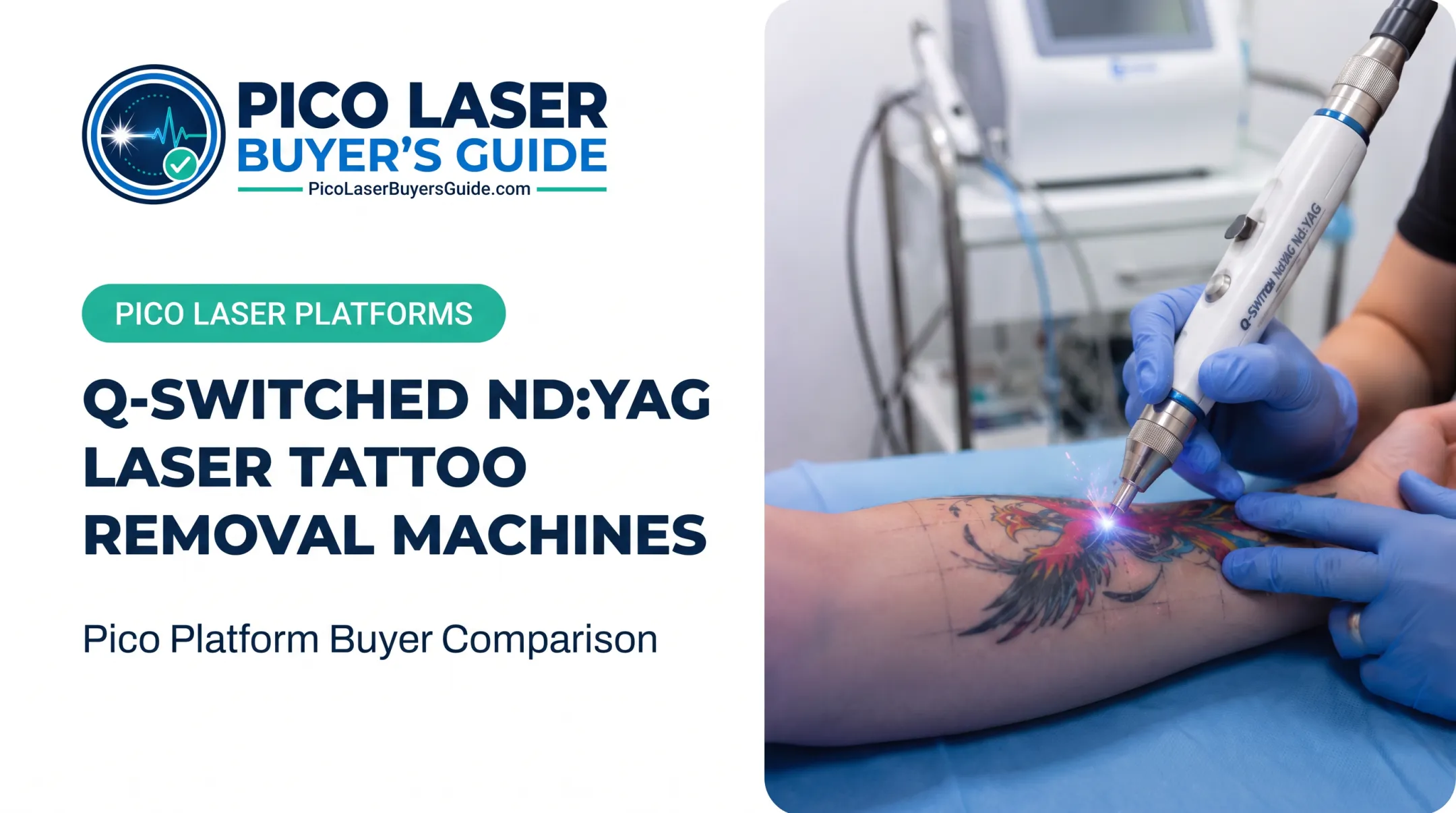
Tattoo lasers deliver very short, high-energy pulses that fragment ink. The body then clears the fragments over time. The FDA notes that complete removal is sometimes not possible, so results depend on the tattoo and patient as much as the device.
Q-switched and picosecond technology
Nanosecond and picosecond describe pulse duration, not wavelength. Q-switched systems pulse in the nanosecond range (the Hollywood Spectra benchmark delivers 5-10 ns). Picosecond systems pulse in the hundreds of picoseconds.
Wavelength decides which inks respond:
- 1064 nm: black, brown, and other dark inks
- 532 nm: red, orange, yellow
- 694 nm ruby: black, blue, green, violet
- 755 nm alexandrite: black, blue, green
- 670, 730, 785 nm: specialty green and blue targeting
A multi-wavelength platform handles multicolor work better than a single-wavelength unit. Shorter pulses do not automatically mean better outcomes.

What drives clinical and commercial relevance
- FDA 510(k) clearance for the exact configuration and wavelength
- Pulse-duration options, spot sizes, and handpieces
- Serviceability and training
- Fitzpatrick skin-type indications, which vary by wavelength
A 510(k) shows substantial equivalence to a predicate device. It is not a ranking of competing lasers. The five platforms below are best-fit options, not a universal ranking. Confirm current configurations and regulatory status with the manufacturer before you buy.
Top Tattoo Removal Lasers for US Clinics
Comparison criteria cover tattoo capability, wavelength flexibility, pulse performance, regulatory documentation, support, and ownership cost. Verify exact specifications and pricing with current manufacturer and distributor sources.
Candela PicoWay
PicoWay is a premium, well-established picosecond platform. Its core wavelengths are 532/1064 nm, with optional 730 and 785 nm handpieces. A fully configured system offers four picosecond wavelengths.
It suits multicolor workflows, especially green and blue ink. One peer-reviewed 730 nm study (15 subjects, Fitzpatrick I-III, Candela-funded) reported mean clearance of 77% for green and 83% for blue/purple after four treatments. Red (26%) and yellow (8%) cleared far less.
Limits: high acquisition cost, dedicated 200-240 VAC power, and separately priced applicators.
| Profile | Details |
|---|---|
| Technical | 240-500 ps (FDA range); Zoom 2-10 mm; 730/785 nm at 2, 3, 4 mm; up to 10 Hz |
| Regulatory | K220853 (2022), K191685 (2019). 532: I-III; 730/785: II-IV; 1064: I-VI |
| Ownership | Estimated $250,000-$325,000 new; base warranty one year or 1M pulses; training offered; third-party financing accepted |

Cynosure PicoSure Pro
PicoSure Pro is built around 755 nm alexandrite, with optional 532 and 1064 nm. That makes it a natural choice for blue, green, and black ink. Confirm which wavelengths a quote actually includes, since standard and optional are different things.
Evidence needs care. The large 116-patient study of black tattoos covered the original PicoSure, not the Pro. No Pro-specific data supports claims about session counts or comfort.
| Profile | Details |
|---|---|
| Technical | 500-900 ps (international brochure); Zoom 2-6 mm; fixed 5, 6, 8, 10 mm |
| Regulatory | K210226 (2021) names the PicoSure Workstation; confirm Pro-specific clearance mapping with the manufacturer. 532 tattoo indication: I-III |
| Ownership | Planning range $225,000-$300,000; 24-48 hour technical response for warranty and contract customers; online training |
Cutera enlighten III
enlighten III pairs picosecond and 2 ns modes across 532, 1064, and 670 nm. That is practical for clinics treating varied tattoos and also doing other aesthetic work. Note that Cutera also lists a separate enlighten SR with 532/1064 nm only.
The 670 nm evidence is an FDA dataset (27 enrolled, 25 analyzed): 84% showed over 50% green/blue clearing. It is not a peer-reviewed comparison, and it does not expand the cleared indication.
| Profile | Details |
|---|---|
| Technical | 750 ps or 2 ns at 532/1064; 660 ps or 2 ns at 670; up to 10 Hz |
| Regulatory | K182997 (2018). 1064: I-VI; 532: I-III; 670: II-IV |
| Ownership | About $180,000-$250,000 new, $90,000-$130,000 pre-owned; confirm warranty and training terms with Cutera |
Quanta System Discovery Pico
Cartessa is the exclusive US partner. Discovery Pico offers picosecond 532/1064 nm; the Plus adds a 694 nm ruby that fires in Q-switched nanosecond mode (30 ns), not picoseconds. That distinction matters when comparing wavelength counts.
A 2026 retrospective cohort of 545 participants (phototypes I-IV) modeled sessions to clearance. It is not a head-to-head trial.
| Profile | Details |
|---|---|
| Technical | 532: 370/500/600 ps; 1064: 450/600/800 ps; up to 10 Hz (694 nm up to 3 Hz) |
| Regulatory | K240983 (June 2025). 532: I-III; 1064: I-VI |
| Ownership | Digital, virtual, in-person training; extended service agreements; confirm warranty duration with Cartessa or Quanta |
Asclepion PicoStar
PicoStar holds FDA clearance (K213889, 2022) with 532/1064 nm and a maximum 400 ps pulse. But Astanza says it no longer sells the device. Treat it as a comparator for existing owners and used-market buyers, not a current new purchase.
The FDA summary lists no clinical performance data. Astanza continues service for existing owners.
| Profile | Details |
|---|---|
| Technical | Zoom 2-5 mm; flat-top 532: 3/5 mm; 1064: 10/16 mm; 0.5-10 Hz |
| Regulatory | 532: I-III; 1064: I-VI |
| Ownership | For pre-owned units, check service history and parts supply |
A Q-switched benchmark
Hollywood Spectra (K213569) is a current US Q-switched Nd:YAG at 1064/532 nm, up to 10 Hz. It is worth pricing against any picosecond quote.
How We Chose the Best Tattoo Removal Lasers
Common purchasing mistakes
- Buying on brand recognition alone
- Assuming a shorter pulse always means better results
- Ignoring wavelength needs for your ink mix
- Overlooking service response and training
Specifications that matter
Compare these specs for flexibility, workflow, comfort, and control:
- Pulse duration, wavelength, and spot size
- Fluence and repetition rate
- Cooling and handpiece options
Larger spots and higher repetition rates speed treatment. Handpiece options determine which inks you can treat. Ask each vendor for cooling details, which often go unpublished.
Evidence and regulation
Distinguish manufacturer claims from peer-reviewed work. A 2016 systematic review found superiority evidence sparse, and later trials conflict. One 49-patient study found 33% vs 14% achieving 75% or greater clearance for picosecond vs nanosecond. A 21-patient same-wavelength trial found no difference after two sessions.

Don't treat one study or a before-and-after gallery as proof. Operator rules also vary by state. California, for example, limits laser tattoo removal to physicians and supervised PAs or RNs.
Patient and clinical fit
Black ink, colored ink, depth, density, and prior treatment all change the right platform. Skin type limits differ by wavelength. A qualified professional must set parameters for each patient.
Total cost of ownership
Price is only the start. Account for:
- Installation and electrical requirements
- Staff training
- Warranty length and what it covers
- Preventive maintenance and service contracts
- Handpieces and consumables
- Downtime and financing
For pre-owned units, FDA's servicing guidance separates proper servicing from remanufacturing. Ask for calibration records, shot count, repair history, and parts availability.
Public pricing is inconsistent. Get written, configuration-specific quotes.
How the Pico Laser Buyer's Guide helps
The Pico Laser Buyer's Guide maintains an independent research library covering 16 pico laser platforms. Each is backed by manufacturer source documents and comparative technical analysis. It also discloses its sourcing and commercial relationships, including possible compensation from manufacturers and distributors.
Conclusion
The best tattoo-removal laser matches your patient population, ink-color mix, volume, budget, staffing, and long-term plan. A platform that excels for a multicolor-focused clinic may be wrong for a practice treating mostly black ink.
Before signing a purchase or lease, verify:
- Current specifications for the exact configuration
- FDA documentation
- Service support, training, and warranty terms
- Total cost of ownership
To narrow your shortlist, use the Pico Laser Buyer's Guide's comparative platform research and technical source library.
Frequently Asked Questions
What is the most effective laser for tattoo removal?
No single laser wins. Effectiveness depends on tattoo color, depth, age, location, skin type, and the device's wavelengths and pulses. Provider expertise matters as much as the machine.
Q-switched vs picosecond (Pico) lasers: which is better for tattoo removal?
Q-switched lasers pulse in nanoseconds and picosecond lasers in picoseconds. Trials conflict on clearance, though some show less pain with picosecond. The right choice depends on the tattoo, wavelengths, evidence, budget, and protocol.
Can a tattoo be completely removed with laser?
Substantial fading or full clearance is possible, but never guaranteed. Ink composition, color, depth, scarring, skin response, and prior treatment all play a part. FDA says complete removal is sometimes impossible.
How much does it cost to remove a tattoo with a laser?
Patient cost per session varies by clinic, tattoo size, and color, and no authoritative standard price exists. Buying a system is a separate matter: new picosecond platforms in this guide run from roughly $180,000 to $325,000 depending on configuration.
What helps speed up laser tattoo removal?
Proper intervals, correct wavelength selection, a qualified clinical setting, aftercare, and sun protection support safe progress. Typical intervals range from a few weeks to about eight weeks. Shortening intervals before skin heals raises risk.