Introduction
Is the Discovery Pico Series the right platform for your services, patient mix, budget and growth plans? The answer depends on the exact configuration quoted, not the name on the brochure.
Discovery Pico is a picosecond laser family from Quanta System. Wavelengths, pulse modes, handpieces and cleared indications differ by model and US configuration. The pico category is also crowded, and a quote can hide big differences in what's included.
This guide covers the technical specs, FDA 510(k) documentation, clinical applications, competitor comparisons and purchase due diligence. Pico Laser Buyer's Guide, an independent buyer education resource, supplies the comparison framework.
Key Takeaways
- Evaluate the exact configuration, never the Discovery Pico name alone.
- Match wavelengths, pulse modes and handpieces to your planned services.
- Check every treatment claim against the current 510(k) and manufacturer documents.
- Training, service, warranty and total ownership cost matter as much as specs.
What Is the Discovery Pico Series?
Series overview and positioning
"Pico laser" describes a pulse technology, and Discovery Pico is a branded Quanta System family. According to an official distributor listing dated December 2025, the US lineup has three configurations:
| Configuration | Wavelengths | Modes |
|---|---|---|
| Discovery Pico | 532/1064 nm | Picosecond, Q-switched, OptiPulse, photothermal |
| Discovery Pico Plus | 532/1064/694 nm | Adds Ruby; all emission modes |
| Discovery Pico Derm | 532/1064 nm | Picosecond only |
Plus is the broadest option; Derm is the narrowest. Buyers' guide data estimates the base model at roughly $160,000, with Plus typically planned between $160,000 and $230,000. Both figures are estimates, so get written quotes.
Technical specifications
- VarioPulse offers three picosecond durations: 450/600/800 ps at 1064 nm and 370/500/600 ps at 532 nm
- Maximum picosecond energy is 800 mJ at 1064 nm and 300 mJ at 532 nm
- Advertised peak power reaches 1.8 GW, which is not a clinical outcome benchmark
- Repetition rates reach 10 Hz, or 3 Hz in the 694 nm photothermal mode on Plus
- OptiBeam II delivers flat-top square, round and fractional profiles
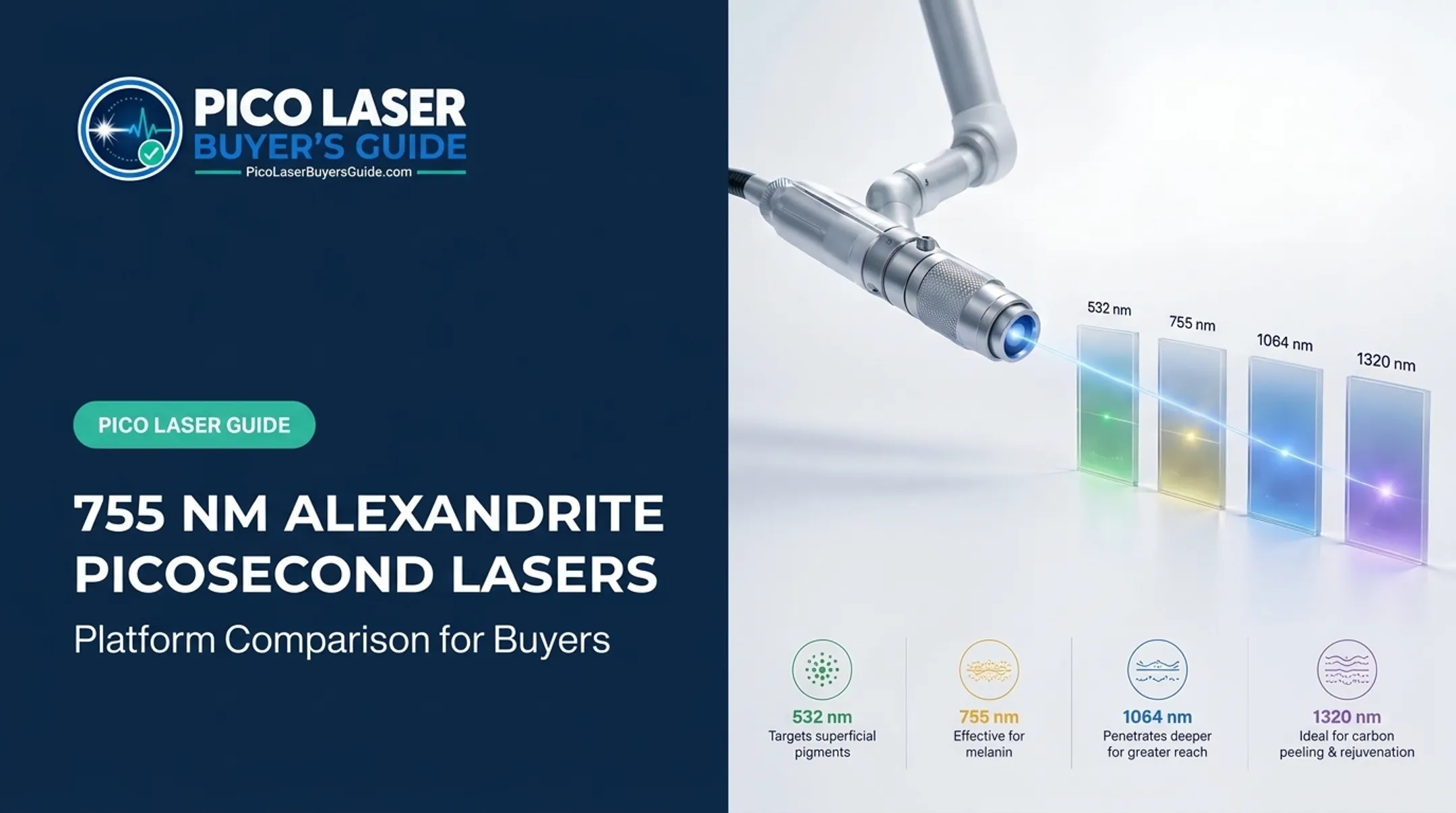
Wavelength drives treatment targets. 1064 nm penetrates deeper (roughly 4 to 6 mm), while 532 nm works superficially and suits red, yellow, and orange inks. Ruby targets stubborn green and blue pigment, though capability does not guarantee results.

Handpieces and FDA documentation
These are Class II 510(k) clearances, not blanket FDA approval. The key records:
- K163222: family labeling separating 532/1064 nm and 694 nm Ruby
- K171945 (2017) and K172376 (2017): fractional handpieces and wrinkle/acne-scar indications
- K191842 (2019): standard and high-coverage microbeam handpieces
- K240983 (June 6, 2025): Pico/Plus/Derm family and selectable picosecond durations
Handpiece sizes listed include round 2 to 12 mm, square 2 to 7 mm, and microbeam 8/9 mm. Which optics ship standard versus optional varies by quote, so confirm the configuration in writing. Marketing copy, clinic claims, and off-label discussion do not constitute clearance.
What Can Discovery Pico Treat?
Cleared picosecond indications
The K240983 picosecond matrix sets skin-type limits that differ by use:
| Wavelength/handpiece | Indication | Fitzpatrick |
|---|---|---|
| 1064 nm | Black, brown, green, blue, purple tattoos | I-VI |
| 532 nm | Red, yellow, orange tattoos | I-III |
| 532 and 1064 nm | Benign pigmented lesions | I-IV |
| 532 and 1064 nm, fractional | Wrinkles | I-IV |
| 1064 nm, fractional | Acne scars | II-V |
Tattoo clearance does not extend the same skin-type range to other uses. Explicit melasma clearance is hard to confirm from Discovery labeling, so verify the current K240983 indications before planning melasma work. Competitors' melasma clearances do not transfer.
Tattoos
Ink color, density, depth, age, layering, location and prior treatment all shape the plan. A multi-wavelength system lets a clinician address different colors in one tattoo. No platform guarantees complete removal or fewer sessions.
Fading for a cover-up is a different goal than full removal, with different timelines and cost. One 2022 trial of 30 tattoos found no significant clearance difference between picosecond and nanosecond lasers, though the picosecond side had less pain and shorter blistering. Brands weren't identified.
Pigment, melasma, scars and wrinkles
Treat pigmentation as several conditions, not one. Melasma recurs and is treatment-sensitive, so it calls for diagnosis, sun protection and conservative planning. In one split-face trial, both pulse types improved melasma with no significant difference, and 12.5% recurred on both sides.
Pigment work relies on photoacoustic fragmentation. Fractional optics instead create localized breakdown tied to collagen remodeling. A model without a fractional handpiece will not do the second job. Published acne-scar and wrinkle studies used 755 nm devices, so they are not Discovery-specific evidence.
Safety, skin type and the treatment course
Candidacy depends on:
- Fitzpatrick type and recent tanning
- History of post-inflammatory hyperpigmentation
- Active skin conditions, medications and prior procedures
Good practice includes consultation, test spots where appropriate, conservative settings, eye protection and qualified medical oversight. Clinician judgment matters more than the device name.
Results build gradually as the body clears fragmented pigment. Session counts vary, and no universal number is honest. Possible reactions include redness, soreness, pinpoint bleeding, blistering and temporary light or dark spots, which can take 6 to 12 months to fade. Patients should call their provider about signs of infection or unusual pain.

Discovery Pico Compared With Other Laser Platforms
Versus other pico brands
"Pico" is a category. Platforms differ in wavelengths, pulse structure, optics, and labeling.
| Platform | Wavelengths and pulses | Notable optics |
|---|---|---|
| Discovery Pico Plus | 532/1064/694 nm; 370-800 ps | Fractional/microbeam |
| PicoSure Pro | 755 nm, optional 532/1064; 500-900 ps | Platinum Focus |
| PicoWay | 1064/532/730/785 nm; 250-450 ps | Resolve, Fusion |
| enlighten III | 532/1064/670 nm; 660-750 ps plus 2 ns | Micro Lens Array |
Scar labeling also differs by Fitzpatrick skin type: Discovery fractional and PicoWay Resolve are II-V, while PicoSure Platinum Focus is I-IV.
Use the table to find fit, not a winner. A multi-mode buyer may favor Discovery, while a tattoo or pigment practice that wants wavelength flexibility may lean toward PicoWay.
Versus Q-switched lasers
Picosecond pulses are trillionths of a second, shorter than nanosecond pulses. Many modern platforms offer both modes, including Discovery. Pulse length alone does not determine outcome, as the 2022 and 2023 trials above show. Ask for peer-reviewed evidence or regulatory documents on any comparative claim.
A practical comparison framework
Build a matrix with these rows:
- Target services, wavelengths and handpieces
- FDA clearances and skin-type indications
- Training, service and consumables
- Warranty and five-year ownership cost
Compare like-for-like written quotes. During demos, ask what is included, what needs an upgrade, and how new staff get supported after install.
How to Evaluate and Buy a Discovery Pico System
- Start with demand. Decide whether tattoos, pigment, scars or a mixed menu will drive revenue, then match the configuration.
- Audit the quote line by line. Check model, wavelengths, VarioPulse, handpieces, modes, installation, software, training, warranty and delivery. Cross-check against the Pico Laser Buyer's Guide source library and FDA records.
- Calculate total ownership cost. Include financing, service contracts, replacement optics, calibration, insurance, training and marketing. The buyer's guide calculator illustrates about $262,000 over five years, using a 6.5% interest assumption and $25 consumables per treatment.
- Get support terms in writing. The distributor advertises lifetime clinical training and a 3-business-day service guarantee. Equipment warranty length is unconfirmed in public materials; the buyer's guide lists 1 year, so confirm it in writing. Articulated-arm, handpiece and calibration service may cost extra, and you should know both the contracting and servicing entities.
- Scrutinize pre-owned units. Request ownership and service history, calibration records, included handpieces, software status, warranty and refurbishment scope. The FDA's remanufacturing guidance looks at actual activities, not seller labels.
- Check state rules first. California requires physician ownership and bars estheticians from laser work. Texas requires delegation with training and physician availability. Confirm your state before booking patients.

Frequently Asked Questions
How much does picosecond (Pico) laser treatment cost?
Patient pricing varies by area, indication, tattoo complexity, provider and sessions. The ASPS lists $697 as an average for laser tattoo removal. Equipment purchase is a separate capital cost, so request a written quote from the manufacturer or distributor.
What is Discovery Pico laser used for?
Uses depend on the model's FDA clearance: tattoos, benign pigmented lesions, wrinkles and acne scars with the right handpieces. Verify against current manufacturer documentation for your configuration.
How many Pico laser treatments are needed?
It depends on the condition, ink color and density, skin type, settings, spacing and prior treatment. No fixed number is reliable, and complete removal may be impossible.
How long after Pico laser will I see results?
Redness or frosting may appear right away. Improvement is progressive as the body clears pigment over weeks, with timing set by condition and individual response.
Is Pico laser effective for tattoo removal, and how does it compare to other lasers?
Results depend on wavelength-to-ink match, pulse delivery, tattoo traits, clinician skill and aftercare. Trials show picosecond and Q-switched lasers can perform comparably, so neither type is universally superior.
What are the side effects and risks of Pico laser treatment?
Expect temporary redness, soreness and swelling. Risks include pigment changes, blistering, scarring and infection, especially with poor candidacy screening or sun exposure. Contact your clinician if symptoms worsen.