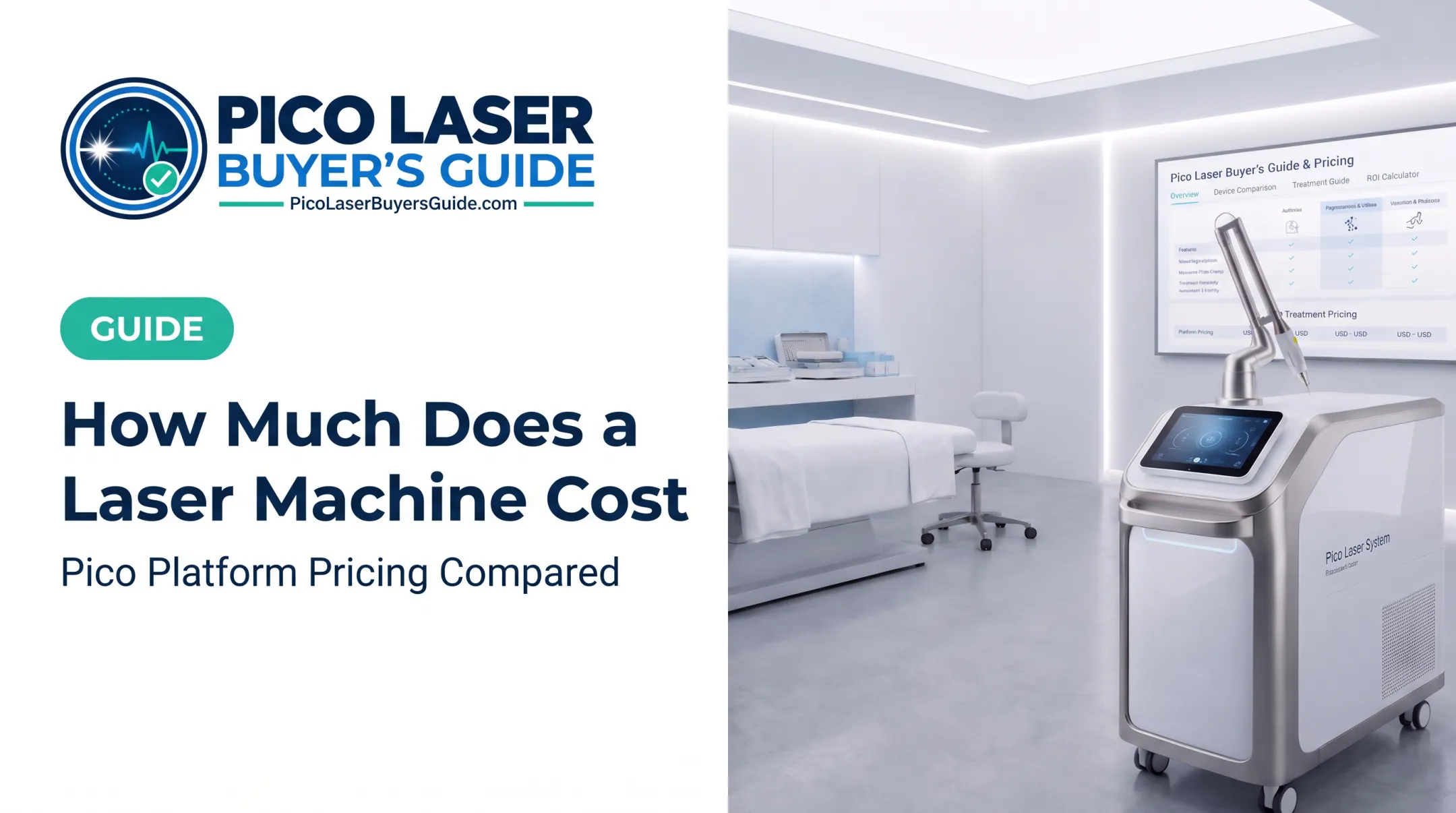

In the United States, equipment prices swing widely. New, refurbished, and pre-owned systems sit in different ranges, and wavelengths, handpieces, warranty, brand support, and expected workload move the number further. A sticker price rarely tells the whole story.
Below, you'll find current price ranges, the costs that sit outside the quote, the factors that drive price, and a simple method for setting a budget that fits your clinic.
Key Takeaways
- No universal price exists: new value platforms run roughly $60,000–$140,000, premium systems $150,000–$250,000+.
- Quotes can leave out freight, installation, training, service contracts, and future handpieces.
- Cheaper systems suit focused menus; premium ones earn their price through breadth, volume, and support.
- Compare documented specs, FDA clearance, warranty, and five-year cost, not upfront price alone.
How Much Does Pico Laser Equipment Cost? (Pricing Overview)
There is no fixed market price. A published figure might be a list price, a negotiated price, a lease payment, an auction result, or a bundle with accessories. Those numbers aren't interchangeable.
Misreading a price carries real risk:
- Underbudgeting for installation, training, service, and facility needs
- Buying a configuration that can't support your planned tattoo, pigment, scar, or rejuvenation services
- Treating a low sticker price as a complete, supported clinical system
Financing structures vary too. One documented example shows $59,975 outright, $30,000 down with $20,000 at 60 days and $14,975 at 90 days, or a lease at $1,300 per month for 60 months with $2,600 down.
Typical Equipment Cost Ranges
The Pico Laser Buyer's Guide's pricing summary covers 16+ platforms and gives these planning ranges:
| Category | Planning range |
|---|---|
| New value platforms | $60,000–$140,000 |
| New premium systems | $150,000–$250,000+ |
| Used systems | $50,000–$120,000 |
| Refurbished (certified pre-owned) | $70,000–$135,000 |

Entry level. PicoTech lists at about $60,000 with five standard wavelengths (1064, 532, 755, 585, 650 nm), two fractional handpieces, and a two-year warranty. Its package includes installation, one day of onsite training, and first-year preventive maintenance.
PICOHI 300 advertises $95,000 new as of September 2026, and PicoLazer lists at $95,995.
Mid-range. PicoPlus has an indicative new price of $120,000–$180,000, with 1064/532 nm core wavelengths and optional 595/660 nm handpieces. Support includes a 24/7 service call center and a one-year standard warranty. PicoFusion HS-298 is estimated at $129,000.
Premium. PicoSure Pro runs roughly $150,000–$220,000 with a 755 nm standard wavelength and optional 532/1064 nm. PicoWay is estimated at $250,000–$325,000 with optional 730/785 nm applicators. StarWalker PICO Pro sits near $160,000–$240,000.
What justifies these prices is documented capability, such as added wavelengths, spot-size range, and service structure, not the brand name.
Resale examples. Public US asking prices include a 2019 PiQo4 at $39,995, an enlighten III at $49,950, and a 2018 PicoWay at $64,995. These are seller asks with different bundles and ages, so they don't measure a used-versus-new discount.
Package Price vs. Base-Unit Price
Always ask what the number includes. The PicoTech package states installation, training, maintenance, and warranty. Delivery, eyewear, and software aren't stated. Quotes are rarely labeled base-unit-only, so ask directly.
Who Typically Buys Each Price Tier?
- New or independent med spa: a focused menu, often a value-tier system
- Dedicated tattoo removal clinic: multi-wavelength capability for multicolor ink, new value or pre-owned
- Dermatology or plastic surgery practice: broader indications and strong support
- High-volume multi-service facility: premium platforms with fast repetition rates and service responsiveness
These pairings are patterns, not documented rules.
Pre-owned or refurbished units cut the initial investment but raise questions about operating hours, service records, remaining warranty, parts, software, and manufacturer support. Candela's US warranty, for example, is nontransferable, so a resale warranty isn't automatically the manufacturer's coverage.
Key Factors That Affect the Cost of Pico Laser Equipment
Technical, operational, regulatory, and business factors all change the quote.
System Type, Condition, and Brand
New OEM units cost the most and carry full manufacturer support. Factory-refurbished units are inspected, tested, and fitted with new wear parts. Dealer-refurbished and pre-owned units vary with age, documentation, and service history.
Discontinued systems need extra scrutiny. Pico Clear, an Alma system, has a used planning range of $20,000–$35,000, but no factory-backed Alma support should be assumed. Seller coverage is commonly 30–90 days. Check parts availability, software support, and measured output before buying.
Wavelengths, Handpieces, and Clinical Configuration
More wavelengths, spot sizes, fractional optics, and tattoo handpieces generally raise the price. Map them to your services:
- Multicolor tattoo removal: 1064, 532, plus 585/650 nm or 730/785 nm options
- Pigmented lesions and dark spots: 532/1064 nm, with 755 nm on some platforms
- Acne scars, pores, wrinkles: fractional handpieces such as Honeycomb, DOE, or Resolve
Multi-wavelength doesn't mean every wavelength is picosecond. PiQo4, for example, mixes pico and nano operation. Verify each mode in the specs. No platform is best for every patient.
Output, Workload, and Throughput
Pulse energy, repetition rate, and spot size affect treatment speed. StarWalker PICO Pro lists up to 800 mJ and 0.5–10 Hz at 1064 nm. PicoTech lists 800 mJ maximum.
A clinic treating a few targeted areas a week doesn't need the same configuration as a multi-provider tattoo removal practice. Match output to expected utilization.
Compliance, Training, Warranty, and Support
Verify the FDA 510(k) clearance for the exact device and configuration. PicoWay's clearance is K191685, and PICOHI 300's K201773 covers tattoo removal and benign pigmentation but not scar revision or skin rejuvenation. Aesthetika PicoTech's May 2025 clearance covers its 1064/532 nm configuration only.
Also confirm:
- Warranty length and what it covers (source, arm, optics, parts, labor, travel)
- Preventive maintenance terms and post-warranty service pricing
- Response times and technician availability
- Training and onboarding
Downtime interrupts bookings and revenue, so support terms can change a quote's real value. Standard warranties run one year for PicoSure Pro, PicoWay, and enlighten III, and two years for PicoTech.
Facility and Installation Requirements
Budget for freight, room preparation, electrical work, cooling, eyewear, installation, calibration, and training. Requirements are model-specific.
Manufacturer electrical specs vary by platform:
- Candela PicoWay: dedicated line, 200–240 VAC, and 30A service (per the site form)
- Picofy: 220–230 VAC
- PICOHI 300: about 220–240 V at 20 A

Confirm the specs in the manufacturer's documentation before you sign. State rules apply too; Texas, for example, requires laser safety officers for Class 3B/4 lasers.
Cost Breakdown of Pico Laser Equipment and Low-Cost vs High-Cost Options
The purchase price is one part of the commitment. Compare the full cost over the period you expect to use the device.
Initial Purchase or Acquisition
Separate the base system from optional wavelengths, handpieces, software, cooling, accessories, and bundled services. Request line-item pricing. For StarWalker PICO Pro, request line-item quotes for every wavelength, optic, and software mode.
Installation, Training, and Commissioning
One-time costs include freight, installation, calibration, facility preparation, staff education, and safety procedures. Candela's PicoWay installation takes about six hours with a field engineer. Candela's terms list freight and insurance among possible purchaser fees.
Operating, Consumable, and Service Costs
Recurring costs include service contracts, utilities, software, insurance, financing, and processing fees. Candela describes PicoWay as having no consumables, but its warranty excludes preventive maintenance. Consumable-free doesn't mean maintenance-free. The Buyer's Guide's calculator uses $25 in consumables per treatment as a sample input.
Maintenance, Repairs, and Downtime
Preventive maintenance, parts, calibration, and technician travel add up. Lost appointment capacity is the hidden piece. Cynosure states a 24–48 hour technical response for warranty and contract customers, which isn't a guaranteed repair time.
Ask each seller for written repair-cost and downtime terms. Independent side-by-side data is scarce across platforms.
Upgrades and Replacements
Plan for added wavelengths, new handpieces, software licenses, and eventual replacement. Candela's PicoWay applicators can be added as a practice grows. Published upgrade pricing is rare, so request figures from each seller.
Low-Cost vs High-Cost Equipment: What's the Difference?
| Factor | Lower-cost | Higher-cost |
|---|---|---|
| Flexibility | Fewer wavelengths or narrower setup | Broader documented capability |
| Durability | Older units, variable history | Newer builds, longer support |
| Precision | Fewer adjustable parameters | More spot, fluence, and handpiece options |
| Downtime risk | Higher if parts are scarce | Lower with strong service networks |
| Long-term value | Strong if utilization fits | Strong with volume and growth |
Lower-cost systems aren't inferior by default. PicoTech's five wavelengths at about $60,000 are a real value proposition, but verify performance with documents, not claims. Higher price is justified by capability you'll use, not branding.
How to Estimate the Right Budget for Pico Laser Equipment (and What Most Buyers Miss)
The right budget depends on clinical fit, utilization, support quality, and total ownership cost, not the lowest quote.
A Simple Budgeting Framework
- List your intended procedures and the wavelengths they require
- Estimate monthly treatment volume and number of providers
- Choose a purchase method (cash, loan, or lease)
- Add installation, training, and facility costs
- Add recurring service, maintenance, and financing costs
- Reserve funds for repairs and downtime
The Pico Laser Buyer's Guide's illustrative five-year calculator uses a 6.5% interest rate and inputs for service, maintenance, handpieces, and treatments. One sample result is $262,000 over five years, or $52,400 annually. That annual cost equates to about 13 monthly treatments to break even. Use it as an illustration, not a projection.

Buyer Checklist
Ask every seller for:
- An itemized quote and all excluded costs
- Verified specifications
- FDA clearance documentation
- Warranty terms and service response commitments
- Training details
- Replacement-part availability
- Ownership history for used equipment
For validating specs, the Pico Laser Buyer's Guide offers a manufacturer-backed comparison library across 16 platforms. The guide is an independent educational resource and discloses its sourcing and commercial relationships.
Common Mistakes
- Focusing only on upfront price
- Confusing treatment-session pricing with equipment pricing
- Overbuying features your services don't need
- Accepting vague output or results claims
- Buying used equipment without service records and support options
Conclusion
Pico laser equipment cost depends on condition, configuration, wavelengths, handpieces, support, installation, and workload. A realistic budget covers more than the purchase price:
- Setup and installation
- Maintenance and consumables
- Financing and upgrades
- Cost of downtime
The best-value system balances documented capabilities, regulatory suitability, reliability, service, and long-term economics for your specific practice.
Frequently Asked Questions
What is pico laser and how much does it cost?
Pico lasers deliver pulses in trillionths of a second, used for tattoo removal and pigment treatment. Patient sessions cost hundreds of dollars; clinic equipment costs roughly $50,000–$250,000+.
How much does it cost to laser your acne scars?
Patient pricing varies by provider, area, protocol, and session count. One academic fee sheet lists fractional treatments from $200 to $1,000 per session. That range reflects patient fees, not equipment purchase cost.
What does pico toning do?
Pico toning is low-fluence picosecond treatment for selected pigmentation and tone concerns, such as melasma. Required capabilities depend on wavelength, settings, handpieces, and provider protocol.
How long can pico laser last?
Warranty, service life, and result duration are separate. Candela's warranty has a one-year or 1,000,000-pulse limit, but that isn't a lifespan rating. Maintenance and support determine usable life.
Can Pico Laser remove dark spots?
Pico systems may treat selected pigmented lesions. Diagnosis, wavelength, settings, skin type, and provider expertise determine suitability and outcomes.
How many Pico laser treatments do I need for melasma?
Plans vary and need medical supervision, sun protection, and maintenance. One 2023 meta-analysis found heterogeneous results, so no fixed number applies. Factor this into utilization planning.