This article is for US clinics, med spas, tattoo removal practices, and equipment buyers weighing clinical capability, regulatory paperwork, operator requirements, and long-term ownership. It is not patient-specific medical advice.
The central point: 1064 nm is highly relevant but not sufficient on its own. Pulse technology, wavelength coverage, evidence, safety systems, and service support all need to be assessed together.
Key Takeaways
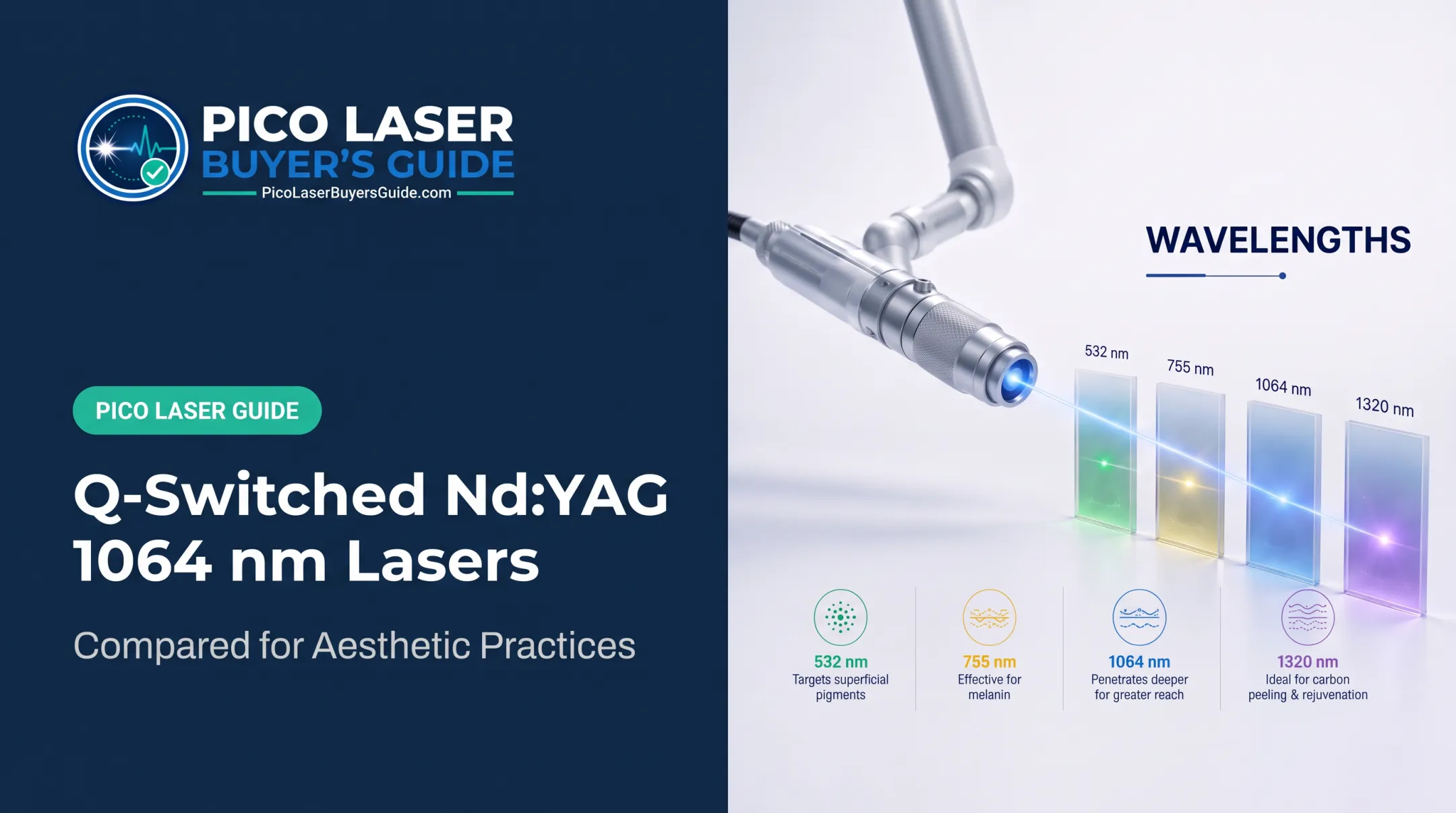
- 1064 nm mainly targets darker pigments; other ink colors often need additional wavelengths.
- "Picosecond" is pulse duration and "1064 nm" is wavelength, so check both.
- A shorter pulse does not guarantee fewer sessions for every tattoo.
- Verify FDA 510(k) documentation, training, maintenance, and total cost of ownership before buying.
Understanding Picosecond 1064 nm Laser Tattoo Removal
How the technology works
Picosecond lasers deliver energy in extremely short pulses. The effect is largely photoacoustic or photomechanical: ink particles shatter rather than heat up. Immune cells then carry the fragments away gradually.
Legacy Q-switched nanosecond lasers work more through photothermal effects. The clinical comparison is not settled, though:
- A 2017 randomized trial of 21 patients found no significant clearance difference after two 1064 nm treatments, though picosecond treatment was less painful.
- A Kono 2020 study of 11 patients found picosecond performed significantly better on black tattoos after four treatments. The cohort was small.
So "picosecond is always better" overreaches. The evidence is mixed.
What the 1064 nm specification means
1064 nm is the wavelength. It governs absorption and penetration, not pulse length. A device sold as "1064 nm pico" still needs a full specification review:
- Pulse duration (for example, PicoWay lists about 339 ps at 1064 nm)
- Fluence, meaning energy per unit area
- Spot size and repetition rate
- Beam profile, which is separate from beam diameter
Maximum energy may not be available at every spot size, so check the usable range by wavelength, spot size, and mode.
Why clinical outcomes vary
Response depends on several patient and tattoo factors:
- Ink density and pigment depth
- Professional versus amateur application
- Cover-ups, tattoo age, and body location
- Skin type and immune clearance
Professional tattoos generally sit deeper than amateur ones. Session counts vary widely, and complete removal is not guaranteed.
Why 1064 nm Matters for Tattoo Removal
Ink colors and practical indications
1064 nm Nd:YAG is the usual first choice for black, gray, and dark blue pigment, with deep penetration and minimal melanin competition. Gray isn't separately named in every FDA label, so confirm against the specific device's documentation.
It is not a universal wavelength:
- 532 nm covers red, orange, and yellow
- 755 nm is listed for selected dark, blue, and green inks
- 730/785 nm and 670/694 nm serve specialty blue, green, and colored-ink work on certain platforms
A wavelength only helps if it's available at useful energy, through the right handpiece, within cleared labeling for that exact configuration.
Skin-type considerations
Lower epidermal melanin absorption at 1064 nm is why clinicians favor it for darker skin. That reduces pigmentary risk. It doesn't eliminate it. In Kono's Fitzpatrick III-IV cohort, pigmentary adverse effects still occurred.
Labels differ by wavelength. One cleared PicoWay label lists 1064 nm for Fitzpatrick I-VI but 532 nm only for I-III. Never carry the 1064 nm skin-type indication over to another wavelength. Test spots, careful parameter selection, sun protection, and experienced clinical assessment still apply.
Evidence versus marketing claims
The ASLMS-reported study by Du and colleagues compared 1064 nm nanosecond, 1064 nm picosecond, 755 nm, and 595 nm lasers on rat tattoos. Findings:
- All four were effective, with 1064 nm ranking ahead of 755 and 595 nm
- No significant overall removal difference between 1064 nm nanosecond and picosecond
- Macrophage recruitment correlated with removal

It was preclinical, not a patient outcome or session benchmark. Keep animal studies, clinical trials, manufacturer data, and testimonials in separate buckets. Claims such as "4-8 sessions" or "50% fewer visits" from vendor materials deserve scrutiny against peer-reviewed work.
How to Evaluate a Picosecond 1064 nm Laser
Core technical specifications
Compare verified figures for:
- Pulse duration and delivered wavelength
- Energy or fluence range and repetition rate
- Available spot sizes and beam quality
- Aiming system, handpiece design, and cooling compatibility
The usable clinical range matters more than one peak number. A 2-mm fluence comparison shows headroom, not a treatment prescription. Parameters come from clinical training and evidence, not a spec sheet.
Wavelength configuration and treatment range
A 1064 nm-only platform may suit a practice whose demand is mostly black and dark ink. A multi-wavelength system (adding 532, 755, or 694 nm at real power) fits clinics seeing varied colors. This is a utilization decision, not a universal rule.
| Platform | Wavelengths noted |
|---|---|
| Candela PicoWay | 1064/532 nm, optional 730/785 nm |
| Quanta Discovery Pico | 1064, 532, 694 nm |
| Cynosure PicoSure Pro | 755 nm core, optional 532 and 1064 nm |
| Aesthetika PicoTech | 1064, 532, 755, 585, 650 nm |
A five-wavelength package isn't automatically five FDA-cleared wavelengths. PicoTech's 1064/532 nm configuration, for instance, shouldn't be assumed to share FDA status with its other wavelengths. Also note PicoSure's cited filing lists Nd:YVO4 and alexandrite sources, not Nd:YAG.
Regulatory and documentation review
Search the FDA 510(k) database by device name or K-number. Confirm applicant, cleared indications, labeling, and intended use. A 510(k) shows substantial equivalence, not superiority over other cleared devices. Clearances are device- and mode-specific.
State rules vary, too. Washington requires a trained, responsible physician and written protocols for delegation. California limits these treatments to physicians and supervised RNs or PAs. Check your own state's rules on ownership, delegation, oversight, training, and recordkeeping.

Clinical evidence and transparency
Ask for peer-reviewed studies, technical manuals, service records, adverse-event information, and before-and-after images with documented parameters. Then ask whether the published evidence matches the exact wavelength, pulse duration, handpiece, spot size, and indication you're buying.
Operator workflow and support
Many workflow and support details are rarely published, so request them in writing:
- Touchscreen usability and parameter control
- Aiming accuracy and handpiece ergonomics
- Cooling, maintenance intervals, and calibration
- Parts availability, training, and technical support
The Pico Laser Buyer's Guide is an independent research resource for comparing manufacturer-backed specifications and documentation across pico platforms. It is a purchasing and technical decision aid, not a clinical protocol, and discloses that commercial compensation may influence placement.
Clinical Safety and Treatment Planning
Patient and tattoo assessment
Assess before treatment:
- Ink colors, depth, and location
- Skin type, prior treatment, and scarring history
- Medications and sun exposure
Cosmetic inks containing iron oxide or titanium dioxide (white, flesh-tone) can darken paradoxically, according to a clinical update largely drawing on Q-switched experience.
Consultation, informed consent, photography, and test spots where appropriate are more reliable than generic settings.
Expected course and aftercare
Fading is progressive and takes multiple visits with healing intervals between. No universal session count exists. Commonly reported reactions include redness, swelling, soreness, and some blistering. The FDA also notes pinpoint bleeding and possible infection or scarring.
Patients should follow the treating professional's aftercare instructions.
Safety systems and operator responsibility
- Wavelength-specific protective eyewear, with optical density appropriate to the laser
- Controlled treatment areas and written laser safety procedures
- Plume control: NIOSH says room ventilation alone is insufficient and recommends local exhaust
- Emergency protocols, documentation, and escalation of complications
ANSI Z136.3 covers health-care laser safety programs, including training and laser safety officers. Device selection cannot replace qualified clinical judgment.
Buying, Ownership, and Business Considerations
New, pre-owned, lease, or finance options
New systems bring warranty and OEM support. Candela advertises a one-year warranty on new purchases, and PicoTech's package lists a two-year limited warranty with installation and a day of training. Pre-owned units cost less but shift risk to you.
Pre-owned inspection checklist:
- Treatment hours and shot count where available
- Handpiece condition and serial numbers
- Power testing
- Calibration, service, and repair records
- Parts availability for that serial number
- Whether support transfers to a new owner
FDA distinguishes servicing from remanufacturing. Ask what work was actually performed on a refurbished unit, not what the label says.
Total cost of ownership
Go beyond sticker price. Include:
- Installation and facility preparation (PicoWay needs dedicated 200-240 VAC service)
- Laser safety equipment and insurance
- Training, maintenance, and consumables
- Downtime and financing costs
- Eventual resale value
Planning ranges run from about $60,000 for PicoTech to $160,000–$240,000 for Fotona StarWalker PICO Pro and $250,000–$325,000 for PicoWay. Treat these as estimates and confirm with quotes.

Build a utilization model from your treatment mix, appointment volume, local pricing, staffing, and conservative downtime. Avoid unsupported ROI promises.
Procurement decision checklist
Send manufacturers and resellers these questions:
- What is the K-number, and does it cover this exact model, wavelength, handpiece, and mode?
- What is the measured output at each wavelength and spot size?
- What are the verified pulse durations?
- What are service response times, parts stock, and escalation procedures?
- What does the warranty exclude (parts, labor, travel, handpieces)?
- What training and clinical support are included?
Compare answers against the Pico Laser Buyer's Guide source library and platform research before requesting quotes.
Conclusion
A picosecond 1064 nm laser can be a valuable platform for darker pigments. Its suitability depends on:
- Verified performance and a complete wavelength strategy
- Patient mix and operator expertise
- Safety infrastructure and regulatory compliance
Before you buy new or pre-owned equipment, document your target tattoo colors and patient population, shortlist appropriately cleared systems, validate technical claims, and use independent comparison research.
Frequently Asked Questions
What is 1064 laser good for?
1064 nm is commonly used for black, gray, and dark blue tattoo pigments. Some devices are also cleared for benign pigmented lesions, wrinkles, or acne scars. Indications depend on the specific device and clearance.
Is 1064 nm better than 532 nm for tattoo removal?
Neither is better overall; ink color decides. 1064 nm suits darker pigments, while 532 nm is commonly used for red, orange, and yellow inks.
What colors can a 1064 nm picosecond laser remove?
Black, gray, and dark blue are the core targets. Some labels also list brown, green, and purple. Multicolored tattoos usually need additional wavelengths.
Is a picosecond 1064 nm laser safe for darker skin?
1064 nm limits melanin absorption, so it is often chosen for darker skin. Risk remains: pigmentary complications still occur. Individualized settings, test spots, sun protection, and trained operators are essential.
How many sessions does 1064 nm picosecond tattoo removal take?
No universal count exists. Published studies used two to ten treatments. Results depend on ink color and depth, tattoo size, skin type, prior treatment, intervals, and individual clearance.
What should a clinic look for when buying a 1064 nm picosecond laser?
Check FDA 510(k) documentation, verified wavelength and pulse specifications, spot sizes, safety systems, training, service, warranty, maintenance history, evidence quality, and total cost of ownership.