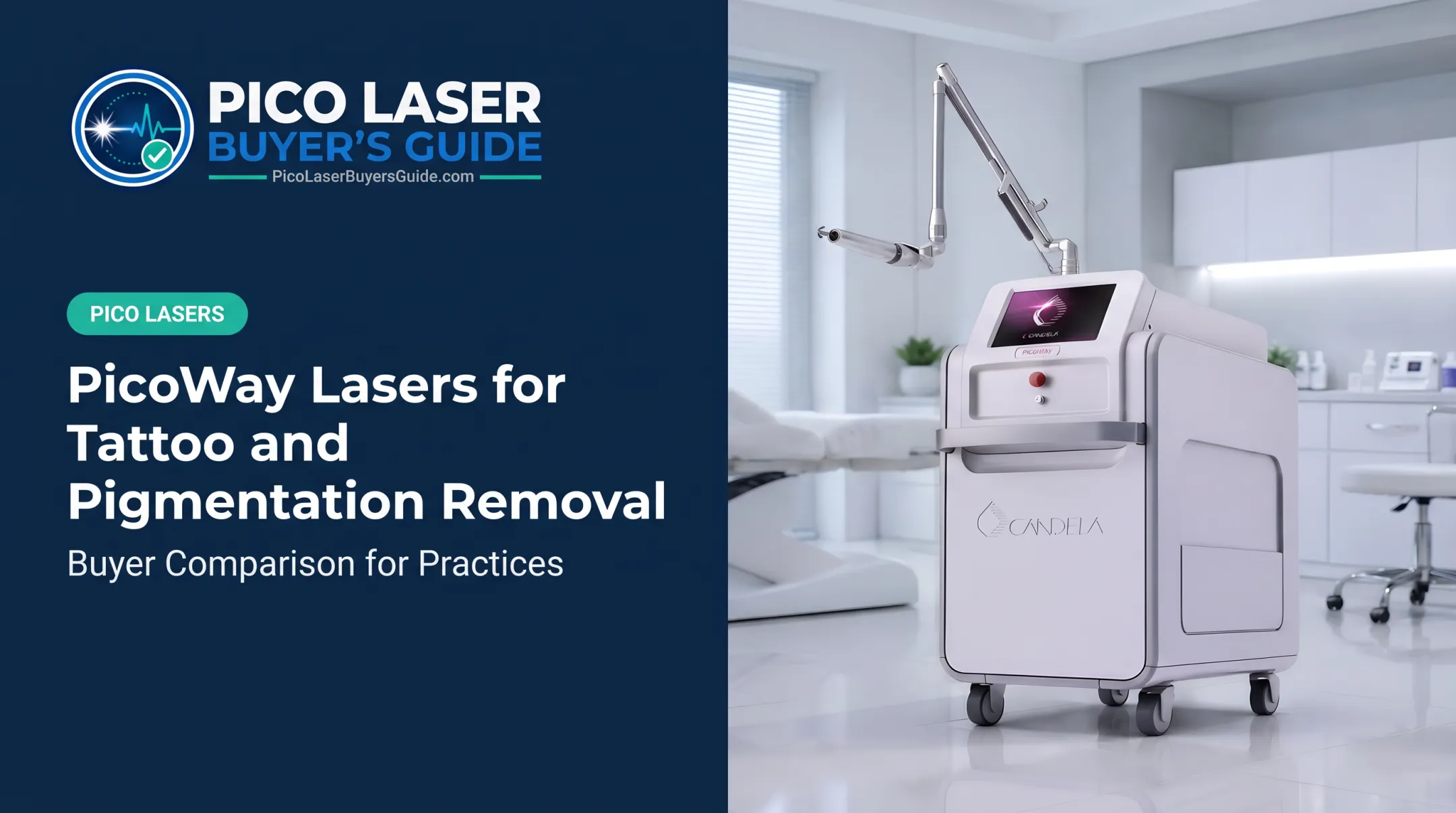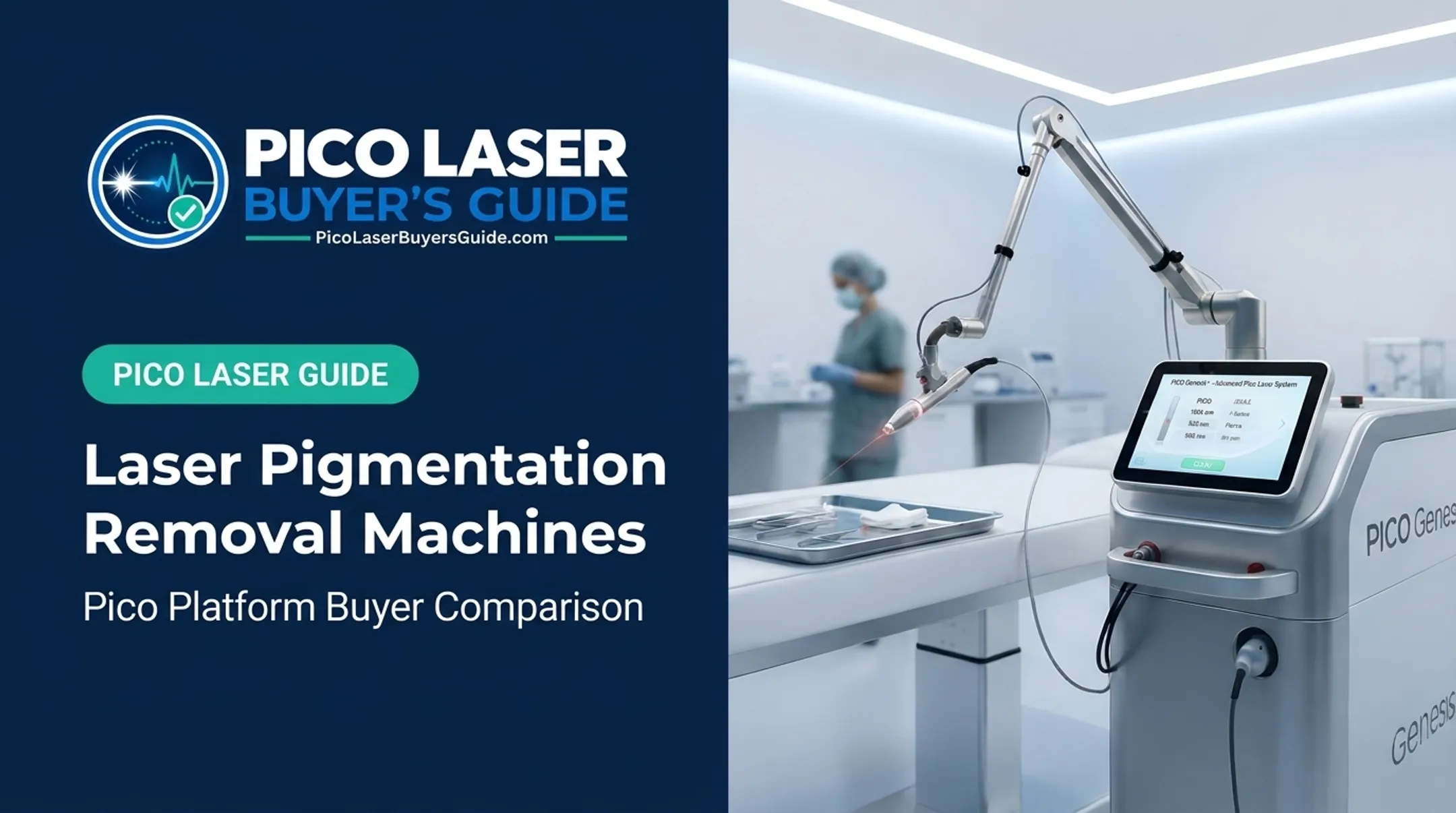

US med spas, dermatology and plastic surgery practices, and tattoo-removal clinics face the same problem. Specifications differ by model, handpiece, and mode, and FDA clearance rarely transfers cleanly between them.
This guide covers how picosecond equipment interacts with pigment, which specifications matter, how to verify FDA and manufacturer claims, and how to judge ownership costs and supplier support.
Key Takeaways
- "Pico" is a category, and wavelengths, modes, handpieces, and cleared indications vary widely.
- Match the platform to your pigment mix, skin types, volume, operator skill, and budget.
- Verify 510(k) clearance, training, service, calibration, and warranty alongside specs.
- Pulse duration, peak power, and marketing copy alone are poor buying criteria.
How Pico Laser Equipment Addresses Pigmentation
Picosecond pulses can fragment pigment through a photomechanical effect while limiting heat in surrounding tissue. A 2023 randomized melasma trial describes this, but it does not mean zero heat or zero injury. Shorter pulses also don't guarantee better outcomes: a randomized black-tattoo trial found no better clearance with picosecond than nanosecond pulses after two treatments.
Matching pigment type to wavelength
Pigment depth, skin type, recent sun exposure, active inflammation, and recurrence risk all shape whether a system fits. Published evidence is diagnosis-specific:
- 532 nm: a 20-patient split-face trial in solar lentigines (Fitzpatrick III-V) favored pico over Q-switched for clearance. PIH rates were 5% versus 30%, though not statistically significant.
- 755 nm: freckle and mixed-type melasma evidence. A 2023 freckle study of 86 participants found 730 nm and 755 nm comparable.
- 1064 nm: melasma evidence and limited existing-PIH case data. In a 59-patient trial at 24 weeks, MASI improved 35.9% with 1064 nm, 25.5% with 755 nm, and 24.0% with 2% hydroquinone.
Melasma recurs. Pooled recurrence in that trial was 4 of 59 patients across all arms, so avoid promising permanent clearance. Treat these findings as diagnosis-specific, not as interchangeable platform claims.
Full beam, fractional, and spot delivery
- Full beam: uniform energy across the spot, used for discrete lesions. A 755 nm trial found efficacy comparable to a diffractive lens array with less PIH.
- Fractional lens arrays: aimed at texture, scars, and resistant melasma. Results differ by wavelength and optic, so one "fractional" claim cannot cover them all.
- Lesion-directed spot treatment: suits lentigines but doesn't establish a toning or melasma protocol.
Fluence, repetition rate, spot size, beam profile, pulse duration, and density interact. The highest available setting is not the safest or most effective one. Maximum energy may not be available at the largest spot size. Settings belong to a qualified clinician.
Which Equipment Specifications Matter When Treating Pigmentation?
Wavelength and indication coverage
Compare the exact wavelengths, handpieces, and indications in official documents. A wavelength on one model may not exist on another configuration. For example:
- PicoSure Pro: nominally 755 nm with optional 532/1064 nm
- PicoWay: 1064/532/730/785 nm
- enlighten III: 1064/532/670 nm
Broader coverage is not automatically better. It matters only when the added wavelengths are powered, usable, and relevant to cleared services.
Pulse characteristics and energy delivery
Published maxima often hide context. Check whether a figure applies to the whole system, one handpiece, or an optional accessory.
| Platform | Pulse duration | Energy |
|---|---|---|
| PicoSure Pro (international brochure) | 500-900 ps | 300 mJ +/- 20% |
| PicoWay | 450/375/250/300 ps by wavelength | Up to 400 mJ at 1064 nm |
| enlighten III | 750 ps at 1064/532 nm | System maxima 600/300/125 mJ |
| PICOPLUS | 450 ps | 800 mJ at 1064; 300 mJ at 532 |
Fluence is not pulse energy, and whole-system maxima aren't necessarily picosecond-mode maxima. A maximum is not a clinically appropriate pigmentation setting.

Workflow and practical requirements
Evaluate how the platform fits daily clinical use:
- Confirm fractional lenses, zoom handpieces, cooling, aiming beams, and interface options
- Measure room footprint and electrical capacity (PicoSure Pro's international brochure lists 200-240 V and a dedicated 30 A outlet)
- Factor in calibration schedules, software updates, consumables, and service response times
Verification and red flags
Trust FDA records, manufacturer specifications, instructions for use, and peer-reviewed evidence first. Treat brochures and undated comparison charts as secondary. Red flags include:
- Vague "pico" branding or unclear pulse-duration claims
- Missing model or serial information
- Specifications that conflict across documents
- Rebranded or gray-market equipment
- Suppliers who can't document training or service
How to Compare Pico Platforms for a Pigmentation Practice
Start with your use case
Define your service mix from your own demand data: pigmentation, tattoo removal, acne-related pigment, and rejuvenation. Wavelength and throughput needs differ by practice type:
- First-time med spa building a pigment menu
- Established practice adding pigment services
- Dermatology group upgrading existing devices
- Tattoo-focused clinic prioritizing multicolor throughput
Build a comparison matrix
Score every system on the same fields:
- Wavelengths, pulse duration, energy range, repetition rate, spot sizes, beam profile
- Modes, handpieces, cooling, and cleared indications
- Footprint, electrical needs, and workflow
- Warranty, training, service, and parts availability
Price the whole package, not the sticker. Include handpieces, installation, shipping, training, service contracts, calibration, financing, consumables, and software.
New versus pre-owned
New systems typically include full manufacturer warranty, current software, and structured training. For used equipment, verify:
- Serial number and ownership history
- Service, calibration, and repair records
- Remaining manufacturer support and parts availability
- Warranty transferability (Candela's US limited warranty, for one, is nontransferable)
- Inspection rights and return terms
- Whether it can legally and safely be installed in your practice
Validate claims before committing
Request a live demo, configuration-specific documents, and training details. Before-and-after images should name the device, settings, skin type, treatment interval, and any other treatments used.
The Pico Laser Buyer's Guide library covers 16 platforms with manufacturer-backed documents. Use it as a research starting point, not a substitute for FDA verification, clinical review, supplier diligence, or legal advice.
A weighted decision rubric
Weight these factors by your practice, rather than crowning one best platform:
- Clinical fit and verified indications
- Operator training and darker-skin safety protocols
- Uptime and service support
- Total ownership cost and expected utilization
Safety, FDA Clearance and Clinical Readiness
Skin-type and pigmentation risk
Picosecond technology may reduce thermal exposure, but burns, PIH, hypopigmentation, and recurrence remain possible. A retrospective study of 56 Fitzpatrick IV-VI patients treated with 755 nm DLA reported transient hyperpigmentation.
A tattoo study in Fitzpatrick III-IV found hypopigmentation in 9 of 37 sites with 532 nm versus 0 of 37 with 1064 nm. Those are tattoo findings, not pigment rates, but they show why wavelength choice matters. Demand device-specific evidence for IV-VI, not "safe for all skin types" language.

Regulatory and operator verification
- Clearance versus approval: 510(k) clearance rests on substantial equivalence. PMA approval is a different pathway.
- Exact record: PicoWay's benign-pigment clearance covers I-IV, while its Resolve acne-scar indication covers II-V. PICOPLUS's 1064 nm tattoo indication reaches I-VI, but its picosecond pigment indication is I-IV.
- Registration: FDA registration and listing are not clearance, and FDA issues no registration certificates.
- Operators: California permits physicians and supervised RNs/PAs for listed laser procedures, while Texas requires trained delegates with physician availability. Check your own state.
- Eye safety: ANSI Z136.3-2024 covers training, laser safety officers, and protective eyewear.
Clinical readiness and risk controls
Qualified professionals should review all protocols and build in:
- Consultation and screening for recent tanning or active inflammation
- Patch testing where clinically appropriate
- Conservative protocol development and informed consent
- Aftercare, adverse-event documentation, and a clear escalation process
Procurement, Cost and ROI Checklist
Total cost of ownership
Planning ranges from the Pico Laser Buyer's Guide: new premium systems run roughly $150,000-$250,000+, value platforms $60,000-$140,000, used $50,000-$120,000, and refurbished $70,000-$135,000. Quotes vary by configuration, so get line-item pricing.
Separate acquisition from installation, training, financing, service, calibration, insurance, consumables, room preparation, and parts. The guide's illustrative five-year calculator shows $262,000 total ownership, or $52,400 a year, needing 13 monthly treatments to cover it.

Model your own utilization, pricing, downtime, and staffing. Run a low-demand scenario that includes unexpected service costs.
Supplier and pre-owned diligence
Before signing, confirm:
- Supplier authorization and serial-number records
- Service, calibration, and repair history
- Warranty, return, and inspection terms
- Training, parts availability, delivery, and installation
- Support response times (Cynosure advertises 24-48 hours for warranty and contract customers, which is not a repair guarantee)
Decision summary
The strongest purchase has verified clinical fit, documented regulatory status, sound safety protocols, dependable support, and sustainable total cost. It is not necessarily the device with the most wavelengths or the highest headline power.
Frequently Asked Questions
How much does a Pico laser treatment cost?
Patient pricing and equipment pricing are separate. Patient fees depend on the procedure, provider expertise, and location. Equipment cost depends on configuration, handpieces, condition, and service terms.
How is Pico laser used to treat pigmentation?
Picosecond pulses fragment pigment mechanically, and wavelength and mode are chosen by pigment type and depth. A qualified professional must diagnose and set parameters.
How many Pico laser sessions are needed for hyperpigmentation?
It varies with pigment type, depth, skin type, device, and recurrence risk. Studies range from one session for lentigines to three for melasma and five for lens-array protocols. There is no universal number.
Is Pico laser safe for darker skin?
Often, with appropriate equipment and conservative protocols. Look for device-specific evidence, patch testing where appropriate, and sun protection, since PIH remains a risk.
How does Pico laser compare to other lasers and treatments for hyperpigmentation?
Q-switched lasers, IPL, fractional resurfacing, peels, and topicals differ in mechanism, downtime, and skin-type risk. Evidence does not favor one option for every case. The AAD positions lasers as an addition to medication and sun protection for melasma.
Is Pico laser FDA approved?
Most are FDA 510(k) cleared, not "approved." Verify the exact model, handpiece, indication, and current FDA record.